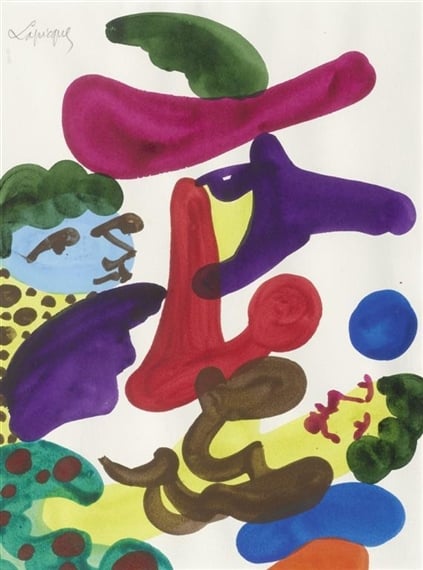
Personnages colorés
Expertenanalyse zu Charles Lapicques Personnages colorés
Stil: Fauvism, Pop Art · Genre: figurative
Expert Art Historical Analysis: "Personnages colorés" by Charles Lapicque
Charles Lapicque’s "Personnages colorés" represents a rare and significant intersection of two major 20th-century movements: Fauvism and Pop Art. While Lapicque is best known for his early Fauvist works and his role in the renewal of French painting after World War II, this piece shows him anticipating and embracing the bold, graphic sensibility that would define Pop Art in the 1960s.
Context and Style As a Fauvist, Lapicque inherited the movement’s core principles: intense, non-naturalistic color, simplified forms, and emotional directness. In "Personnages colorés", these traits are pushed to their extreme. The figures (“personnages”) are reduced to flat, almost poster-like silhouettes, drenched in saturated, unmodulated hues. Yet the work also exhibits a Pop Art sensibility—its bright, commercial palette, its focus on everyday human subjects, and its bold outlining recall the contemporary mass-media imagery that Pop artists like Roy Lichtenstein and Tom Wesselmann would soon exploit.
Significance What makes "Personnages colorés" historically important is its bridging of two eras. Lapicque created this work at a moment when Abstract Expressionism and Informel dominated European painting; his insistence on recognizable figures and jarring color foreshadows the return to figuration that Pop Art championed. The painting is not merely a Fauvist holdover—it is a prescient statement that popular culture and high art could coexist through the very same chromatic audacity that the Fauves pioneered. Lapicque’s figures are simultaneously primitive and modern, joyful and unsettling, proving that Fauvism’s radical color theory could evolve to meet the new visual language of consumer society.
In essence, "Personnages colorés" is a masterpiece of stylistic fusion: it respects the Fauvist emphasis on color as an autonomous force while embracing the Pop Art impulse to flatten and immortalize the ordinary. Lapicque here demonstrates that the boldest experiments of one movement can be the foundation for the next.
Visuell ähnlich
20 Werke mit ähnlicher Komposition und Farbpalette
Le premier jour
Charles Lapicque
Le Prisonnier
Charles Lapicque
Untitled
Fritz Winter
Amsterdam
Pierre Alechinsky
Image with a Flower
Vilen Barsky
Rosa-Viola-Bianco
Carla Accardi
Untitled
Vilen Barsky
Untitled
John Ferren
Breathing
Fons Heijnsbroek
L`Accueil
Maurice Esteve
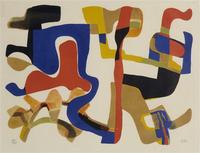
L`Accueil
Maurice Esteve
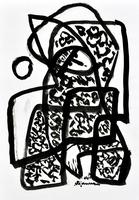
Prayer
George Stefanescu
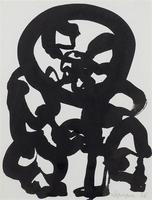
Le Pardon
Charles Lapicque
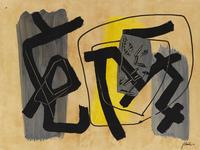
Schwarz vor Grau und Gelb
Fritz Winter
Woman and Birds in the Night
Joan Miro
Number 13
James Brooks
Alienation
Wu Guanzhong
Grand Inquisitor
Dave Holt
In Society (En société)
Pierre Alechinsky
Negativo-Positivo
Carla Accardi