
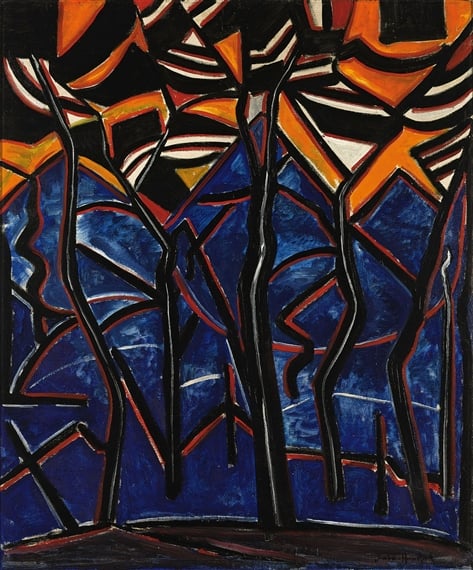
Expertenanalyse zu Jacoba van Heemskercks Bomen
Stil: Expressionism · Genre: landscape
Expert Analysis of "Bomen" by Jacoba van Heemskerck
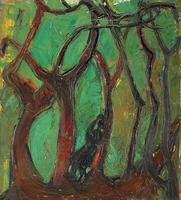
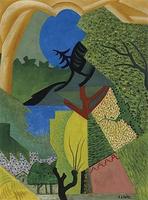
As an early 20th-century Dutch Expressionist landscape, Bomen (Dutch for "Trees") exemplifies the radical departure from naturalistic representation that defines the movement. Jacoba van Heemskerck, closely associated with the German Der Blaue Reiter circle, transforms a simple arboreal subject into a vibrating field of emotional and spiritual energy.
Significance within Expressionism:
- Abstraction of Form: Van Heemskerck reduces trees to bold, angular shapes and dynamic, intersecting lines. Rather than depicting leaves and bark with botanical accuracy, she conveys the essence of growth, thrust, and organic struggle—a hallmark of Expressionist distortion used to evoke inner experience over external reality.
- Expressive Color: The work likely employs a non-naturalistic, intense palette (characteristic of her era in the Netherlands and Germany). Colors are chosen for emotional resonance—contrasting, often jarring hues that heighten the tension between the natural subject and the artist’s subjective response.
- Rhythm and Movement: The composition pulses with directional force. The trees’ limbs reach and bend in a choreographed motion, suggesting not stillness but the vital, turbulent life of nature. This dynamism reflects the Expressionist belief that art should capture a world in flux, seen through the artist’s soul.
Art-Historical Importance:
- Gender and Modernism: As a female painter active in a male-dominated avant-garde, van Heemskerck’s work challenges assumptions about early Expressionism. Her landscapes—like Bomen—are not sentimental nature scenes but rigorous, architectonic compositions that align with the radical abstraction pioneered by her contemporaries Wassily Kandinsky and Franz Marc.
- Bridge Between Movements: Her style synthesizes Dutch florid color sense with the spiritual abstraction of Der Blaue Reiter. Bomen thus stands as a key example of how Northern European Expressionism pushed landscape beyond topography into a universal, emotional language.
In summary, Bomen is significant because it uses the humble motif of trees to demonstrate Expressionism’s core mission: to make the visible world a vehicle for the invisible—feeling, energy, and the artist’s unique inner vision. Van Heemskerck’s bold geometry and chromatic intensity cement this work as a vital, early contribution to modern landscape painting.
Genre
Stil
Visuell ähnlich
20 Werke mit ähnlicher Komposition und Farbpalette
Bild no. 41
Jacoba van Heemskerck
Movement of Galaxies
Nina Tokhtaman Valetova
Forest (Red-green)
Natalia Goncharova
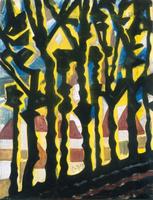
Scheiber Hugó, Házak a Fák Alatt,
Scheiber Hugó
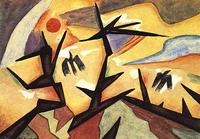
Otros Troncos
Xul Solar
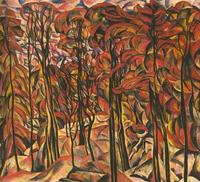
Autumn in the Park
Abraham Manievich
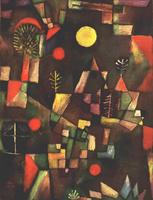
Full moon
Paul Klee
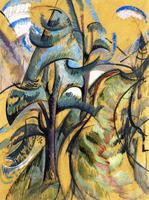
Beyond the Radiant Valley (Reiderfurka)
Alice Bailly
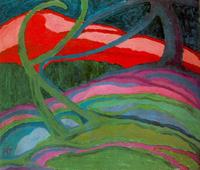
Landscape in Dark Colours (Trees)
Janos Mattis-Teutsch
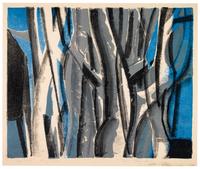
Gray Wood
Robert Blackburn
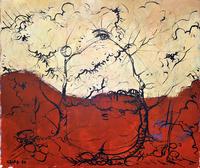
The landscape behind
Alfred Freddy Krupa
Amor
Tia Peltz
Landscape
Edward Wadsworth
Lanscape II
Karlo Zvirynsky
Abstract Composition
Jacoba van Heemskerck
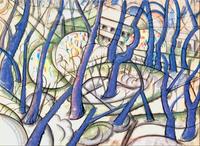
Scheiber Hugó, Parkban,.
Scheiber Hugó
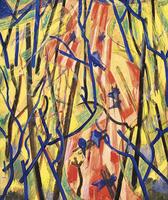
Scheiber Hugó, Fények a Parkban
Scheiber Hugó
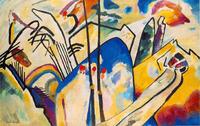
Composition IV
Wassily Kandinsky
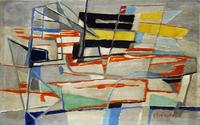
Cargo suédois au Radoub
Gustave Singier
Paysage au Lambrequin Rose
André Lhote