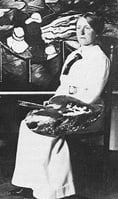
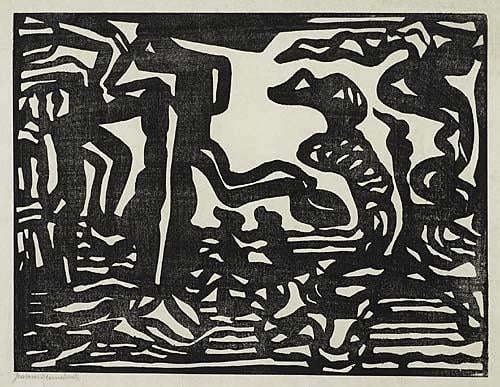
Экспертный разбор работы «Composition» художника Jacoba van Heemskerck
Стиль: Abstract Art · Жанр: abstract
Expert Analysis: "Composition" by Jacoba van Heemskerck
Jacoba van Heemskerck’s Composition stands as a vital document of early European abstraction, emerging from the crucible of pre‑World War I avant‑garde movements. Although the specific date of this work is not provided, its abstract vocabulary aligns her with the revolutionary current that redefined painting in the 1910s—a period when artists sought to transcend representation and express universal spiritual truths through pure form.
Significance within Abstract Art
Van Heemskerck was a Dutch artist who became an active member of the German Expressionist group Der Blaue Reiter (The Blue Rider), founded by Wassily Kandinsky and Franz Marc. This association placed her at the epicenter of the movement that championed abstraction as a means of accessing the inner, spiritual dimensions of reality. Composition exemplifies this ambition: her use of dynamic, intersecting lines and fragmented planes draws directly from Cubism—specifically the analytical phase of Picasso and Braque—but she repurposes those geometric structures for an expressive, almost cosmic purpose. Unlike the somber, muted palette of Analytical Cubism, van Heemskerck often employed vibrant, emotionally charged colors (as seen in her known works), a hallmark of the Expressionist desire to evoke feeling over descriptive accuracy.
Spiritual and Theosophical Underpinnings
What makes van Heemskerck’s abstraction particularly significant is its grounding in Theosophy, a mystical philosophy that influenced many Blaue Reiter artists, especially Kandinsky. Theosophy held that visible reality was merely a veil for a deeper, harmonic spiritual order. In Composition, the seemingly non‑objective forms—sharp angles, sweeping curves, and layered color fields—are not random; they are intended as visual equivalents of spiritual vibrations. The title itself, Composition, echoes Kandinsky’s own abstract works (e.g., Composition VII), underscoring a shared belief that art could orchestrate color and line like music, bypassing material description to speak directly to the soul.
Position in the History of Abstraction
Van Heemskerck’s work occupies a crucial transitional space between Cubist structure and fully non‑objective painting. Before the war, pure abstraction was still rare; most abstract pioneers (Kandinsky, Malevich, Mondrian) were developing their radical languages around 1911–1914. Van Heemskerck’s Composition shows a confident synthesis of these impulses—she retains enough fragmented references (perhaps to landscape or still life) to ground the abstraction, while pushing toward the total liberation of form. Her untimely death in 1923 at age 47 cut short a trajectory that might have placed her alongside Kandinsky and Mondrian as a founding figure of geometric abstraction.
Conclusion
Composition is significant not only as a fine example of early abstract painting but also as a testament to the cross‑cultural exchanges within the European avant‑garde. Van Heemskerck, a woman in a male‑dominated field, forged a distinctive voice that married Dutch rationalism with German Expressionist spirituality. Her work reminds us that abstraction was never a single, monolithic move; it was a diverse search for new visual languages, and Composition is a key, if often overlooked, contribution to that search.
Визуально похожие
20 работ с близкой композицией и палитрой
Terril III
Pierre Alechinsky
Polo
Louis Schanker
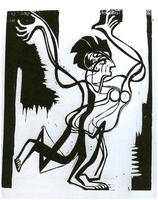
Palucca
Ernst Ludwig Kirchner
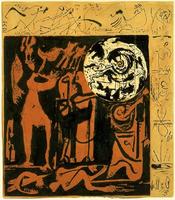
Untitled
Jackson Pollock
Gilgamesh
Karl Otto Gotz
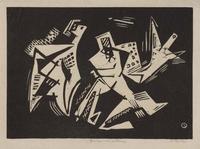
Forms in Action
Louis Schanker
Negativo-Positivo
Carla Accardi
New Delhi surplombée
Pierre Alechinsky
Black & White (Number 20)
Jackson Pollock
Celebration
Will Barnet
Dedicated to Jacques Callot
Willi Baumeister
Plate from Les Cantiques Spirituels
Alfred Manessier
Football
Louis Schanker
Bird's Eye View of the Sea (L'eau à vue d'oeil d'oiseau)
Pierre Alechinsky
Magic Rupestre
Willi Baumeister
Forest Witches
Paul Klee
Amants, venez/Le coup d'envoi
Louis Soutter
Black and White Diptych
Melissa Meyer
Untitled
Afro
Africa I
Willi Baumeister