Analisi esperta di Composition abstraite di Leon Arthur Tutundjian
Stile: Surrealism · Genere: abstract
Expert Analysis of "Composition abstraite" by Léon Arthur Tutundjian
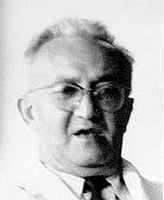
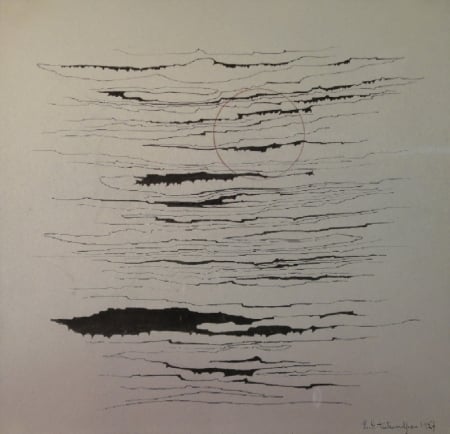
Léon Arthur Tutundjian’s “Composition abstraite” stands as a compelling synthesis of Surrealist automatism and pure abstraction, marking a unique moment in the interwar avant-garde. Though the work belongs to the genre of abstract art, it is deeply rooted in Surrealism’s core ambition: to liberate the unconscious mind and give form to the irrational.
Significance within Surrealism and Abstract Art
Tutundjian, an Armenian-born French artist active in the 1920s–30s, was part of the Surrealist circle but increasingly pushed toward non-representational forms. “Composition abstraite” exemplifies this pivot. Unlike the more figurative dreamscapes of Dalí or Magritte, Tutundjian’s abstraction employs biomorphic shapes—fluid, organic, and often unsettling—that evoke primordial life, cellular structures, or geological forces. This approach aligns with Surrealism’s fascination with the subconscious and the natural world, yet it strips away recognizable objects, allowing the viewer to experience pure associative response.
The work’s significance lies in how it bridges two movements: it retains Surrealist spontaneity and psychological depth while anticipating the post-war “abstract surrealism” of artists like Arshile Gorky or Roberto Matta. Tutundjian’s technique—likely using automatic drawing or staining—creates a sense of movement and metamorphosis, as if the composition is perpetually forming or dissolving.
Key Characteristics
- Ambiguous forms: Soft, curved shapes seem to float in a shallow, undefined space. They suggest nothing literal but resonate as bodily or sensory fragments.
- Tension between order and chaos: While the composition feels intuitive, there is a subtle geometric understructure—a nod to Constructivism—that prevents complete entropy.
- Materiality: The surface texture and muted palette (often earth tones with accents) emphasize the material presence of paint, reinforcing the abstract genre’s focus on the medium itself.
Conclusion
“Composition abstraite” is significant because it demonstrates how Surrealism could transcend narrative and iconography to become a purely abstract language of emotion and psyche. Tutundjian’s work challenges the boundary between conscious arrangement and unconscious impulse, making it a vital, if often overlooked, contribution to the development of abstract art in the 20th century. It remains a testament to Surrealism’s capacity to explore inner worlds without relying on representational anchors.
Visivamente simili
20 opere con composizione e palette affini
Greece Summer
Brice Marden
"Coefficient of Friction"
Roger Weik
All Over Pour Painting
Ronnie Landfield
Untitled
Makinti Napanangka
"Of Deriving"
Roger Weik
Guld i havet
Rune Jansson
“Pulse” To Steve Reich
Li Chevalier
Kungka Kutjarra (Two Women/Hair String Ceremony)
Makinti Napanangka
"Acting At"
Roger Weik
Number 72
Roger Weik
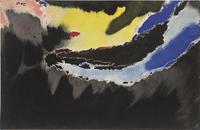
Untitled
Ivan Serpa
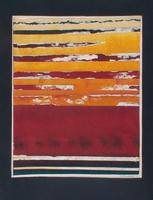
Sunscape
Małgorzata Serwatka
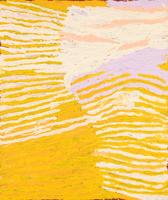
Untitled (Lupulnga)
Makinti Napanangka
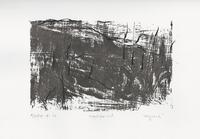
Landscape (late autumn)
Alfred Freddy Krupa
Autunno
Antonio Corpora
Untitled [The Travels of Kungka Kutjarra (Two Women)]
Makinti Napanangka
"Distinguishing Features"
Roger Weik
"Sign Of"
Roger Weik
Il Vicino Pianeta
Antonio Corpora
Übergang
Daniel Sambo-Richter