Expert analysis of Charles Demuth’s End of the Parade, Coatesville, Pa.
Style: Precisionism · Genre: cityscape
Expert Analysis: "End of the Parade, Coatesville, Pa." by Charles Demuth
Artist and Style: Charles Demuth is a central figure of Precisionism, an early 20th-century American movement that merged Cubist geometry with realist clarity. The style celebrates the modern industrial landscape through sharp lines, simplified forms, and a cool, detached palette—often likened to “Immaculate” or “Cubist-Realist.”
Genre and Subject: As a cityscape, this work focuses not on a bustling metropolis but on a small Pennsylvania steel town. Coatesville was an industrial hub, and Demuth’s choice reflects Precisionism’s fascination with factories, water towers, and railroads as emblems of American progress.
Significance:
-
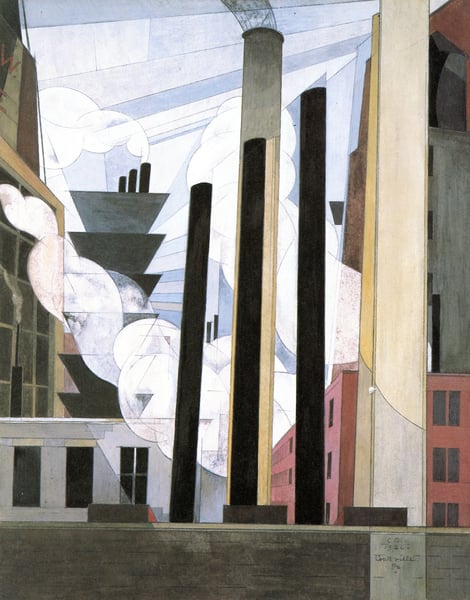
Precisionist Landmark: The painting exemplifies Precisionism’s hallmark—transforming utilitarian industrial structures into elegant geometric compositions. Demuth reduces the parade route, flags, and architecture to crystalline planes, balancing celebration with cold, analytical order.
-
Suburban/Industrial Narrative: Unlike many cityscapes that center on skylines or street life, Demuth captures the aftermath of a parade—a fleeting civic ritual—set against the looming presence of steel mills. This juxtaposition of human festivity and industrial might underscores the tension between community and mechanization typical of the 1920s.
-
Cultural Commentary: The “end” of the parade suggests a moment of pause or even decline, hinting at the fragility of American small-town industry. Demuth’s precise yet slightly emptied scene invites reflection on the transience of both celebration and the industrial era itself.
-
Formal Mastery: The work demonstrates Demuth’s signature use of transparent, overlapping planes and muted, earthy colors—evoking both architectural blueprint and modernist painting. His control of line and space makes the ordinary extraordinary, elevating a local scene to a national icon of Precisionist vision.
Conclusion: “End of the Parade, Coatesville, Pa.” is significant as a quintessential Precisionist cityscape that documents American industrial life with geometric rigor and poetic restraint. It stands as a quiet monument to the intersection of civic ritual and the relentless geometry of industry—a core theme of the movement.
Visually similar
20 works with related composition and palette
After All
Charles Demuth
Scheiber Hugó Nagyváros
Scheiber Hugó
Nenyto
Cassandre
Factories
Joseph Stella
Factories
Joseph Stella
Scheiber Hugó, Esti Fények
Scheiber Hugó
Scheiber Hugó, Külváros
Scheiber Hugó
Usines près de Charleroi
Maximilien Luce
By-Products Plants
Joseph Stella
Plant
Maria Stolarova

British Industries. Steel
Richard Jack
Scheiber Hugó, Nagyvárosi Fények
Scheiber Hugó

The Lights of the Plant
Maria Stolarova
Scheiber Hugó, Gyárváros
Scheiber Hugó
Gasworks
Rita Angus
Urban landscape
Mario Sironi
Our Factories
Vasile Dobrian
Urban Landscape
Mario Sironi

The anguish of departure
Giorgio de Chirico

Houses in Flames
Jean David