
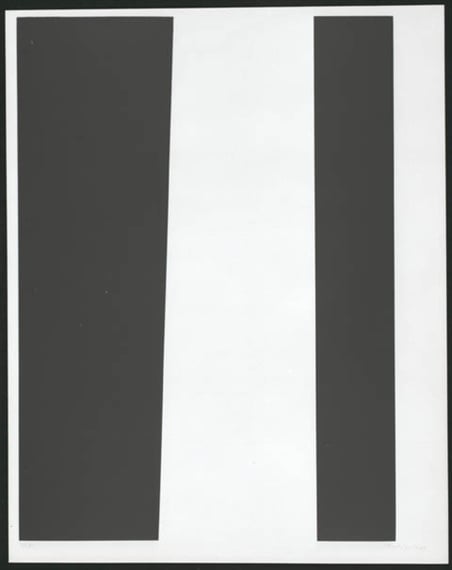
Expert analysis of Guido Molinari’s Black/White
Style: Hard Edge Painting · Genre: abstract
Expert Analysis: Guido Molinari's Black/White (c. 1960s)
As a defining work of Hard Edge Painting, Molinari’s Black/White exemplifies the movement’s core principles: crisp, unmodulated color fields, razor-sharp boundaries, and a rigorous rejection of gestural expressionism. The stark palette of black and white removes all anecdotal or emotional content, forcing the viewer to focus solely on the relational dynamics of form and space.
Significance within Hard Edge Painting:
- Optical tension and movement: Molinari uses evenly spaced vertical bands of black and white to create a rhythmic pulse that activates the picture plane. The high contrast generates a flickering, near-kinetic effect—a hallmark of the artist’s interest in “plasticity” and visual perception.
- Reduction to essentials: By limiting himself to two non-colors, Molinari pushes Hard Edge’s logic to its extreme: color is no longer a carrier of meaning or mood but a purely structural element. The canvas becomes a field of equalized forces, where no single stripe dominates.
- Canadian modernist innovation: While American Hard Edge painters (e.g., Ellsworth Kelly, Al Held) often used vibrant hues, Molinari’s monochrome approach aligns with his broader series exploring “black and white as pure chromatic structure.” This work distills his theory that painting should be an autonomous, non-referential system, prefiguring later Minimalist and Op Art concerns.
Genre (Abstract) and Execution:
The work is entirely non-representational. Molinari’s technique—masked, machine-like edges applied with flat acrylic—eliminates the artist’s hand, reinforcing the cool, impersonal aesthetic of Hard Edge. The equal-width stripes suggest a seriality that resists hierarchical composition, instead creating an all-over surface that appears infinite.
Conclusion:
Black/White is significant not just as a quintessential Hard Edge painting, but as a radical investigation of perception itself. Molinari’s disciplined reduction to black and white strips abstraction to its barest bones, making visible the optical and spatial tensions that define the style. It stands as a key work in the mid-century dialogue between North American geometric abstraction and the European avant-garde, affirming Molinari’s role as a pioneer of rigorous, non-objective art.
Visually similar
20 works with related composition and palette
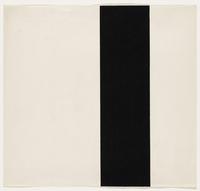
Vertical Band
Ellsworth Kelly
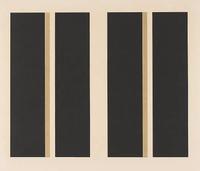
Untitled (Vertical Lines)
John McLaughlin
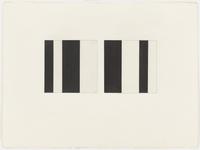
Annunciation Study I
Brice Marden
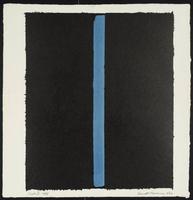
Canto II
Barnett Newman
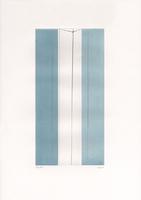
Triptyque
Genevieve Asse
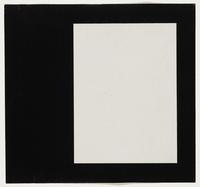
Rectangle from the series Line Form Color
Ellsworth Kelly
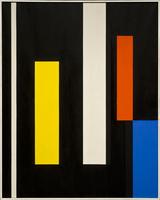
First Theme #2
Burgoyne Diller
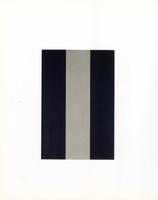
Star (for Patti Smith)
Brice Marden
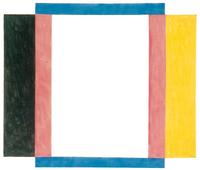
Toile découpée
Louis Cane
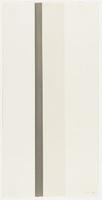
Sumi Drawing
Anne Truitt
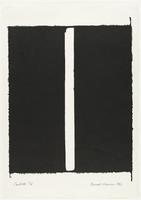
Canto III
Barnett Newman
Untitled
Rubem Ludolf
Heartbeats
Roman Cotosman
Number 17
John McLaughlin
Renewal Suprematist square
Kazimir Malevich

Untitled (9 - 1 - A - 17)
Yves Gaucher
Summer 88, No. 6
Anne Truitt
Looking Glass
Gene Davis
Untitled
Friedrich Vordemberge-Gildewart
Radical III
Aurelie Nemours