Análisis experto de Opposition triangulaire de Guido Molinari
Estilo: Hard Edge Painting · Género: abstract
Expert Analysis: "Opposition triangulaire" by Guido Molinari
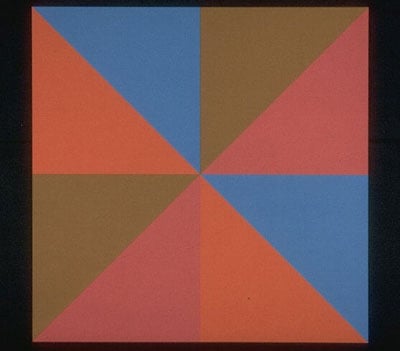
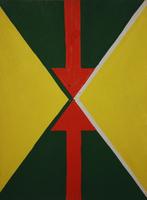
Guido Molinari’s "Opposition triangulaire" is a quintessential example of Hard Edge Painting, a mid‑20th‑century movement that emerged in reaction to the gestural spontaneity of Abstract Expressionism. Hard Edge painting emphasizes crisp, razor‑sharp boundaries between fields of uniform color, privileging clarity, flatness, and optical impact over brushstroke texture or emotional expression. Molinari, a leading Canadian exponent of this style, consistently explored the visual dynamics of geometric abstraction—and "Opposition triangulaire" stands as a landmark demonstration of his core concerns.
Significance within Hard Edge and Geometric Abstraction
The work’s title—"Opposition triangulaire" (French for “triangular opposition”)—directly signals its conceptual and formal focus: the tension created by juxtaposing triangular forms. In keeping with Hard Edge principles, each triangle is rendered as an unmodulated, flat shape with no interior modeling or shading, its edges defined by absolute, razor‑like transitions. This precision forces the eye to read the canvas as a unified optical field, where shape and color interact without the distraction of depth or illusionistic space.
-
Formal Innovation: By limiting himself to triangles in dynamic opposition—whether through rotation, inversion, or contrast of color—Molinari achieves a sense of equilibrium that is simultaneously unstable. The “opposition” is not merely visual but structural: the triangles push against each other, their straight edges creating an implied grid or directional force that activates the entire picture plane. This aligns with the Hard Edge fascination with perceptual simultaneity, where the viewer experiences multiple spatial readings at once.
-
Color as Structure: Like other Hard Edge painters (e.g., Ellsworth Kelly, Frank Stella), Molinari uses color not as expression but as a structural element. Each triangle’s hue is applied as a solid, saturated field, and the color choices likely work to heighten the opposition—complementary or high‑contrast pairs that vibrate optically. The lack of internal variation forces the color relationships to bear the full weight of composition, making the painting’s “argument” purely about the physics of visual perception.
-
Role of the Edge: The “hard edge” is itself the subject. The meeting point between triangles is not a line or a contour; it is a boundary where two colors abruptly end and begin. This technique eliminates illusionistic space and declares the painting’s flatness—a key tenet of modernist abstraction. In "Opposition triangulaire", the edge becomes a site of both division and connection, embodying the tension promised by the title.
Legacy and Context
Molinari’s work bridges American Hard Edge painting and the post‑war Canadian geometric abstraction known as the Plasticien movement (which he helped found). "Opposition triangulaire" is significant because it demonstrates how Hard Edge principles could be adapted to a non‑Western, specifically Quebecois context, while still engaging with universal perceptual issues. The painting’s rigorous reduction—triangles, clean edges, opposition—makes it a touchstone for understanding how geometric abstraction can produce intense visual drama through the simplest means. It asks viewers to see color and form not as symbols but as direct physical experience, exemplifying Hard Edge’s ultimate goal: to make painting an act of pure, sensory presence.
Género
Estilo
Visualmente similares
20 obras con composición y paleta relacionadas
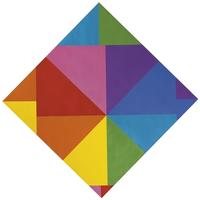
Acht farben im horizontal-diagonal-quadtrat
Max Bill
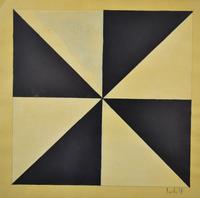
Composição geométrica
Rubem Ludolf
Untitled
Max Bill
Untitled
Antonio Palolo
Aus violettem kern
Max Bill
Converge
Harriet Korman
Componenti antagoniste
Galliano Mazzon
Opposing (#15)
Frederick Hammersley
Pasadena Lifesavers Yellow Series #5
Judy Chicago
Hommage à Picasso
Max Bill
Pura Vida Road
Gregorio Undurraga
politics
Pierre Kiandjan
Mild appearance
Galliano Mazzon
Sidi Ifni (from America's Hommage à Picasso)
Frank Stella
Espaces intérieurs
Charles Bezie
Orphée
Pierre Kiandjan
dusty maths
Pierre Kiandjan
Pasadena Lifesavers Red #5
Judy Chicago
Untitled
Sandu Darie
Diagonal Light
Genevieve Asse