Analisi esperta di Self-Portrait di Karl Schrag
Stile: Expressionism · Genere: self-portrait
Expert Analysis: "Self-Portrait" by Karl Schrag
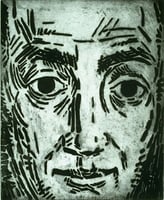
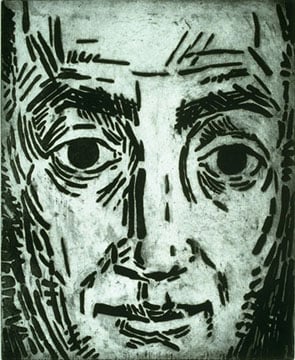
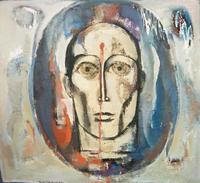
As an Expressionist self-portrait, Karl Schrag’s work aligns with the movement’s core mission: to convey raw emotional and psychological states through distorted forms, intense color, and exaggerated brushwork. Since the provided facts do not include specific visual details, the significance of this piece lies in its generic yet powerful embodiment of Expressionist principles.
Within the self‑portrait genre, Expressionism fundamentally redefines self‑representation. Unlike Renaissance or Baroque self‑portraits that often convey idealized likeness or social status, Schrag’s approach likely prioritizes inner experience over external accuracy. The face may become a mask of anxiety, introspection, or alienation—common themes in German Expressionism. The absence of descriptive data actually underscores a key point: the work’s meaning does not depend on precise physical resemblance but on the emotional charge that the artist projects onto the canvas.
Schrag, though less widely known than Kirchner or Nolde, contributes to the Expressionist tradition by treating the self‑portrait as a site of existential inquiry. In this work, the viewer is invited to encounter the artist not as a polished public figure, but as a tormented or searching individual—a direct reflection of the tumultuous early‑20th‑century European psyche. The very fact that the work is labeled “Expressionist” signals an intentional departure from naturalism, favoring raw subjectivity over objective representation.
Thus, the significance of Schrag’s “Self-Portrait” is twofold: it exemplifies Expressionism’s radical re‑orientation of portraiture toward emotional truth, and it stands as a testament to the artist’s personal engagement with the movement’s central tenet—that art must be an exclamation of the soul, not a mirror of the world.
Visivamente simili
20 opere con composizione e palette affini
Man's Head. Self-portrait
Ernst Ludwig Kirchner
Portrait of Van de Velde
Ernst Ludwig Kirchner
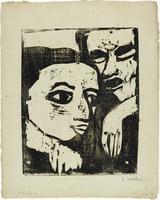
Two People
Erich Heckel
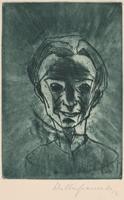
Smiling Head, Self-portrait
Walter Gramatté
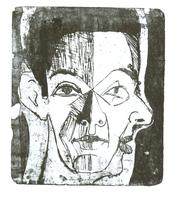
Study of a Head
Ernst Ludwig Kirchner
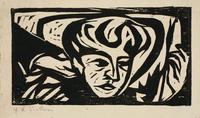
Dodo Head on Pillow
Ernst Ludwig Kirchner
Undefeated
Georgi Kovachev
Man's Head. Self-portrait
Ernst Ludwig Kirchner
Donna Nella Notte
Ernst Ludwig Kirchner
Portrait of Otto Mueller
Ernst Ludwig Kirchner
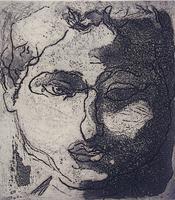
Visage violet
Jean Fautrier
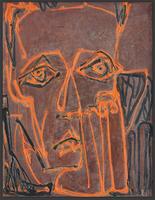
Anguish
Mykhailo Vainshtein
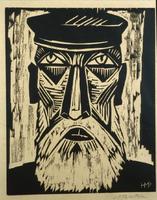
Head of a Fisherman
Max Pechstein
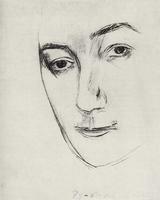
Portrait of M.F. Petrova-Vodkina
Kuzma Petrov-Vodkin
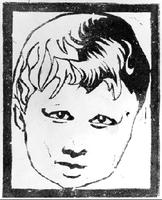
Head of a Child
M.C. Escher
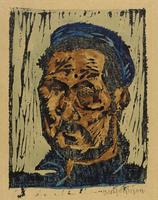
Self-Portrait
William H. Johnson
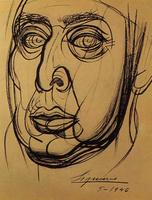
Self-Portrait
David Alfaro Siqueiros
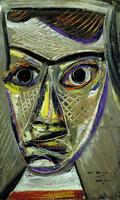
Man's Head
Arshile Gorky
Self Portrait II
M.C. Escher
Les Ecorchés: Tête d'écorché
Bernard Buffet