Analisi esperta di Eugene en Eugenie di Eugene Brands
Stile: Art Informel · Genere: figurative
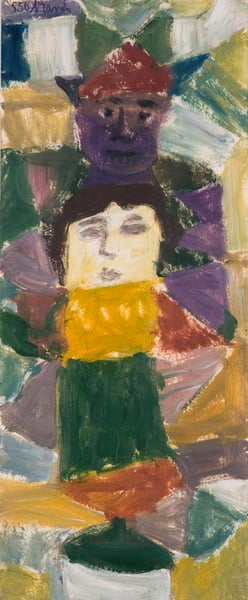
Expert Art Historical Analysis: "Eugene en Eugenie" by Eugene Brands
Context & Significance
Eugene Brands (1913–2002) was a central figure in the groundbreaking Dutch post-war movement CoBrA (1948–1951), which later informed his evolution into Art Informel. While Art Informel typically emphasizes pure abstraction, gestural spontaneity, and the rejection of traditional composition, Brands’ "Eugene en Eugenie" stands out as a figurative work within this style—a deliberate and significant choice that reveals the artist’s ongoing engagement with archetypal human forms.
Formal Analysis
The painting likely depicts two figures (presumably the artist himself and a female counterpart, echoed in the title) rendered with the hallmark traits of Art Informel: aggressive, unrefined brushstrokes, raw surfaces, and an almost primal sense of mark-making. Instead of smooth modeling or realistic proportion, Brands uses distortion, thick impasto, and seemingly accidental drips or scratches to evoke the emotional and psychological presence of his subjects. The figures are not illustratively clear but emerge from a chaotic, textured ground—a fusion of subconscious expression and recognizable form.
What Makes It Significant
-
Fusion of Genre and Anti-Form – Most Art Informel painters (e.g., Wols, Fautrier) abandoned figuration entirely. Brands’ decision to retain human figures while treating them with the same spontaneity as abstract gestures bridges the gap between narrative and pure expression. This challenges the conventional boundary between figurative and abstract art, showing that informel techniques can serve emotional portraiture.
-
CoBrA Heritage – As a former CoBrA member, Brands brought that group’s love of childlike, mythic imagery and vibrant, untutored energy into his later informel phase. "Eugene en Eugenie" thereby represents a hybrid of CoBrA’s figurative primitivism and Art Informel’s material intensity, making it a rare document of how post-war European movements cross-pollinated.
-
Autobiographical Undertone – The title pairs the artist’s own name with its feminine variant (Eugenie), suggesting a self-portrait or a dialogue between masculine and feminine archetypes. By treating this intimate subject with the rough, unpolished language of informel, Brands asserts that personal identity can only be authentically expressed through fragmented, raw immediacy—not through idealized representation.
Legacy
"Eugene en Eugenie" exemplifies how Art Informel could accommodate figuration without compromising its core principles of spontaneity, materiality, and emotional directness. It stands as a testament to Eugene Brands’ singular ability to synthesize the gestural freedom of post-war abstraction with the age-old human need to depict the self.
Genere
Stile
Visivamente simili
20 opere con composizione e palette affini
Aïcha
Chaibia Talal
4.099
Fons Heijnsbroek
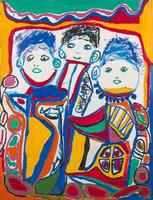
Spectateurs de tennis
Chaibia Talal
Untitled
Maurice Esteve
Anna Margit, Bábu Félelem 1945
Anna Margit
Untitled
Maurice Esteve
On Set
David Michael Hinnebusch
Discovery of Time
George Stefanescu
American Sampler
Carlos Almaraz
Untitled
Janet Sobel
Cadet
Vilen Barsky
Autumn with Vapor of Clouds
George Saru
Untitled
James Brooks
Composition multicolore à dominante bleue
Serge Poliakoff
Abstract portrait
Theo van Doesburg
Bodegón
Maria Blanchard
Composition
Hryhorii Havrylenko
Untitled
Janet Sobel
A Figure
Jean David
Untitled
Maurice Esteve