Expertenanalyse zu Carlos Meridas La Máscara Mágica
Stil: Cubism · Genre: abstract
Expert Analysis of "La Máscara Mágica" by Carlos Merida
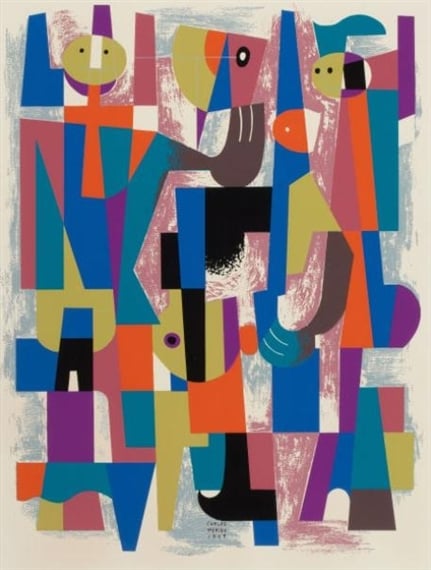
Carlos Merida’s “La Máscara Mágica” (The Magic Mask) stands as a compelling example of how Cubism was reinterpreted beyond its European origins to address non-Western cultural identities. Categorized as an abstract work within the Cubist style, the painting exemplifies Merida’s distinctive approach: a fusion of geometric fragmentation with pre-Columbian and folkloric symbolism, particularly from his Guatemalan and Mexican heritage.
Significance within Cubism
While Picasso and Braque pioneered Cubism as a radical deconstruction of perspective and form, Merida’s adaptation introduces a layered cultural narrative. The “mask” – a recurring motif in Mesoamerican art – becomes a vehicle for re-contextualizing Cubist principles. Here, the mask is not merely a subject but a structural device: Merida breaks down its organic contours into angular, overlapping planes typical of Cubism, yet retains the ritualistic, enigmatic aura of its original context. The abstraction does not erase meaning; instead, it abstracts to amplify the mask’s symbolic potency as a mediator between the visible and the spiritual.
Abstract Genre and Cultural Synthesis
The abstract genre allows Merida to distill the essence of the mask into pure shape and color, bypassing literal representation. The palette likely draws from indigenous textiles and murals, while the faceted forms echo the synthetic phase of Cubism. This synthesis marks “La Máscara Mágica” as a key work in Latin American modernism, where European avant-garde techniques were repurposed to express regional identity. Merida’s Cubism is thus significant for its transcultural dialogue: it acknowledges the formal innovations of the Parisian school while asserting the autonomy of Indigenous aesthetic traditions. The result is a vibrant, magical abstraction that challenges the Eurocentric narrative of Cubism, proving that the style could be a flexible language for global artistic expression.
Visuell ähnlich
20 Werke mit ähnlicher Komposition und Farbpalette
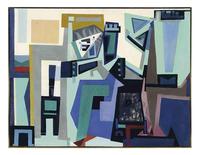
By the Sea
Peter Busa
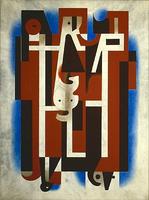
The Prodigal Son
Carlos Merida
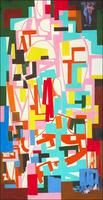
Untitled
Ad Reinhardt
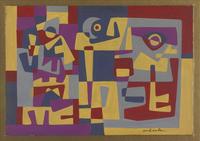
Strangers
Steve Wheeler
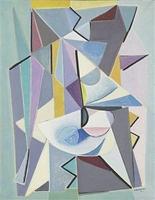
Composizione
Bice Lazzari
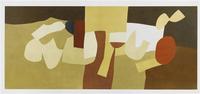
Controcanto
Afro
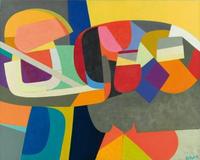
Brouclé
Maurice Esteve
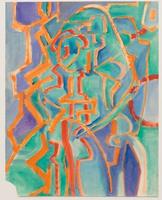
Untitled
Luchita Hurtado
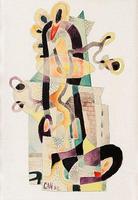
Scissor plant
Gosta Adrian-Nilsson
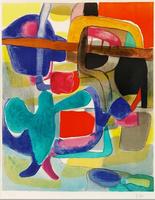
L'oiseau Vert
Maurice Esteve
Untitled
Conrad Marca-Relli
Cubist landscape
Carloluigi Colombo
Pure Myth
Perle Fine
Abstract Composition
Maurice Esteve
Abstract Composition
Maurice Esteve
Messidor
Maurice Esteve
L`Accueil
Maurice Esteve
L`Accueil
Maurice Esteve
Harbor of Ravenna
Carloluigi Colombo
Agrigente
Jean-Michel Atlan