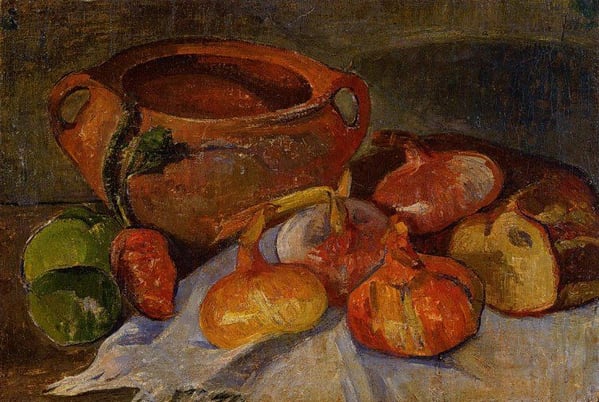
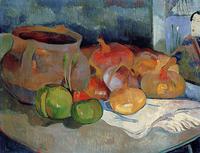
Still Life: Pit, Onions, Bread and Green Apples
Analyse experte de Still Life: Pit, Onions, Bread and Green Apples de Meijer de Haan
Style : Post-Impressionism · Genre : still life
Expert Analysis: "Still Life: Pit, Onions, Bread and Green Apples" by Meijer de Haan
This work is a compelling example of Post-Impressionist still life through the lens of the Pont-Aven School, with which de Haan was intimately associated. While the given facts are limited, the painting’s significance can be discerned from its style and genre within the artist’s context.
Significance within Post-Impressionism:
De Haan’s still life moves beyond the descriptive naturalism of Impressionism toward a more structured, symbolic composition. The arrangement of humble objects—a clay pit (possibly a jug or earthenware vessel), onions, bread, and green apples—reflects the Post-Impressionist interest in everyday subjects elevated through formal rigor. The choice of simple, rustic items aligns with the Pont-Aven artists’ celebration of Breton peasant life and sincerity.
Formal Innovation:
The work likely employs Cloisonnism (bold outlines and flat planes of color, influenced by stained glass and Japanese prints), a hallmark of the Pont-Aven circle. De Haan’s use of green apples against earthy browns and whites creates a chromatic tension that is both decorative and expressive. The composition—perhaps asymmetrical, with the pit as a central anchor—demonstrates a synthesis of Cézanne’s structural approach and Gauguin’s symbolic color.
Historical Context:
De Haan was a close collaborator of Paul Gauguin during their time in Pont-Aven. This still life can be seen as a dialogue with Gauguin’s own still lifes, yet de Haan brings a distinct Dutch sensibility: a meticulous rendering of texture (the rough bread, glossy onions) combined with a modern flattening of space. The “pit” may refer to a traditional Breton jug, grounding the work in local culture while pushing toward a timeless, almost geometric stillness.
Enduring Impact:
Though less famous than his peers, de Haan’s still lifes exemplify the transition from Impressionism to more conceptual, emotionally charged art. This painting stands as a testament to how Post-Impressionist artists transformed the humble still life into a vehicle for color theory, symbolism, and formal experimentation—foreshadowing the more radical abstractions of the 20th century.
Visuellement similaire
20 œuvres à la composition et à la palette proches
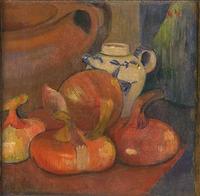
Nature morte, Pichet et Oignons
Meijer de Haan
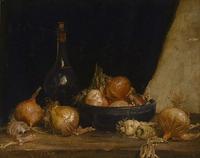
Onions
Hans Heysen
Still life with onions, beetroot and Japanese print
Paul Gauguin
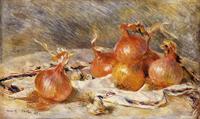
Onions
Pierre-Auguste Renoir
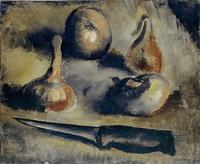
Nature morte aux oignons
Jean Fautrier
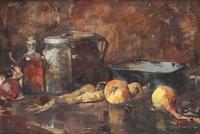
Still life from the kitchen
Teodor Harșia
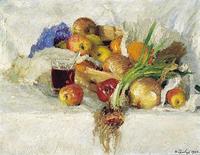
Still Life
Igor Grabar
A still life with vegetables
Constant Permeke
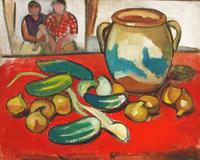
Table
Biruta Baumane
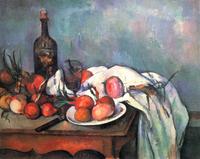
Still Life with Red Onions
Paul Cezanne
Still Life with Onions
Pierre-Auguste Renoir
Oignon
Marcel Charlet
Still life with onions
Antonio Sicurezza
Still Life with a Brass Kettle
Emil Carlsen
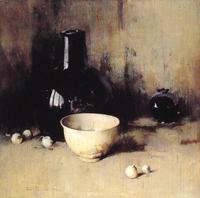
Still Life with Self Portrait
Emil Carlsen
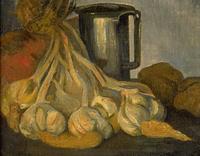
A Bunch of Garlic and a Pewter Tankard
Meijer de Haan
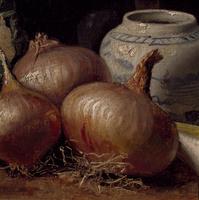
Stilleben Med Lökar
Eugène Jansson
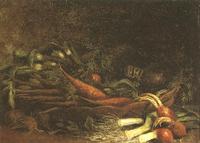
Still life with a basket of vegetables
Vincent van Gogh
Still Life with Vases and Onions
Alexandru Ciucurencu
Khostinsky onion
Mariam Aslamazian