Expert analysis of Camille Bombois’s La gitana
Style: Naïve Art (Primitivism) · Genre: portrait
Expert Analysis: La gitana by Camille Bombois
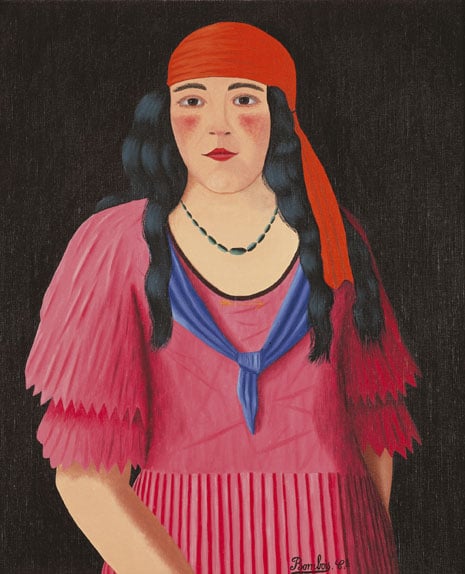
Camille Bombois’s La gitana stands as a compelling example of Naïve Art, a movement defined by its rejection of academic training in favor of intuitive, unrefined expression. Painted in the early 20th century, this portrait of a gypsy woman exemplifies the raw vitality and directness that distinguish Bombois’s work—and Naïve painting more broadly—from the polished traditions of fine art.
Significance within Naïve Art and Primitivism
Bombois, a former wrestler and carnival strongman who taught himself to paint, brings a visceral, almost sculptural solidity to his subjects. In La gitana, the figure is rendered with bold, unmodulated outlines and a flat, saturated palette—typical of Naïve technique—that bypasses conventional modeling and perspective. The sitter’s dark, piercing eyes, heavy brows, and exoticized attire (a red headscarf, gold earrings, a patterned shawl) are not idealized but presented with a forthrightness that borders on the archetypal. This directness is a hallmark of Naïve portraiture: the artist paints what he sees and feels, unburdened by Renaissance rules of proportion or Impressionist atmospheric effects.
Formal and Symbolic Characteristics
The composition is rigorously frontal and symmetrical, lending the gypsy an almost iconic, hieratic presence. Bombois uses strong contrasts—black hair against a light background, red fabric against dark skin tones—to create a sense of immediate, unmediated impact. The background is simplified to a flat, neutral tone, emphasizing the figure as a pure object of the artist’s gaze. Unlike the ethnographic or romanticized gypsies of academic painters (e.g., Corot or Tissot), Bombois’s gitana feels present, even confrontational, as if she might step out of the canvas.
Why This Work Matters
La gitana is significant because it embodies the core paradox of Naïve Art: its apparent “primitivism” is not a lack of skill but a different kind of mastery—one rooted in sincerity, folk tradition, and the artist’s personal vision. Bombois, like Henri Rousseau before him, transforms the ordinary into the monumental. Here, a simple portrait of a Romani woman becomes a testament to the power of outsider art to challenge the hierarchies of taste. The painting’s bold forms and unapologetic flatness prefigure later developments in both modernism (e.g., figurative abstraction) and popular illustration, proving that artistic “naïveté” can be as potent as academic refinement.
Visually similar
20 works with related composition and palette
Portrait of N.Z. Rappoport
Valentin Serov
Double Portrait
Jose de Almada-Negreiros
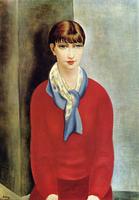
Kiki de Montparnasse in a red jumper and a blue scarf
Moise Kisling
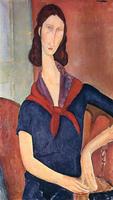
Jeanne Hebuterne (with a scarf)
Amedeo Modigliani
Kondor Béla, Kékruhás Nő
Kondor Béla
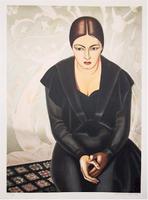
Maidenhood
Clarence Holbrook Carter
Head of a Young Girl
Amedeo Modigliani
Untitled
Antonio Bueno
[Unkown]
William-Adolphe Bouguereau
Portrait of seated blonde woman
Rafael Zabaleta
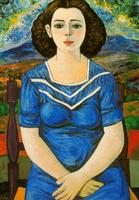
Portrait of seated brunette
Rafael Zabaleta
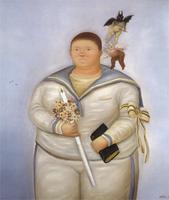
Self-Portrait the Day of the First Communion
Fernando Botero
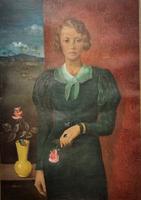
Czene Béla, Bessy
Czene Béla
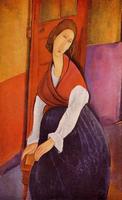
Jeanne Hebuterne in Red Shawl
Amedeo Modigliani
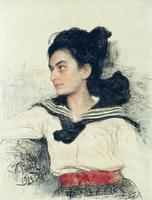
Portrait of Maria Osipovna Lowenfeld
Ilya Repin
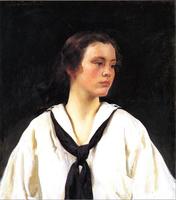
Sally
Joseph DeCamp
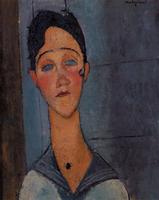
Louise
Amedeo Modigliani
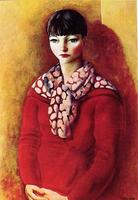
Kiki de Montparnasse in a red dress
Moise Kisling
Proust: Albertine disparue
Maria Bozoky
Paulette Jourdain
Amedeo Modigliani