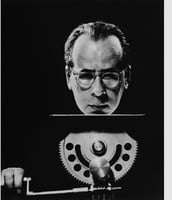
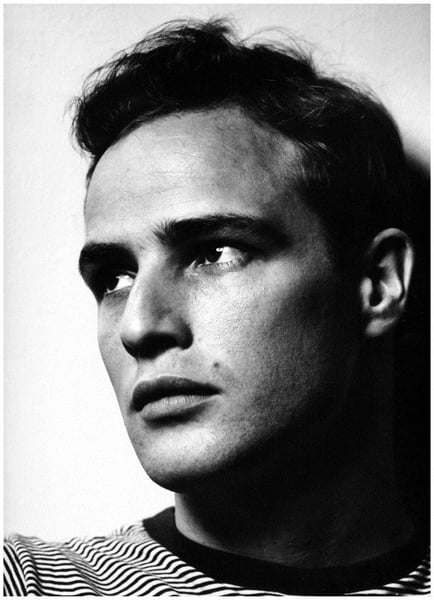
Analisi esperta di Marlon Brando di Philippe Halsman
Genere: photo
Expert Analysis: "Marlon Brando" by Philippe Halsman
Philippe Halsman’s portrait of Marlon Brando stands as a masterful convergence of two titans of 20th-century culture—a photographer renowned for his psychological acuity and an actor who redefined cinematic naturalism. Though the genre is photography, Halsman elevates the medium beyond mere documentation into a penetrating study of persona and presence.
Significance within Style and Period
Halsman, a leading figure in mid-20th-century portrait photography, brought a unique blend of technical precision and humanistic insight to his celebrity subjects. He is best known for his “jump” series, where he captured subjects in midair to reveal their unfiltered character. Yet his still portraits, like this one of Brando, are equally celebrated for their psychological depth.
What makes this portrait significant is Halsman’s ability to distill Brando’s volatile, brooding magnetism—the very qualities that made him a symbol of post-war rebellion and Method acting. The photograph likely employs Halsman’s signature lighting: dramatic chiaroscuro emphasizing the actor’s sculpted face, with deep shadows that evoke introspection and raw intensity. Brando’s gaze, often described as both confrontational and vulnerable, becomes the focal point, inviting the viewer into a charged silence.
Contextual Importance
-
Cultural Moment: Taken during the height of Brando’s career (mid-1950s, following On the Waterfront and The Wild One), the image freezes a transitional era in Hollywood—from studio-glamour to gritty realism. Halsman’s portrait captures not just a star, but an anti-hero archetype that reshaped American masculinity.
-
Artistic Technique: Halsman was a master of the “psychological portrait,” insisting that a true photograph reveals the subject’s inner essence. Here, he likely used a large-format camera for exquisite detail, then employed subtle retouching (common in the era) to heighten contrasts and texture, giving the skin a lived-in, almost tactile quality.
-
Legacy: This photograph endures as a definitive image of Brando, often reproduced alongside his film stills. It exemplifies Halsman’s belief that “a portrait is a work of art insofar as it reveals the character of the sitter.” The tension between Brando’s polished Hollywood surface and his brooding interior places the work in the lineage of great psychological portraiture—from Rembrandt to Irving Penn.
Conclusion
In “Marlon Brando,” Halsman achieves what the best portrait photography aims for: an unflinching, empathetic encounter with a complex soul. The work is significant not only for its technical mastery but for its role in cementing both artists’ cultural legacies—Halsman as the architect of the modern celebrity portrait, and Brando as the inscrutable icon of a generation.
Visivamente simili
20 opere con composizione e palette affini
Stefano Franco-Bora 1992 Nineteen Atelier Colette Paris14
Stefano Franco-Bora
Johannes Profile Photograph
Johannes Meintjes
From "Other Faces"
Samira Eskandarfar
Self Portrait
Vasyl Kasiyan
Andy Warhol
Philippe Halsman
Italy, May 1977 - August 1978
Francesca Woodman
JM
Johannes Meintjes
L'artiste maudit
Hugues Folloppe

Imperial Valley. From the Series Day Sleeper
Dorothea Lange
Portrait Of Jamie Wyeth
Andy Warhol
Vladimir Frandolić (5.12.1993)
Alfred Freddy Krupa
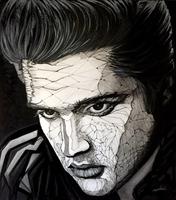
Colecção Personalidades - ELVIS PRESLEY & HIS INTRINSIC DREAMS
Sónia Domingues
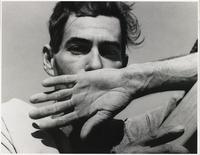
Migratory Cotton Picker, Eloy, Arizona
Dorothea Lange
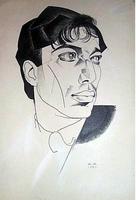
Portrait of poet Boris Pasternak
Jury Annenkov
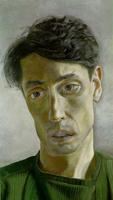
John Minton
Lucian Freud

Morning
Elina Brotherus

The Renaissance Lover IX
Troy Schooneman
Portrait of E.V. Braginsky
Konstantin Yuon
Même un point noir est oeuvre d'art
Ben
Carter Burden (white)
Andy Warhol