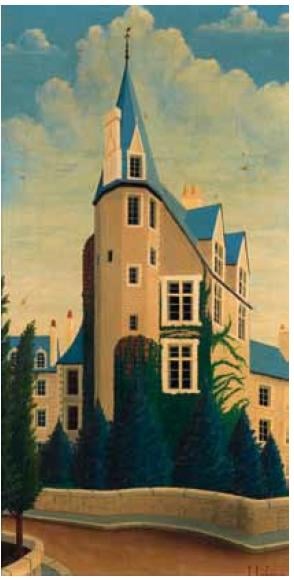
La porte Saint-Pierre à Nantes
Expert analysis of Jules Lefranc’s La porte Saint-Pierre à Nantes
Style: Naïve Art (Primitivism) · Genre: cityscape
Expert Art Historical Analysis: "La porte Saint-Pierre à Nantes" by Jules Lefranc
Jules Lefranc's La porte Saint-Pierre à Nantes is a compelling exemplar of Naïve Art (also referred to as Primitivism), a style that flourished in the late 19th and early 20th centuries as a deliberate counterpoint to academic painting. The work’s significance lies in how it embodies the core virtues of Naïve Art—directness, unmediated vision, and a rejection of illusionistic depth—while engaging with a specific historical and urban subject.
Stylistic Significance within Naïve Art / Primitivism
Naïve artists typically lacked formal training, and their work is characterized by flat, simplified forms, bright local colors, and a disregard for linear perspective. Lefranc’s rendering of the Porte Saint-Pierre—a historic gate in Nantes—displays these hallmarks. The architecture is likely depicted with a childlike clarity: geometric shapes, minimal shading, and a decorative, almost folkloric patterning of bricks and stones. The sky and foliage would be rendered in saturated hues, unmodulated by atmospheric effects. This “primitive” fidelity to the object’s essence, rather than its naturalistic appearance, aligns with the Primitivist impulse to recover a perceived lost innocence in art—a quality that artists like Henri Rousseau (the most famous Naïve painter) championed.
Genre and Subject: The Cityscape as Naïve Document
As a cityscape, the painting functions as both a personal record and a cultural artifact. Unlike academic city views that emphasize perspective and civic grandeur, Lefranc’s approach likely offers a humble, intimate portrayal. The Porte Saint-Pierre was a medieval gate of Nantes, a structure steeped in local history (it was part of the city’s fortifications, later a symbol of Breton identity). In Lefranc’s hands, the gate becomes a static, hieratic icon—a flat symbol rather than an architectural study. This aligns with Naïve Art’s tendency to treat all subjects with equal importance, flattening hierarchy and creating a sense of wonder. The work’s significance thus rests in its ability to render a monumental subject with the unpretentious charm of a folk painting, turning the viewer’s attention to the raw, perceptual experience of the place.
Contrast with Academic Traditions
In the late 19th century, French academic painting prized technical precision and historical accuracy. Lefranc’s Porte Saint-Pierre would have stood in sharp contrast: its lack of linear perspective, unconventional proportions, and naive handling of light would have appeared “primitive” to contemporaries. Yet this very “otherness” is now celebrated as a form of authenticity. The work captures the Spirit of Primitivism—an artistic movement that valorized instinct over refinement, and emotional truth over verisimilitude. By focusing on a humble city gate rather than a picturesque vista, Lefranc invites viewers to see the built environment through fresh eyes, free from the conventions of the art academy.
Conclusion
La porte Saint-Pierre à Nantes is significant as a pure example of Naïve cityscape painting—a genre that retains a direct emotional connection to its subject. Lefranc’s work, though lesser-known, enriches our understanding of how Primitivism operated outside the Parisian avant-garde, rooted in local topography and personal vision. It stands as a testament to the power of untrained art to transform a mundane landmark into an icon of sincere, unmediated seeing.
Visually similar
20 works with related composition and palette
Espalion en Auvergne
Jules Lefranc
Loches
Jules Lefranc
Un coin en Provence
Jules Lefranc
Lla Tour De Chenonceaux
Henri Matisse
Peille
Jules Lefranc
Rue des Teinturiers
Jules Lefranc
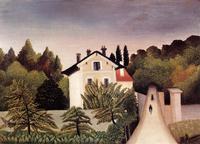
House on the Outskirts of Paris
Henri Rousseau
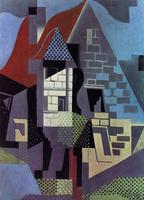
Landscape at Beaulieu
Juan Gris
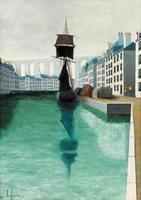
Morlaix, brume matinale
Jules Lefranc
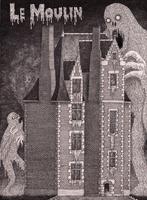
Le Moulin
Don Kenn
Chateau de Comblat
Paul Signac
Rock Street
Jacek Yerka
Landscape with Factory
Henri Rousseau
Naples
Maurice Prendergast
Landscape in Chassy
Balthus
Landscape
Henri Rousseau
The Inn at Montigny les Cormeilles
Camille Corot
Sea view
Travis Herberger
The Red House
Auguste Herbin
Laval, le chateau
Jules Lefranc