
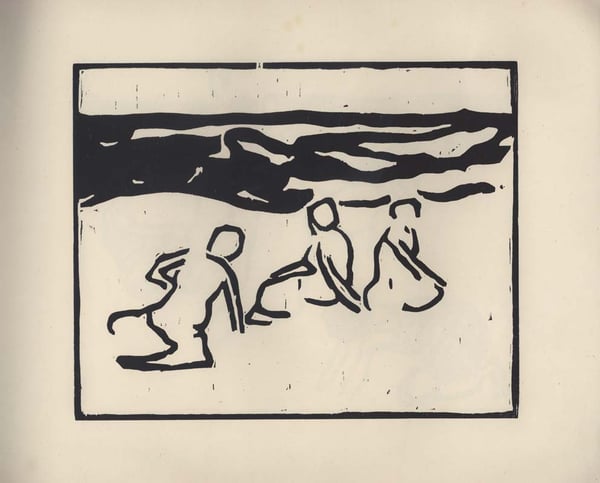
Expertenanalyse zu Arthur Segals Vom Strande. Page 9
Stil: Dada, Expressionism · Genre: illustration
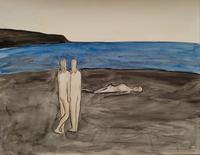
Expert Analysis: "Vom Strande. Page 9" by Arthur Segal
Arthur Segal’s Vom Strande. Page 9 holds a distinctive place within early 20th-century avant-garde art by synthesizing two seemingly opposed movements: Expressionism and Dada. As an illustration, the work exemplifies how the graphic arts became a fertile ground for radical formal and conceptual experiments.
Significance within Expressionism and Dada
The Expressionist component is evident in the work’s likely emphasis on subjective emotion, distorted forms, and a heightened, often jarring use of line or color. Segal, a Romanian-born artist active in the Berlin Dada scene, was deeply influenced by the Brücke and Der Blaue Reiter groups; his beach scenes often reduce figures to simplified, rhythmical shapes that convey psychological tension rather than naturalistic space. Here, the beach motif (implied by the title Vom Strande – “From the Beach”) becomes a stage for existential unease, a hallmark of Expressionist illustration.
Yet the Dada label inflects this Expressionist intensity with irony, fragmentation, and anti-art defiance. Dada illustrations—especially those produced for publications like Der Dada or Die Pleite—often subverted traditional pictorial logic through collage, absurd juxtaposition, or deliberate crudeness. Page 9 likely belongs to a series or a book of such illustrations, where the beach setting may be twisted into something absurd or nonsensical, challenging the viewer’s expectations of what a “beach scene” should be. Segal’s Dada contributions, while less combative than those of his peers like George Grosz or John Heartfield, are significant for their integration of Expressionist pathos with Dada’s critical dismantling of bourgeois representation.
Genre and Context
As an illustration, the work embodies Dada’s embrace of mass-reproducible media to reach a wider public. Segal was a member of the Novembergruppe and exhibited at the famous Dada Fair in Berlin (1920). His illustrations often accompanied anarchist or pacifist texts, and Vom Strande may have been part of a portfolio or artist book—a format that allowed for serial experimentation. The “Page 9” designation suggests a sequence, perhaps a narrative that subverts itself, inviting the viewer to question linear order and meaning.
Conclusion
Vom Strande. Page 9 is significant precisely because it straddles two contradictory artistic impulses: the deeply felt, individualist expression of Expressionism and the collective, ironic destruction of Dada. In Segal’s hands, the illustration becomes a site of productive tension—a beach scene that is no longer a peaceful idyll but a space of formal and existential disruption. This work underscores how Dada was not merely a rejection of tradition, but also a transformation of Expressionist emotionality into a critical tool for the modern, disenchanted world.
Visuell ähnlich
20 Werke mit ähnlicher Komposition und Farbpalette
Vom Strande. Page 11
Arthur Segal
Two Dancers
Christian Rohlfs
In the Meadow
Erich Heckel
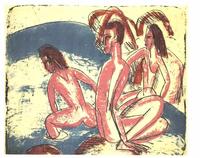
Tree Bathers Sitting on Rocks
Ernst Ludwig Kirchner
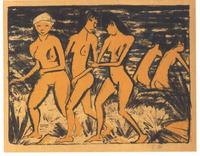
Five Yellow Nudes at the Water
Otto Mueller
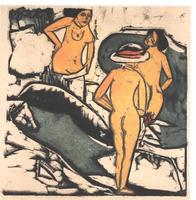
Bathing Women between White Rocks
Ernst Ludwig Kirchner
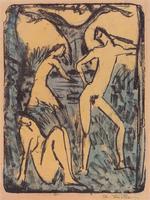
Zwei Mädchen Und Stehender Jüngling
Otto Mueller
In Love (Verliebt)
Christian Rohlfs
Mother and Children
Ernst Ludwig Kirchner
Beach Boys
Walter Battiss
Vom Strande. Page 7
Arthur Segal
Figure
Funasaka Yoshisuke
Women and Sculptures on the Beach
Ernst Ludwig Kirchner
Vom Strande. Page 5
Arthur Segal
Fränzi Reclining
Erich Heckel
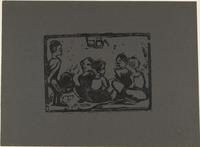
Children
Christian Rohlfs
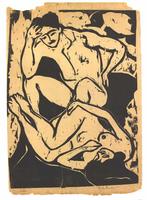
Nacked Couple on a Couch
Ernst Ludwig Kirchner
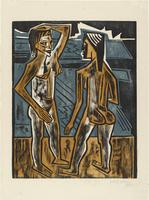
Dialogue
Max Pechstein
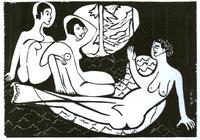
Three Nudes in the Forest
Ernst Ludwig Kirchner
Untitled
Kateryna Lysovenko