
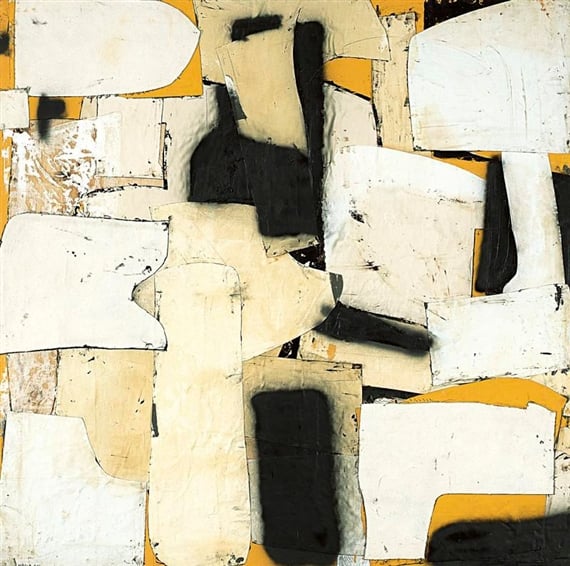
Expert analysis of Conrad Marca-Relli’s X-L-31-62
Style: Abstract Expressionism · Genre: abstract
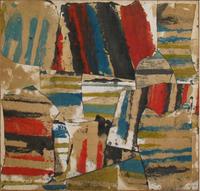
Conrad Marca-Relli’s "X-L-31-62" (1962) is a landmark example of the artist’s singular contribution to Abstract Expressionism—a movement often defined by gestural painting but which he expanded through the radical use of collage. As a founding member of the New York School, Marca-Relli distinguished himself by eschewing the direct brushstroke in favor of meticulously cut and assembled canvas fragments, transforming the surface into a relief-like field of layered planes.
Significance within Abstract Expressionism:
-
Pioneering collage technique: Unlike the poured paint of Jackson Pollock or the color fields of Mark Rothko, Marca-Relli built his compositions by cutting painted canvas into geometric and organic shapes, then gluing them onto a support. In X-L-31-62, the “X-L” likely refers to extra-large scale—a hallmark of Abstract Expressionism’s ambition—while the numerical code suggests a systematic, almost serial approach to abstraction. The resulting work possesses a tactile, architectural presence that bridges painting and sculpture.
-
Dialectic between control and spontaneity: The cut edges and sharp angles of the collaged forms engage in a dynamic tension with visible traces of painted gesture. Marca-Relli would often paint the base canvas and the cut pieces separately, then arrange them with a precision that belies the improvisational ethos of the movement. This interplay makes X-L-31-62 a meditation on construction versus accident, order versus chaos.
-
Negative space as active participant: Where many Abstract Expressionists filled the picture plane with all-over marks, Marca-Relli’s collages deliberately preserve raw, unpainted gaps. In this work, the negative spaces between the cut canvas shapes function as compositional intervals, creating a rhythm that guides the viewer’s eye across the monumental surface. This thoughtful use of void presages later Minimalist concerns with spatial clarity.
-
Material innovation: By using canvas as both support and medium, Marca-Relli emphasized the physicality of the painting process. X-L-31-62 demonstrates his characteristic palette—earthy browns, blacks, and whites—which grounds the abstraction in a sense of organic matter, yet the rigorous geometry hints at urban architecture, reflecting the artist’s early training in engineering.
Why it matters: X-L-31-62 encapsulates Marca-Relli’s attempt to reconcile the heroic scale and emotional intensity of Abstract Expressionism with the deliberate structure of collage, anticipating the later turn toward process art and assemblage. It stands as a testament to the movement’s diversity, proving that the New York School’s search for the “sublime” could be achieved not only through painterly abandon but through the careful, almost architectural assembly of cut fragments.
Visually similar
20 works with related composition and palette
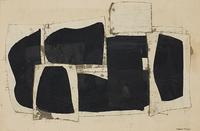
Untitled Collage
Conrad Marca-Relli
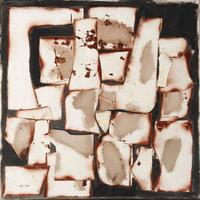
J-M-3-81
Conrad Marca-Relli
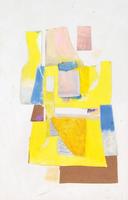
Sem título
Menez
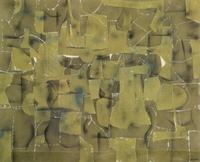
Sand Brown L-A-2-82
Conrad Marca-Relli
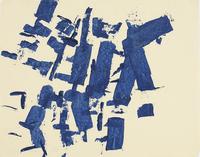
Untitled
Charlotte Posenenske
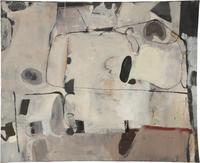
Untitled
Richard Diebenkorn
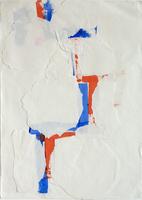
Untitled
Charlotte Posenenske
Untitled
Charlotte Posenenske
Untitled
Conrad Marca-Relli
Untitled
Esteban Vicente
Fortune Teller
Conrad Marca-Relli
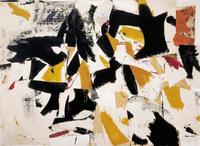
Pamplona
Conrad Marca-Relli
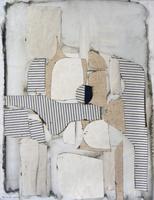
Untitled
Conrad Marca-Relli
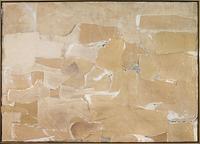
Taos #2
Conrad Marca-Relli
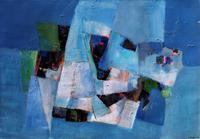
Construction
Alexander Bogen
Picture for a Lady
Charles Garabedian
The Piano
Alexander Bogen
Feb 28-53 (vertical seconds)
Ben Nicholson
Solstice
Kenzo Okada
Cap d'Ail
Conrad Marca-Relli