
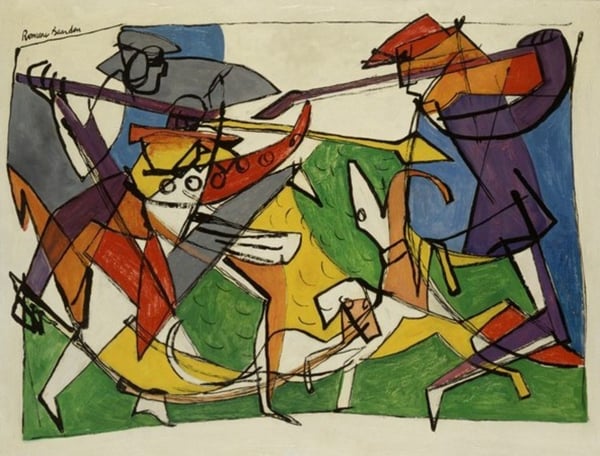
Analisi esperta di The Uncoupling of the Hounds di Romare Bearden
Stile: Cubism · Genere: genre painting
Expert Analysis of "The Uncoupling of the Hounds" by Romare Bearden
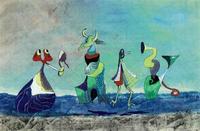
Romare Bearden’s "The Uncoupling of the Hounds" stands as a significant work within the Cubist tradition, reimagining the genre of genre painting through the lens of African American experience and modernist fragmentation.
Stylistic Significance:
Bearden adopts Cubism’s hallmark techniques—geometric fragmentation, multiple perspectives, and flattened picture plane—to depict a seemingly straightforward hunting scene. However, unlike the analytical Cubism of Picasso and Braque, which often focused on still lifes or figures in static interiors, Bearden applies these formal innovations to a dynamic, narrative moment: the release of hounds for the chase. This synthesis infuses the Cubist vocabulary with a sense of movement and ritual, challenging the Eurocentric boundaries of the style. The work demonstrates how Cubism could be adapted to convey the rhythms and social realities of African American rural life, a subject largely absent from early Cubist practice.
Genre Painting Reimagined:
As a genre painting—traditionally a depiction of everyday life—"The Uncoupling of the Hounds" operates on multiple levels. Bearden does not simply record a scene; he deconstructs it, presenting the hounds, hunters, and landscape as interlocking geometric planes that suggest both the physical energy of the moment and the psychological tension of the hunt. This approach elevates a quotidian activity into a formal meditation on space, time, and identity. By merging Cubist abstraction with African American cultural motifs (the hunt, the rural South, the communal act), Bearden asserts that modernism can and must speak to diverse experiences.
Cultural and Historical Context:
Bearden’s significance lies in his ability to bridge the gap between avant-garde European art and the lived experiences of Black Americans. In "The Uncoupling of the Hounds," the Cubist style becomes a tool for representing not just form, but the profound social subtexts of power, labor, and tradition. The uncoupling itself—the moment of release—can be read as a metaphor for liberation or the breaking of constraints, a theme resonant in Bearden’s broader oeuvre. This work exemplifies his pioneering role in the formation of a Black modernist aesthetic, proving that Cubism was not a monolithic import but a flexible language capable of telling new stories.
Legacy:
Today, "The Uncoupling of the Hounds" is recognized as a key example of how Bearden expanded the possibilities of Cubist genre painting, infusing it with narrative depth and cultural specificity. It challenges viewers to see the everyday as worthy of radical artistic reinvention, and remains a powerful testament to the artist’s ability to synthesize formal innovation with personal and collective history.
Genere
Stile
Visivamente simili
20 opere con composizione e palette affini
Lust for life (Pastorale)
Pablo Picasso
Figures with Pipes
Carlos Merida
The musicians
Gino Severini
Jitterbugs (IV)
William H. Johnson
Hombre Con Guitarra
Maria Blanchard
Udnie, Young American Girl
Francis Picabia
Clam Diggers
Karl Knaths
Biathlon
Danil Nemirovsky
The key
Jackson Pollock
Lying female nude
Pablo Picasso
Composition
Jean Bertholle
Two women on the beach
Pablo Picasso
Les joies des autres
Andre Lanskoy
Still Life
Marcel Janco
Bortnyikm Sándor, A Táncosnő
Sandor Bortnyik
Abstract Composition
Andre Lanskoy
Abduction By Boat
Robert Goodnough
Battle at Sunset with the God of Maize (Composition No. 1)
Arshile Gorky
Three Figures
Louis Schanker
The Watchdogs
Conroy Maddox