
Analisi esperta di Work No. 205 (Everything Is Going to be Alright) di Martin Creed
Stile: Conceptual Art · Genere: installation
Artwork: Work No. 205 (Everything Is Going to Be Alright)
Artist: Martin Creed
Style: Conceptual Art
Genre: Installation
Analysis
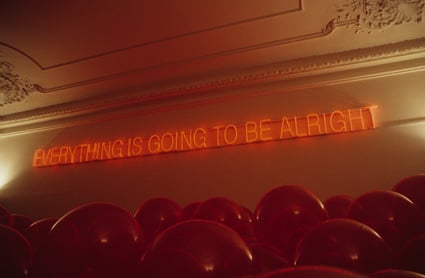
Martin Creed’s Work No. 205 epitomizes the core tenets of Conceptual Art, where the idea or language itself becomes the primary aesthetic object. The piece consists of a simple neon sign—often mounted on a gallery wall or integrated into architectural space—that spells out the phrase “EVERYTHING IS GOING TO BE ALRIGHT.” Its significance lies in the tension between the banality of the message and the context of its display.
1. Authority and Ambiguity of Language
The phrase, rendered in a glowing, commercial-sign format, borrows the visual language of reassurance—a mantra we might see in self-help, advertising, or even religious kitsch. Yet by placing it in a sterile gallery or public space, Creed strips it of any clear origin or authority. Is the statement a genuine promise, a hollow platitude, or a darkly ironic observation? The ambiguity forces viewers to project their own emotional state onto the work, making the piece a mirror of contemporary anxiety and the desire for comfort.
2. Minimalist Intervention and Context
Creed’s signature is the reduction of art to its conceptual skeleton. Here, the installation is little more than tubing and electricity, yet its effect depends entirely on its setting. In a museum, it can feel like a quiet, almost humorous moment of respite; in a contested public space (e.g., a hospital or a political demonstration), it might read as a poignant or even confrontational statement. This site-sensitivity aligns with Conceptual Art’s insistence that meaning arises from the context, not the object.
3. Emotional Paradox
The work’s title, Work No. 205, is deliberately anti-poetic—a bureaucratic label that conflicts with the comforting message. This juxtaposition underscores the absurdity of reducing human emotion to a commercialized slogan. The piece thus becomes a critique of how language is commodified to manage feelings, while also offering a genuine, if fragile, moment of hope. It is simultaneously sincere and cynical, a hallmark of Creed’s play with contradiction.
4. Significance Within Conceptual Art
Work No. 205 belongs to a lineage of text-based conceptual works by artists like Joseph Kosuth or Jenny Holzer. However, where Kosuth deconstructs linguistic meaning and Holzer weaponizes text for political purposes, Creed opts for a disarmingly simple, almost childlike statement. Its power lies in its universality and its refusal to resolve—evoking an emotional response without dictating one. This openness makes it a landmark example of how Conceptual Art can engage the public on a visceral, as well as intellectual, level.
In sum, Work No. 205 (Everything Is Going to Be Alright) is significant because it transforms a cliché into a profound meditation on language, context, and the human need for reassurance, all while staying rigorously true to the conceptual tradition of saying the most with the least.
Visivamente simili
20 opere con composizione e palette affini
Complete & Unabridged
Roberto Chabet

This Is Not a Landscape
Fernando Calhau
Subject and Object
Joseph Kosuth

Untitled
Ron Cooper
Four Colors Four Words
Joseph Kosuth
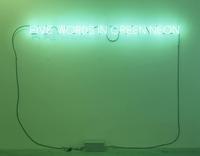
Five Words in Green Neon
Joseph Kosuth
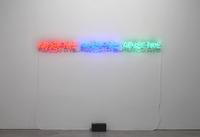
Three Adjectives Described
Joseph Kosuth
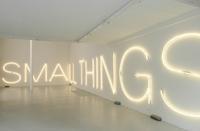
Work No. 275 (Small Things)
Martin Creed
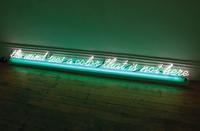
The Mind Sees a Color that Is Not Here
Ron Cooper
One and eight - a description
Joseph Kosuth
Work No. 336 (Feelings)
Martin Creed
I Do Not Own Tate Modern or the Death Star
Pierre Huyghe

After
Dominique Gonzalez-Foerster
Untitled
Jason Rhoades
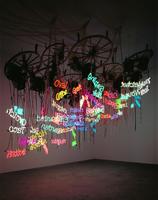
Twelve-Wheel Waggon Wheel Chandelier
Jason Rhoades
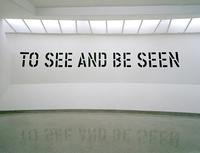
To See and Be Seen
Lawrence Weiner

Trust Yourself
Tracey Emin
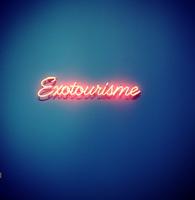
Exotourisme, 2002 (Courtesy Esther Schipper, Berlin)
Dominique Gonzalez-Foerster
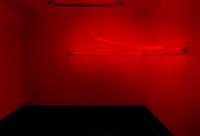
”Monument” 4 for those who have been killed in ambush (to P.K. who reminded me about death)
Dan Flavin
Perfect Door/Perfect Odor/Perfect Rodo
Bruce Nauman