Expert analysis of Albrecht Anker’s Portrait of a boy (Walter Stucki?)
Style: Realism · Genre: portrait
Expert Art Historical Analysis: "Portrait of a boy (Walter Stucki?)" by Albrecht Anker
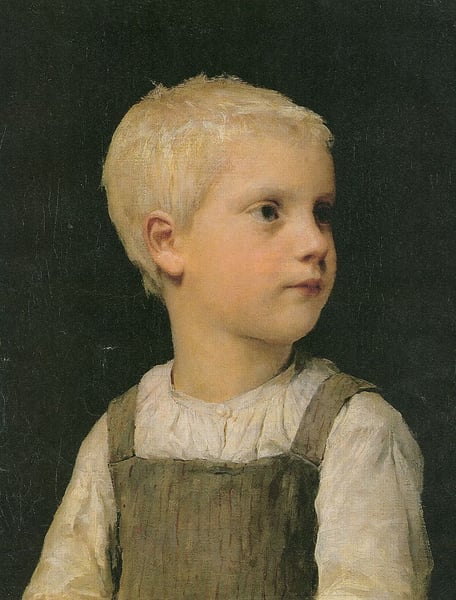
Albrecht Anker (often rendered in English as Albert Anker) was a leading Swiss painter of the 19th century, celebrated for his unwavering commitment to the Realist tradition. This portrait, depicting a young boy tentatively identified as Walter Stucki, exemplifies the core tenets of Realism while offering a window into Anker’s profound sensitivity toward childhood.
Stylistic Significance within Realism
Anker’s work stands out for its meticulous attention to naturalistic detail and unidealized, honest representation. Unlike the Romantic portraiture of the era, which often projected drama or nobility, Anker captures the boy with a quiet, unposed directness. The sitter is not a generalized “child” but a specific individual, complete with the subtle asymmetries of a real face, the nuanced shadows of indoor lighting, and the particular texture of his clothing. This fidelity to observed reality aligns with the Realist movement’s rejection of artificiality—Anker focuses on the mundane truth of a boy’s expression, likely a moment of quiet contemplation or shyness.
The Significance of Childhood in Anker’s Oeuvre
Anker is particularly renowned for his empathetic depictions of children, and this portrait is a prime example. In the context of 19th-century art, children were often sentimentalized or used as allegorical symbols. Here, Anker presents the boy with genuine psychological depth. The tentative attribution “Walter Stucki?” suggests the sitter might have been a real local child, perhaps from Anker’s home village of Ins. By elevating an ordinary boy to the dignity of a formal portrait, Anker underscores the Realist belief that everyday life—and the inner world of a child—deserves serious artistic attention. The boy’s direct gaze, slightly parted lips, and the soft handling of light on his face create an intimacy that invites viewers to ponder his thoughts, making the portrait a subtle study of youth’s quiet solemnity.
Technical Mastery
Anker’s technique reinforces the Realist ideal. The brushwork is controlled and descriptive, rendering the boy’s skin with subtle gradations of warm and cool tones to suggest volume and life. The background is kept neutral and muted, ensuring the viewer’s focus remains on the face and the gentle play of light—a hallmark of Anker’s portraiture. This restraint allows the personality of the sitter to emerge without distraction.
Conclusion
In “Portrait of a boy (Walter Stucki?),” Albert Anker demonstrates why he is considered one of the finest Realist portraitists of the 19th century. The painting is significant not only for its technical virtuosity but for its deeply humanistic approach: it transforms a simple portrait of a child into a timeless meditation on individuality, sincerity, and the beauty of ordinary life. It stands as a quiet but powerful testament to Realism’s capacity to find profound meaning in the familiar.
Visually similar
20 works with related composition and palette
Little Girl with a Blue Bowl
William-Adolphe Bouguereau
Portrait of a boy with cap
Albrecht Anker
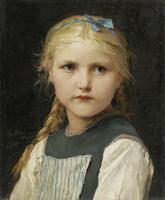
Portrait of a girl
Albrecht Anker
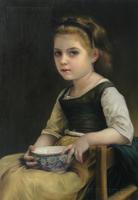
Petite Fille Au Bol Bleu
William-Adolphe Bouguereau
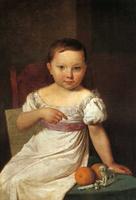
Portrait of Nastya Havskaya
Alexey Venetsianov
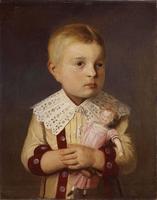
Child with doll
Albrecht Anker
Portrait of a blond girl
Albrecht Anker
Girl with basket of plums
Émile Munier
Girl with Milk
Alexey Venetsianov
Portrait of a boy
Albrecht Anker
Apples
William-Adolphe Bouguereau
A Young Girl in Profile
William-Adolphe Bouguereau
Bildnis Eines Jungen Mädchens
Barbara Krafft
Little redhead with orange
Ludwig Knaus
Girl in Peasant Costume. Probably Gesina the Painter's Half Sister.
Gerard Terborch
Lucy (Study)
Cesare Tallone
Portait of a Young Girl
Alexei Harlamoff
Portrait of child with toys
Alexandre Cabanel
Peasant Girl with a Sickle in the Rye
Alexey Venetsianov
The Fair Spinner
William-Adolphe Bouguereau