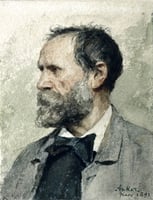
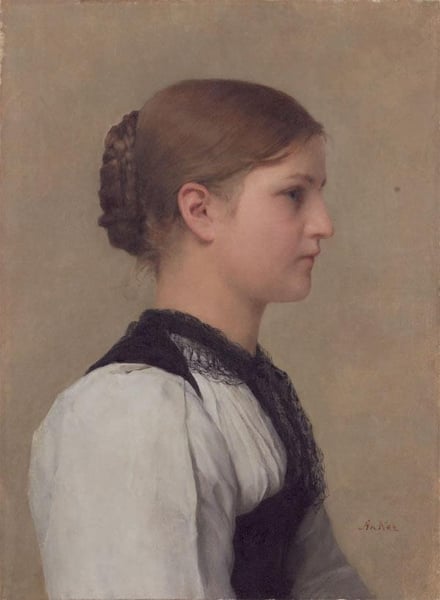
Half-length portrait of a girl in traditional Bernese costume
Details
Expert analysis of Albrecht Anker’s Half-length portrait of a girl in traditional Bernese costume
Style: Realism · Genre: portrait
Expert Analysis: "Half-length portrait of a girl in traditional Bernese costume" by Albert Anker
This work stands as a quintessential example of Swiss Realism in the 19th century, a movement dedicated to the truthful, unidealized depiction of everyday life and regional identity. Painted by Albert Anker (often anglicized as Albrecht), one of Switzerland’s most celebrated artists, the portrait is far more than a simple likeness—it is a document of cultural heritage and a masterclass in subtle psychological observation.
Significance within Realism and Genre While Realism elsewhere (e.g., in France with Courbet or Millet) often focused on the struggles of the rural poor, Anker’s variant is distinguished by its warmth, dignity, and quiet celebration of domestic virtue. This portrait exemplifies that approach. The girl is not a generalized peasant type but a specific individual, presented with meticulous honesty. Her direct gaze, the slight asymmetry of her features, and the unposed naturalness of her expression reject both Romantic idealization and the cold detachment of emerging photography. Instead, Anker captures a fleeting moment of youthful self-awareness, imbuing the sitter with a profound sense of personhood.
Cultural and Historical Dimensions The “traditional Bernese costume” is not mere decorative flourish; it is the central subject of the portrait’s significance. In the late 1800s, Switzerland—a young federal state—was actively constructing a national identity rooted in its diverse rural traditions. By painting a child in regional dress, Anker participates in this cultural preservation, treating the costume with documentary precision: the embroidered bodice, the starched lace cap, the heavy jewelry. Each fold and accessory is rendered with what art historians call optische Treue (optical fidelity), a hallmark of Anker’s technique. Yet the costume never overwhelms the girl’s humanity; rather, it becomes a natural extension of her world, grounding her in a specific time and place without resorting to cliché.
Technical Mastery Anker’s realism relies on controlled chiaroscuro, a restrained palette of earth tones accented by the crisp white of the costume, and a soft, diffused light that models form without harshness. The half-length format focuses attention on the face and hands—the instruments of identity and work. The painting’s smooth, almost invisible brushwork evinces a studio-trained precision that nonetheless feels effortless, avoiding the slickness of academic Salon art. This combination of ethnographic detail and psychological depth makes the work a touchstone for understanding how Realism could serve both art and national memory.
Conclusion Albert Anker’s portrait transcends its genre by elevating a single, ordinary girl into an emblem of Swiss cultural continuity. It is significant because it marries the Realist mission of truth-telling with a gentle, humanistic vision, proving that the most profound art can emerge from the simplest, most authentic subjects.
Visually similar
20 works with related composition and palette
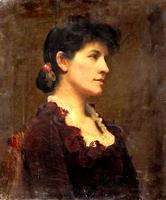
profile woman portrait
Armando Montaner Valdueza
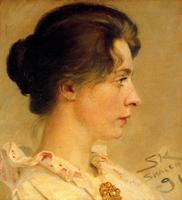
Marie in Profile
Peder Severin Kroyer
Eliza Eastlake
Edward Poynter
Italian girl
Ludwig Knaus
Study for Disappointed Love
Karl Ferdinand Sohn
Profile of a girl
Silvestro Lega
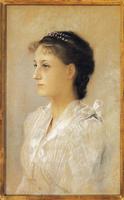
Emilie Flöge, Aged 17
Gustav Klimt
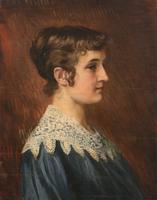
Portrait of Maria Mihaylova-Marushka (the daughter of the archaeologist Karel Škorpil)
Ivan Mrkviсka
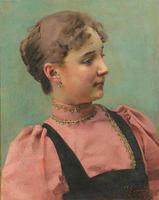
A Portrait of a Young Lady
Vojtech Hynais
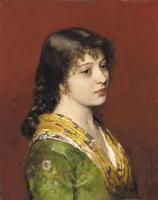
The Yellow Shawl
Eugene de Blaas
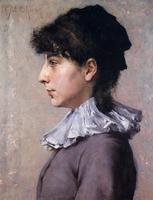
Portrait of Virginia Gerson
William Merritt Chase
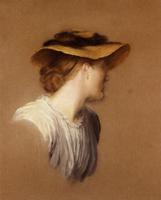
Portrait Of The Artist's Wife Mary
George Frederick Watts
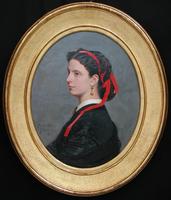
Portrait of Lilia Monti born Countess Magnoni
Giovanni Boldini
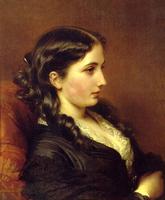
Study of a Girl in Profile
Franz Xaver Winterhalter
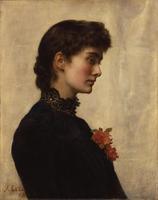
The Artist's Wife, Marion Collier (née Huxley)
John Collier
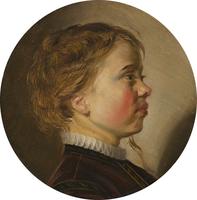
Young Boy in Profile
Judith Leyster
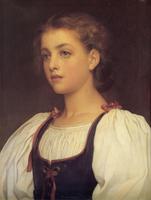
Biondina
Frederic Leighton
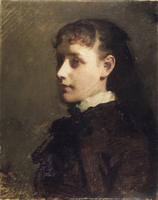
Jessie Jay Burge
Abbott Handerson Thayer
Portrait of a Woman
Pierre-Auguste Renoir
Portrait of E.E. Perov
Vasily Perov