Expert analysis of Carlo Carra’s The Drunken Gentleman
Style: Metaphysical art · Genre: still life
Expert Analysis of "The Drunken Gentleman" by Carlo Carrà
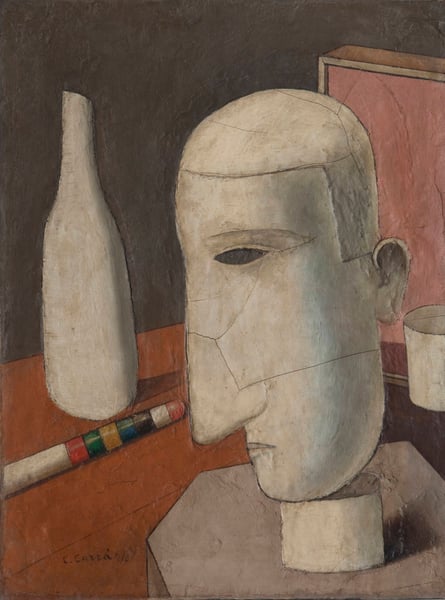
Carlo Carrà’s The Drunken Gentleman is a pivotal work within the brief but influential movement of Metaphysical Art (Pittura Metafisica), a style that emerged around 1917 and profoundly shaped later Surrealism. Painted as a still life, the work exemplifies the movement’s core principles: the unsettling stillness of ordinary objects, the use of unnatural perspective, and a dreamlike atmosphere that questions reality.
Significance within Metaphysical Art
-
A Departure from Futurism: Carrà, formerly a leading Futurist, co-founded Metaphysical Art with Giorgio de Chirico. The Drunken Gentleman marks a radical shift from Futurism’s celebration of speed and dynamism to a frozen, enigmatic world. The “gentleman” is likely a mannequin or tailor’s dummy—a recurring Metaphysical motif—rendered with stark, simplified geometry. Its drunkenness is not literal but symbolic: a state of dislocation, where reason is suspended and the familiar becomes strange.
-
Still Life as Philosophical Inquiry: By categorizing this work as a still life, Carrà elevates the genre from mere decoration to a vehicle for metaphysical speculation. Objects (a bottle, a glass, perhaps a geometrical form) are arranged in a shallow, box-like space with sharp, unnatural shadows. No anecdotal narrative exists; instead, the composition invites the viewer to ponder the gap between the object’s physical presence and its hidden essence. The “drunkenness” suggests a tipping point between order and chaos, sobriety and illusion—mirroring Metaphysical Art’s obsession with the uncanny.
-
Influence on Surrealism and Modernist Still Life: This painting, like other Metaphysical works, directly inspired Surrealist artists (e.g., Magritte, Dalí) who adopted its irrational juxtapositions and psychological tension. Carrà’s treatment of form—firm, volumetric, and eerily clean—also anticipates the “magic realism” of later 20th-century painting. In The Drunken Gentleman, the still life becomes a stage where the ordinary is defamiliarized, and the viewer is left to question what is seen versus what is known.
Conclusion
The Drunken Gentleman stands as a landmark of Metaphysical Art because it encapsulates the movement’s search for a reality beyond appearances. Carrà transforms a humble still life into a disquieting riddle: the gentleman is drunk on a world where logic falters, and objects hold silent, unsettling secrets. Its significance lies in its radical reimagining of painting as a philosophical tool—a quiet, static drama that reshaped the course of modern art.
Museum / Gallery
Genre
Style
Visually similar
20 works with related composition and palette
Frauenkopf
Pablo Picasso
Kondor Béla, Hajnal Gabriella
Kondor Béla
Primitive heads
Constant Permeke
Head
Kazimir Malevich
Kondor Béla, Női Fej
Kondor Béla
Face
Charles Blackman
Study of a Head
Amedeo Modigliani
Portrait of Raymond
Amedeo Modigliani
Head of a man
Pablo Picasso
Untitled
Zdzislaw Beksinski
Green Eye Mask
Amadeo de Souza-Cardoso
Interior of the Atelier
Corneliu Michailescu
Detektiv
Josef Capek
Three Men
Ossip Zadkine
Am Spiegel
Lasar Segall
Head of a man
Pablo Picasso
Dos
Xul Solar
Figure
Jean David
Nude (Bust)
Pablo Picasso
Untitled
Zdzislaw Beksinski