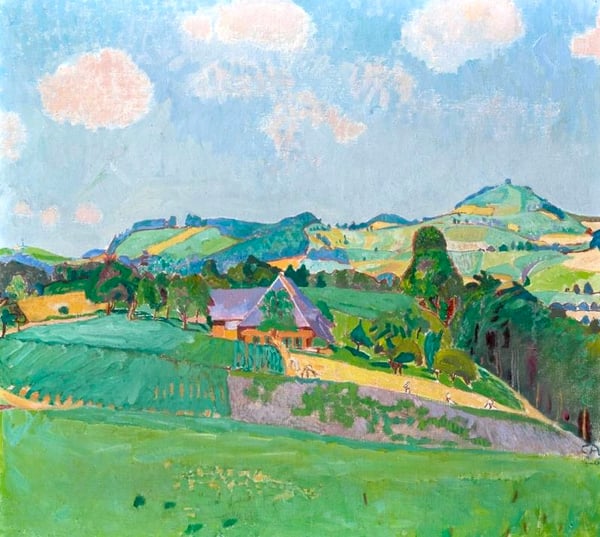
Landscape Near Oschwand
Analisi esperta di Landscape Near Oschwand di Cuno Amiet
Stile: Post-Impressionism · Genere: landscape
Expert Analysis of Landscape Near Oschwand by Cuno Amiet
Cuno Amiet’s Landscape Near Oschwand is a vibrant testament to the artist’s pivotal role in the transition from late Impressionism to early Expressionism, firmly rooted in the Post-Impressionist idiom. Painted in the countryside around his home in Oschwand, Switzerland, the work exemplifies Amiet’s distinctive fusion of Fauvist color theory with a deeply personal, almost spiritual engagement with nature.
Significance within Post-Impressionism
Amiet was a key figure in the Swiss avant-garde, and this landscape demonstrates his departure from naturalistic depiction in favor of heightened emotional and symbolic expression—a core ambition of Post-Impressionism. Rather than recording a literal view, Amiet uses the landscape as a vehicle for pure visual sensation. His brushwork is energetic and broken, reminiscent of Van Gogh’s dynamic strokes, while his palette leans toward the non-naturalistic, high-keyed hues that anticipate the Fauves.
Color as Emotional Catalyst
The significance of Landscape Near Oschwand lies in Amiet’s radical use of color. He juxtaposes complementary tones—vibrant oranges against cool blues, lush greens against magenta shadows—to create a luminous, almost vibrating surface. This chromatic intensity is not merely decorative; it evokes the artist’s subjective experience of the Swiss terrain—its light, its fertility, and its cosmic harmony. The sky may pulse with streaks of rose and yellow, while the fields are rendered in patches of saturated vermillion and emerald, transforming the ordinary into the ecstatic.
Composition and the Sense of Place
Unlike many Post-Impressionists who sought exotic or urban subjects, Amiet found profound artistic meaning in the familiar fields and hills of the Swiss Emmental region. The composition of Landscape Near Oschwand typically employs a high horizon line and a rhythmic, undulating flow of land, drawing the viewer into a meditative immersion. The absence of human figures or narrative distractions focuses attention solely on the elemental dialogue between earth, sky, and light.
Historical Context
Painted during Amiet’s mature period (circa 1910–1920), this work reflects his residence at Oschwand, where he hosted and influenced younger Swiss expressionists. His synthesis of Post-Impressionist structure with raw color energy marks him as a crucial bridge between French Post-Impressionism (Cézanne, Gauguin, Van Gogh) and the German Brücke expressionists, with whom he exhibited. Landscape Near Oschwand is thus significant not only as a beautiful landscape but as a document of how a Swiss master transformed a local vista into a universal statement of chromatic vitality.
Visivamente simili
20 opere con composizione e palette affini
Landscape in Lower Austria
Egon Schiele
Hillside, Springtime, Giverny
Theodore Robinson
The Hills from Hayfield Green
Lucien Pissarro
The Mount Riboudet in Rouen at Spring
Claude Monet
Kmetty Colourful Landscape
Kmetty János
La colline noire
Roderic O'Conor
The Stone of Wall 1
Grant Wood
Giverny Hillside
Guy Rose
Blackpool Vale, Devon
Lucien Pissarro
Spring in the Valley
Willard Metcalf
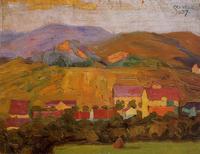
Village with Mountains
Egon Schiele
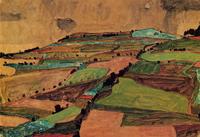
Field Landscape (Kreuzberg near Krumau)
Egon Schiele
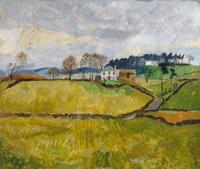
Cumberland Landscape (Northrigg Hill)
Christopher Wood
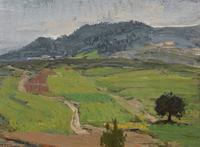
Landscape
Alekos Kontopoulos
View of Pont-Aven from Lezaven
Paul Gauguin
Meadows at Eragny
Camille Pissarro
Campagne
Marcel Charlet
Landscape
Maximilien Luce
Landscape of Creuse at spring
Armand Guillaumin
Landscape
Grant Wood