
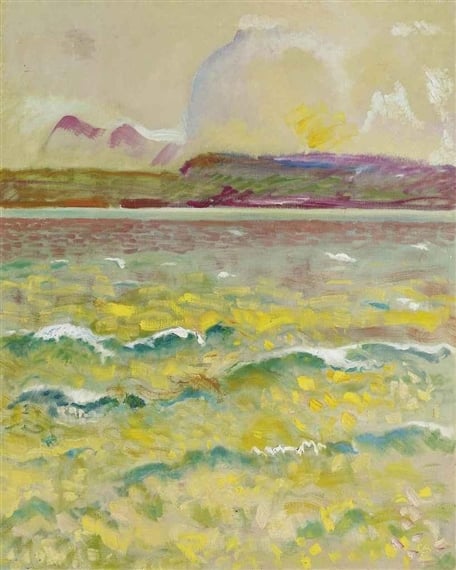
Expertenanalyse zu Cuno Amiets Thunersee mit Wellen
Stil: Post-Impressionism · Genre: landscape
Expert Analysis of "Thunersee mit Wellen" by Cuno Amiet
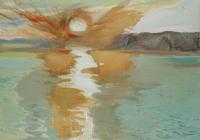
Cuno Amiet’s Thunersee mit Wellen (Lake Thun with Waves) stands as a compelling example of Post-Impressionist landscape painting, distinguished by its bold departure from naturalistic representation in favor of heightened emotional and chromatic intensity. Created during a period when Amiet was deeply engaged with the radical color theories of the Fauves, this work encapsulates the Post-Impressionist drive to convey subjective experience through simplified form and expressive palette.
Significance within Post-Impressionism
-
Color as Emotional Force: True to the Post-Impressionist ethos—and Amiet’s own Fauvist leanings—the painting employs vibrant, unnaturalistic hues to evoke the dynamic energy of Lake Thun’s waves. Rather than mimicking the actual colors of water and sky, Amiet uses deep blues, purples, and greens, often juxtaposed with warm oranges and yellows, to create a visual rhythm that captures the turbulence and luminosity of the scene. This approach aligns with the period’s shift from optical realism to symbolic color.
-
Structural Simplification: The composition reduces the lake, waves, and distant shoreline to broad, sweeping brushstrokes and simplified planes. This flattening of space—reminiscent of works by Paul Cézanne or Vincent van Gogh—emphasizes the two-dimensional surface of the canvas while still suggesting depth through overlapping color zones. The waves are rendered as rhythmic, almost calligraphic strokes, turning a natural phenomenon into a pattern of pure form and movement.
-
Swiss Modernism’s Bridge: Cuno Amiet (1868–1961) is celebrated as a pioneer of modern art in Switzerland. Thunersee mit Wellen illustrates his crucial role in introducing Post-Impressionist and Fauvist ideas to a Swiss audience, merging international avant-garde sensibilities with the local Alpine landscape tradition. The painting’s significance lies not only in its aesthetic achievements but also in its testament to Amiet’s ability to transform a familiar geographical setting—Lake Thun, a beloved subject of Swiss painters—into a vehicle for radical artistic expression.
Conclusion
Thunersee mit Wellen is significant as a vivid demonstration of Post-Impressionism’s core ambition: to use color, form, and brushwork not for transcription, but for transmission of feeling. Amiet’s bold handling elevates a tranquil lakeside view into a charged, almost abstract composition, marking a key moment in the evolution of Swiss landscape painting toward Expressionism.
Genre
Visuell ähnlich
20 Werke mit ähnlicher Komposition und Farbpalette
Landscape with of rhythm
Ferdinand Hodler
Sea etude
Mikalojus Konstantinas Ciurlionis
Marina
Samuel Mutzner
Vaszary János, Balaton
Vaszary János
Barra
Samuel Peploe
Marina del Mar Mediterráneo
Rubén de Luis
Seascape
Bui Xuan Phai
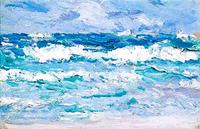
Waves
Samuel Peploe
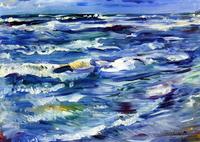
The Sea near La Spezia
Lovis Corinth
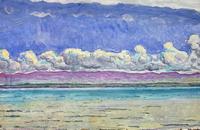
The Lake
Ferdinand Hodler
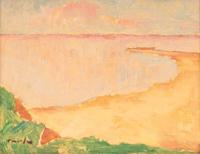
Mangalia Beach
Nicolae Tonitza
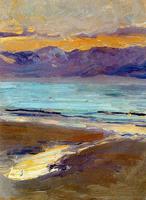
Seashore
Joaquín Sorolla
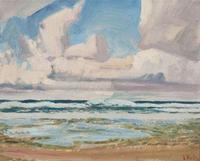
Barbados, B.W.I., Winter
J. E. H. MacDonald
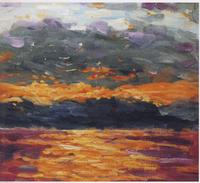
Sunset over the Sea
Winston Churchill
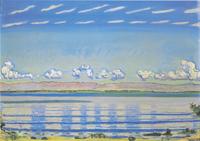
Rhythmic landscape on Lake Geneva
Ferdinand Hodler
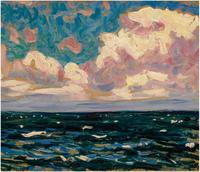
Breeze
Roderic O'Conor
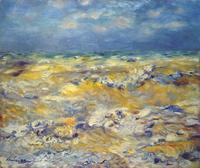
Seascape near berneval
Pierre-Auguste Renoir
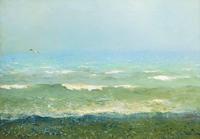
Mediterranean Seacoast
Isaac Levitan
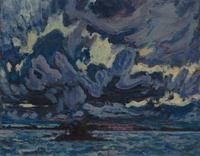
Wind Clouds
J. E. H. MacDonald
Sunset
Panayiotis Tetsis