Analisi esperta di Independence war di Avigdor Arikha
Stile: Expressionism · Genere: symbolic painting
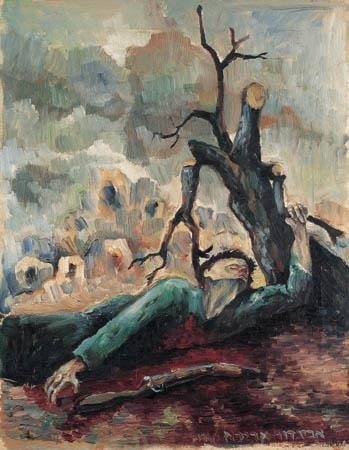
Expert Analysis: "Independence War" (1948) by Avigdor Arikha
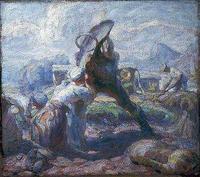
Avigdor Arikha’s Independence War is a pivotal early work that reveals the raw emotional core of his artistic journey before his celebrated turn to realist introspection. Executed in an Expressionist style and functioning as a symbolic painting, this piece stands as a visceral testament to the artist’s firsthand experience of the 1948 Arab-Israeli conflict—a foundational event he participated in as a young soldier. The work’s significance lies in its fusion of personal trauma and national mythmaking, bridging Arikha’s abstract-expressionist roots with a deeply humanist symbolism that would later define his mature oeuvre.
What makes this work significant:
-
Autobiographical immediacy within a national epic: Arikha, a Holocaust survivor who immigrated to Palestine, channeled the chaos and sacrifice of the war into an expressionist language. Rather than a documentary depiction, he uses distorted forms, harsh contrasts, and agitated brushwork to convey the psychological weight of battle. The symbolic elements—perhaps a lone figure, fragmented landscape, or emblematic colors—elevate the scene from a specific event to a universal meditation on survival and renewal.
-
A missing link in Arikha’s evolution: While Arikha is best known for his later hyper-realistic still lifes and portraits (born from a self-imposed break from abstraction), Independence War captures him at a critical juncture. It shows his early commitment to expressive figuration and symbolic narrative, a direction he would soon abandon. The painting thus offers rare insight into the emotional urgency that preceded his famous stylistic conversion—a moment when abstraction still carried the weight of lived experience.
-
Expressionism as a vehicle for historical memory: In the context of mid-century Israeli art, this work stands out for its refusal to idealize. Unlike heroic socialist-realist depictions of the war, Arikha’s expressionist approach registers disorientation and vulnerability. The symbolic genre allows him to compress time and emotion into a single charged image—making the past feel immediate and the personal feel collective.
In sum, Independence War is significant not only as a document of Arikha’s formative years but as a powerful synthesis of expressionist technique and symbolic storytelling. It captures the tension between destruction and creation that defines both the artist’s biography and the birth of a nation, marking a crucial—and often overlooked—chapter in his journey toward clarity.
Genere
Stile
Visivamente simili
20 opere con composizione e palette affini
An Improvised Dressing-station
Austin Osman Spare
Landscape with Cottages
Vincent van Gogh
The Fall of Icarus
Marc Chagall
War Scene
Arturo Souto
Egry József, Pihenő Favágók 1911
Egry József
An Advanced Dressing Station in France
Henry Tonks
Zonnebeke
William Orpen
Demon by the walls of monastery
Mikhail Vrubel
The Harvesters
Paul Cezanne
Untitled
Ilya Isupov
Sapecada
Alfredo Andersen
The death of Captain Franchetti in 1870
Émile Bayard
German Prisoners
Frederick Varley
Attentat de Berezowski contre le tsar Alexandre II
Jean-Baptiste Carpeaux
Smârdan Attack
Nicolae Grigorescu
Soldiers
Ilya Isupov
Paths of Glory
C. R. W. Nevinson
The Sunken Road
Frederick Varley
Potatoes
Ivan Grohar
Untitled
Bui Xuan Phai