Analisi esperta di Standing Nude Woman with Crossed Fingers di Avigdor Arikha
Stile: Expressionism · Genere: nude painting (nu)
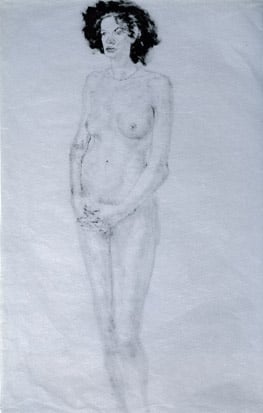
Expert Analysis: Avigdor Arikha’s “Standing Nude Woman with Crossed Fingers”
Avigdor Arikha (1929–2010) occupies a singular position in postwar art: after a successful abstract period, he abandoned non-representational work in 1973, dedicating himself exclusively to drawing and painting from life in a single session, under natural light. This shift positions him as a crucial figure in the late 20th‑century resurgence of figurative realism, but one filtered through the emotional intensity and subjective distortion of Expressionism. “Standing Nude Woman with Crossed Fingers” exemplifies this hybrid approach.
Formal and Thematic Significance
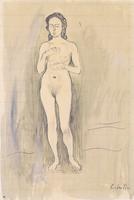
The work’s genre—a nude study—is by its very nature a dialogue with the entire Western tradition, from Renaissance Venus to the modern odalisque. Yet Arikha rejects idealization. The model is neither posed in a mythic narrative nor reduced to abstract form. Instead, she stands plainly, her crossed fingers—a detail both ordinary and psychologically loaded—anchoring the composition in a moment of hesitation, hope, or superstitious gesture. The crossing of fingers becomes the painting’s emotional fulcrum, introducing a note of vulnerability and narrative ambiguity that distinguishes the work from more conventional academic nudes.
Within the Expressionist mode, Arikha does not resort to violent brushwork or garish color. His brush is brisk, even terse, but the modeling is built from light and shadow rendered in a muted, earthy palette—greys, ochres, and flesh tones that seem absorbed from the studio’s northern light. The figure is set against a neutral ground, eschewing props or setting, forcing the viewer’s attention onto the body’s posture and the subtle tension in the fingers.
Significance within Arikha’s Oeuvre and Expressionism
What makes this painting significant is its refusal to choose between two poles: the immediacy of perception (Arikha insisted on painting only what he saw in a fixed moment, never working from memory or imagination) and the expressive charge of gesture. The crossed fingers are a real, observed detail—not a symbolic insertion—but they carry emotional weight precisely because they are left unexplained. This aligns with Arikha’s belief that the task of painting is to capture “the reality of the moment” without narrative commentary, a stance that makes his work a bridge between Expressionism’s psychological truth and the rigorous observation of a Chardin or Velázquez (both influences he openly acknowledged).
In the history of the nude, “Standing Nude Woman with Crossed Fingers” reclaims the body as a site of ordinary, fleeting human experience—fragile, self-conscious, and manifestly present. It stands as a quiet rebuttal to both the depersonalized nudes of Minimalism and the dramatic affectations of earlier Expressionism, asserting that significance can reside in the smallest, most transient gesture.
Visivamente simili
20 opere con composizione e palette affini
Bela Adalbert Czobel, Akt
Bela Czobel
Női Akt
Bela Czobel
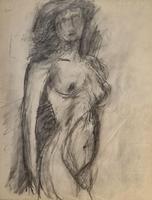
Béla Czóbel Female Nude
Bela Czobel
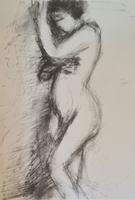
Nude Standing
Bela Czobel
Nude Girl standing
Paula Modersohn-Becker
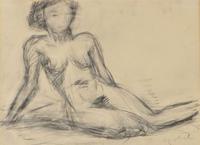
Nude Sitting
Bela Czobel
Untitled
Craig Mullins
Nude
Bela Czobel
Nude
Rupert Bunny
Seated Female Nude
Paula Modersohn-Becker
Bather
Pierre-Auguste Renoir
Nude Model with Drapery
Maurice Prendergast
Anna Margit, Ledér
Anna Margit
The Model
Kuzma Petrov-Vodkin
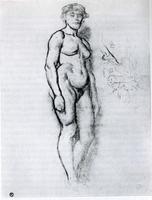
Woman Standing in Semi Profile
Henri de Toulouse-Lautrec
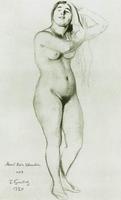
Nude
Boris Kustodiev
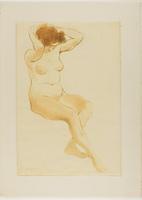
Femme de Trois Quarts Se Coiffant
Theophile Steinlen
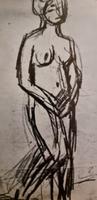
Czobel Bela Nude
Bela Czobel
Female Nude (Study for "Truth")
Ferdinand Hodler
Naked man
George Bouzianis