
Analisi esperta di 4 Self-distorting Grids di Francois Morellet
Stile: Kinetic Art, Minimalism · Genere: installation
Expert Analysis: "4 Self-distorting Grids" by François Morellet
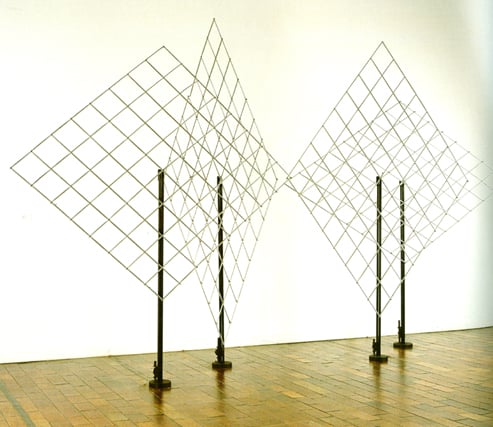
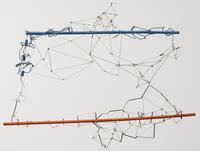
François Morellet’s 4 Self-distorting Grids stands as a seminal work at the intersection of Kinetic Art and Minimalism, embodying a radical rethinking of both traditions. As an installation, it transforms the viewer’s experience from passive observation to active engagement with time, space, and perception.
Formal and Conceptual Innovation
At first glance, the piece presents the archetypal Minimalist grid—a rigid, rational structure that asserts order and neutrality. Yet Morellet subverts this stasis through kinetic self-distortion. The grids are not fixed; they move, warp, and shift via mechanical or optical means, introducing chance and unpredictability. This dynamic defies Minimalism’s typical emphasis on immutable form, injecting a temporal, almost playful instability. The work thus bridges the austerity of Minimalism with the movement-based preoccupations of Kinetic Art, where art exists in a state of perpetual becoming.
Significance within Kinetic Art
Unlike earlier Kinetic works that often relied on viewer motion or simple motorized rotation, Morellet’s grids self-distort—they actively alter their own geometric logic. This internal disruption mirrors the artist’s broader interest in “systematic chance,” where predetermined rules (the grid) yield unpredictable outcomes (the distortion). It challenges the viewer to reconsider order as an illusion, a fragile construct constantly undermined by its own components.
Minimalist Critique and Expansion
The piece also critiques Minimalism’s fetishization of the object. By introducing motion, Morellet dematerializes the grid, turning it into a process rather than a static artifact. This aligns with his famous statement that art should be “boring” to escape subjective expression—yet here, the self-distortion ensures the work never truly stabilizes, keeping the viewer in a state of perceptual flux.
Legacy
4 Self-distorting Grids anticipates later developments in Op Art, computational art, and installation-based participatory works. It is a landmark of French Kineticism and a key example of how Minimalist language could be animated without losing its conceptual rigor—proving that the grid, far from being a prison, can be a generator of infinite, self-deconstructing possibilities.
Visivamente simili
20 opere con composizione e palette affini
PRESSURE WAVE
Rashid Al Khalifa
Hollow Egg
Alexander Calder
Peinture qui perle blanche
Daniel Dezeuze
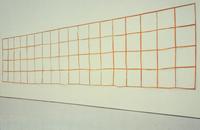
Untitled
Daniel Dezeuze
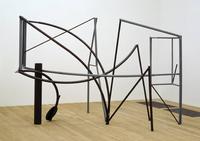
Emma Dipper
Anthony Caro
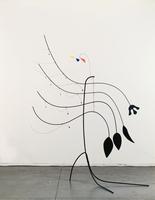
FOUR LEAVES AND THREE PETALS
Alexander Calder
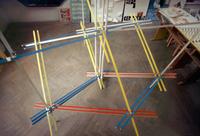
Assembly (Triangulary Bars I)
Constantin Flondor
Con gli specchi
Fausto Melotti
Probably Best Seen in a Dark Room with the T.V. On
Tony Feher
Beading Painting
Daniel Dezeuze
Red Cascade
Alexander Calder
Twelve Soups
Charles Long
Méta-mécanique
Jean Tinguely
Water Line
Maya Lin
Untitled
Fausto Melotti
Yellow Swing
Anthony Caro
Screen
Bill Bollinger
Mobile Stabile
William Turnbull
Shuttler B
William Tucker
Drawing without Paper 84/25 and 84/26
Gego