Analisi esperta di Apres La Pluie. Tarang, Yap di Paul Jacoulet
Stile: Ukiyo-e · Genere: genre painting
Expert Analysis: "Apres La Pluie. Tarang, Yap" by Paul Jacoulet
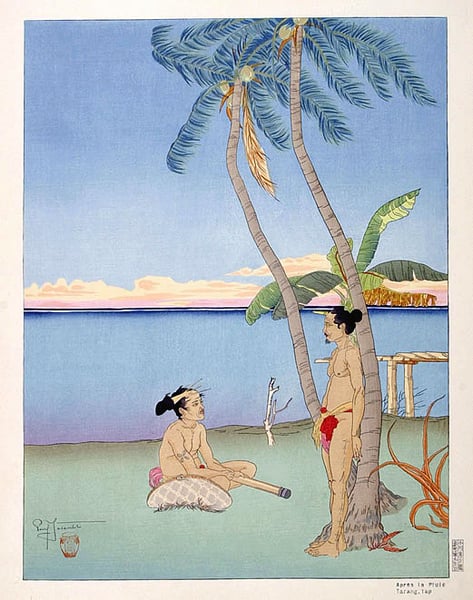
Paul Jacoulet (1896–1960) occupies a unique position in the history of ukiyo-e, blending the technical precision of Japanese woodblock printing with a Western artist’s fascination for the Pacific islands. Created in the mid-20th century, "Apres La Pluie. Tarang, Yap" (After the Rain, Tarang, Yap) is a genre painting that captures a quiet moment of daily life in the Micronesian island of Yap, part of the Caroline Islands. This work is significant for several reasons:
-
Cultural Synthesis and Exoticism: Jacoulet’s prints are among the few ukiyo-e works to depict non-Japanese, non-Western subjects with ethnographic care. Here, he portrays two Yapese women after a rain shower—one holding a palm-leaf umbrella, the other adjusting her traditional grass skirt. Their calm, posed interactions reflect the influence of Japanese bijin-ga (pictures of beautiful women) but translated into a Pacific context. Jacoulet’s attention to costume, posture, and landscape detail offers a romanticized yet respectful view of a culture then under Japanese administration (1914–1945).
-
Technical Mastery in Ukiyo-e: Despite working well after the classical ukiyo-e period, Jacoulet adhered to traditional methods: carved woodblocks, water-based pigments, and hand-printing on washi paper. In this print, the subtle gradation of the wet ground, the translucent effect of the umbrella’s oiled paper, and the layered greens of the foliage demonstrate his exceptional skill with bokashi (color gradation). His palette—soft blues, muted greens, and warm flesh tones—creates a serene, luminous atmosphere, evoking the freshness of the title.
-
Documentation of a Vanishing World: Jacoulet travelled extensively through the Pacific, often living among local communities. "Apres La Pluie" records a specific geographic locale (Tarang, Yap) and a way of life that would soon be disrupted by World War II and subsequent modernization. The print serves as a visual ethnography, preserving the textiles, hairstyles, and material culture of Yapese women in the 1930s–40s.
-
Artistic Legacy: Jacoulet’s work is often cited as a bridge between Eastern and Western printmaking traditions, and between the ukiyo-e genre and the Western tradition of plein-air observation. His prints were popular among expatriates and collectors in Japan and abroad, and today they are valued for their rarity and their role in expanding the repertoire of ukiyo-e beyond Japan.
In summary, "Apres La Pluie. Tarang, Yap" is significant as a masterful example of cross-cultural ukiyo-e: it combines Japanese printmaking heritage with a Pacific subject, offering a poetic, historically valuable glimpse into the daily life of Yap under colonial rule. Its technical refinement and ethnographic content make it a standout piece in Jacoulet’s oeuvre and in the broader history of the medium.
Visivamente simili
20 opere con composizione e palette affini
La Jeune Chef Saragan Et Son Esclave Forum, Tomil, Yap
Paul Jacoulet
Ariwara no Yukihira
Tsukioka Yoshitoshi
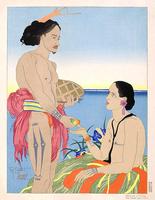
Amoreux A Tarang Yap. Ouest Carolines
Paul Jacoulet
Zwei Mädchen Mit Gegabeltem Baum
Otto Mueller
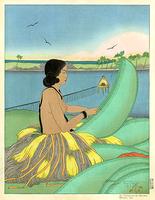
La Tresseuse De Paniers. Remoue, Yap
Paul Jacoulet
Calme Truck
Paul Jacoulet
Le Sculpteur De Tokobuei. Mers Du Sud
Paul Jacoulet
Le Betel Yap
Paul Jacoulet
Zwei Mädchen Mit Gegabeltem Baum
Otto Mueller
The Pearl of the Bamboo, from The Kingdom of the Pearl
Edmund Dulac
Osho Catches Fish for his Stepmother
Utagawa Kuniyoshi
Models Hugs
Katsushika Hokusai
Awabi divers
Kitagawa Utamaro
Tokaido 53 Stations, #D
Utagawa Kunisada
Badeszene Mit Vier Figuren, Haus Und Boot (nach Rechts)
Otto Mueller
Girls pearl-divers
Kitagawa Utamaro
Day of the Gods
Paul Gauguin
The Fuji from Gotenyama at Shinagawa on the Tokaido
Katsushika Hokusai
Yama-uba
Katsushika Hokusai
Zwei Mädchenakte Und Gekreuzte Stämme Am Waldteich
Otto Mueller