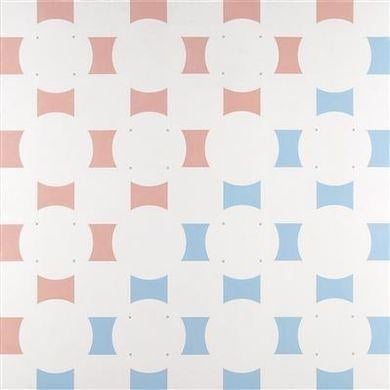
Induzione cromatica (bianco, rosato, azzurrato) e formale (stratificazione alternante dischi e quadri in primo piano)
Details
Expert analysis of Mario Ballocco’s Induzione cromatica (bianco, rosato, azzurrato) e formale (stratificazione alternante dischi e quadri in primo piano)
Style: Op Art · Genre: abstract
Expert Analysis: "Induzione cromatica (bianco, rosato, azzurrato) e formale (stratificazione alternante dischi e quadri in primo piano)" by Mario Ballocco
Mario Ballocco’s Induzione cromatica is a masterful contribution to Op Art, a movement that exploits the physiological and psychological mechanics of vision to create illusions of movement, depth, and vibrating color. This abstract work is significant for its precise, systematic investigation of two core Op Art principles: chromatic induction and formal stratification.
The title itself is a programmatic statement. “Chromatic induction (white, pinkish, bluish)” directs our attention to how adjacent hues—specifically a restrained palette of near-neutrals—can generate afterimages and perceptual shifts. Ballocco likely employed a technique of placing cool, warm, and achromatic fields in close proximity, forcing the retina to “correct” or enhance contrasts. The result is a subtle but persistent flicker, where white appears to take on complementary tints and the pinkish and bluish tones seem to oscillate in intensity.
The “formal (alternating stratification of discs and squares in the foreground)” reveals Ballocco’s structural logic. By layering alternating geometric units (discs and squares) in a shallow, ambiguous foreground, he creates a tension between figure and ground. The repetition of these simple shapes, slightly offset or varied in size, produces a moiré-like effect—a hallmark of Op Art. The viewer’s eye is compelled to scan, unable to settle on a single plane, generating a kinetic sensation despite the static canvas.
Ballocco’s significance lies in his rigorous, almost scientific approach. As a former member of the concrete art group “Movimento Arte Concreta” (MAC), he bridged geometric abstraction with perceptual psychology. Here, he reduces form to its most essential dialectic—the curve versus the angle—and color to a triad of delicate tonalities. The work is not merely decorative; it is an experiment in how the brain constructs spatial order from minimal cues. In the context of Op Art’s 1960s heyday, Ballocco’s piece stands out for its restraint: rather than loud contrasts, it achieves optical vibration through a whisper of pink, blue, and white. This subtlety makes it a sophisticated exemplar of the movement’s ambition to meld art with the science of perception.
Visually similar
20 works with related composition and palette
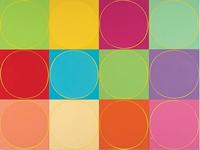
Untitled Circle Painting: 12 multicoloured panels, no.1
Ian Davenport
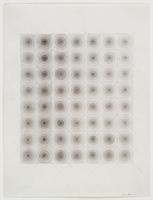
Untitled
Eva Hesse
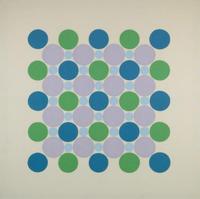
Four Blue Five
Thomas Downing
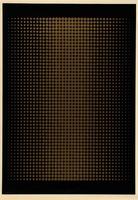
Punktstruktur
Almir Mavignier
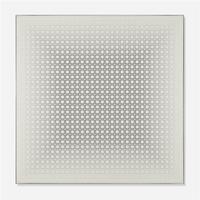
Frigid Light
Julian Stanczak
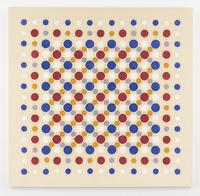
Reel
Thomas Downing
Bianco + Giallo
Dadamaino
I Suppose It Is
Tess Jaray
Fourths
Mark Lancaster
Costellazione
Antonio Calderara
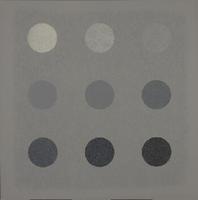
Silver Series
Paul Brach
Untitled (White Flower)
Agnes Martin
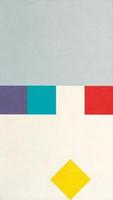
Yellow Detached From the Row
Camille Graeser
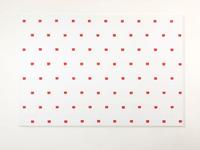
Imprints of a No. 50 Paintbrush Repeated at Regular Intervals of 30 cm.
Niele Toroni
V74-63S
Herman de Vries
Problemi di stratificazione
Mario Ballocco
Quilt
Thomas Downing
Grid #9: Saranac
Thomas Downing
Cassiopée II NB
Victor Vasarely
Grid Twenty-Nine
Thomas Downing