
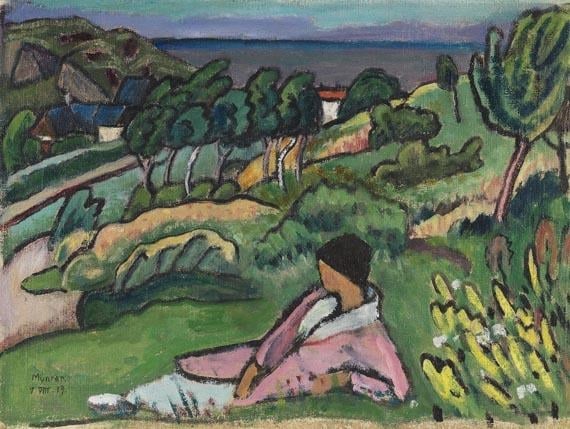
Analisi esperta di Landschaft am Meer di Gabriele Munter
Stile: Expressionism · Genere: genre painting
Expert Analysis of Gabriele Münter’s Landschaft am Meer (Landscape by the Sea)
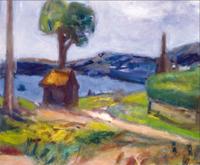
Gabriele Münter’s Landschaft am Meer exemplifies the core aims of Expressionism by transforming a seemingly ordinary genre painting into a vibrant, emotionally charged vision of coastal life. Though only limited facts are supplied, we can draw on the artist’s known methods and the movement’s hallmarks to highlight the work’s significance.
Within the Expressionist Style:
Expressionism rejected naturalistic representation in favor of subjective emotional truth. Münter, a key member of Der Blaue Reiter, achieved this through:
- Bold, non-naturalistic color – likely saturated blues, greens, and yellows to evoke the sea’s energy and the sun’s intensity, not mere observation.
- Simplified, almost abstracted forms – figures and landscape elements reduced to flat, rhythmic shapes, emphasizing inner feeling over surface detail.
- Dynamic, gestural brushwork – visible strokes that convey the artist’s immediate response to the scene, a hallmark of Münter’s intuitive painting method.
As a Genre Painting:
The genre category—scenes of everyday life—allowed Münter to elevate a casual moment (perhaps bathers, fishermen, or promenaders by the shore) into a timeless expression of human connection with nature. Unlike earlier naturalistic genre works, this painting prioritizes mood and sensory experience over narrative. The figures, if present, are likely absorbed into the landscape, suggesting a unity between humanity and the elemental forces of wind, water, and light.
Significance:
- Gender and Modernism – As one of the few prominent female Expressionists, Münter brought a distinctly personal, unmediated perspective to a movement often dominated by male angst. Her Landschaft am Meer demonstrates that Expressionist intensity could arise from serene, everyday subjects, not only urban anxiety or spiritual crisis.
- Bridge to Abstraction – Münter’s simplification of forms pushes the genre scene toward pure shape and color, anticipating the more radical abstraction of later Expressionists. The painting stands as a crucial step in the early 20th-century shift from depicting what we see to expressing how we feel.
- Unflinching Joy – While many Expressionists leaned into darkness, Münter’s work often radiates a clear, joyous vitality. This landscape likely captures the radiant harmony of nature, offering an optimistic counterbalance to the movement’s more tortured works.
In sum, Landschaft am Meer is significant because it synthesizes the emotional immediacy of Expressionism with the accessible intimacy of genre painting, all while asserting Münter’s unique voice as a woman artist redefining everyday life as a site for profound visual poetry.
Genere
Stile
Visivamente simili
20 opere con composizione e palette affini
Seashore
Maurice Prendergast
Sunset at Giverny
Claude Monet
The Sea Seen from Collioure
Henri Matisse
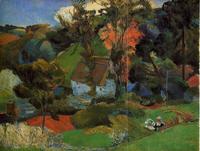
Aven running through Pont-Aven
Paul Gauguin
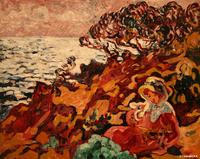
Woman at the Seaside
Louis Valtat
Berény Róbert, Bozótos
Berény Róbert
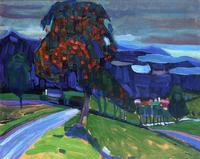
Autumn in Murnau
Wassily Kandinsky
View Close to Antibes
Pierre-Auguste Renoir
Red Rooftops near Marnat
Émilie Charmy
Resnik
Nadezda Petrovic
Midday Landscape
Chaim Soutine
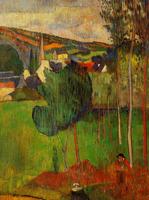
View of Pont-Aven from Lezaven
Paul Gauguin
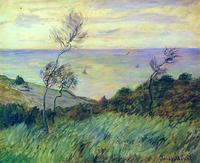
Cliffs of Varengeville, Gust of Wind
Claude Monet
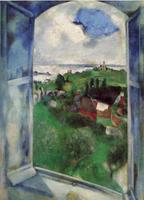
The Window
Marc Chagall
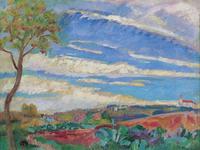
Landscape with a Red Tree
Wojciech Weiss
Czóbel Béla , Szentendre Törökvölgy
Bela Czobel
Breton Landscape - Fields by the Sea (Le Pouldu)
Paul Gauguin
View of the beach at Bellangenai
Paul Gauguin
Spring Dawn on the South Bank of river
Guan Zilan
Zeebrügg Bárkák
Bela Czobel