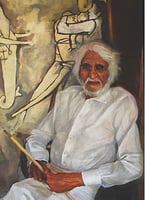
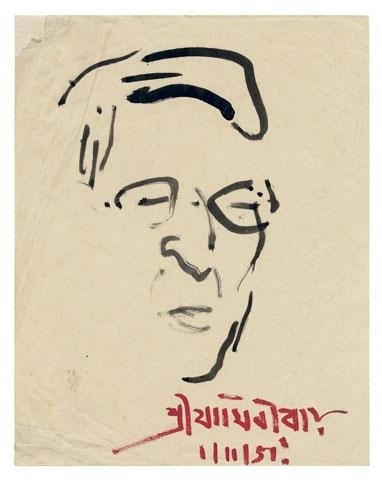
Analisi esperta di Portrait of Jamini Roy di M.F. Husain
Stile: Expressionism · Genere: portrait
Expert Analysis of "Portrait of Jamini Roy" by M.F. Husain
Style & Period Context
Expressionism in India reached a powerful synthesis during the mid-20th century when artists like M.F. Husain merged Western modernist vocabulary with indigenous visual traditions. This portrait belongs to that moment—a period when Indian artists were redefining national identity through a distinctly modern lens. Husain, a founding member of the Progressive Artists’ Group, frequently used bold distortion, vibrant palette, and raw emotional intensity to elevate his subjects beyond mere likeness.
Subject Matter as Tribute
The choice of Jamini Roy—a pioneering figure who himself broke from academic realism by embracing Bengali folk art—is deeply significant. Husain’s portrait becomes a meta-commentary on artistic lineage and rebellion. By depicting Roy in an expressive mode, Husain honors his predecessor’s legacy while asserting his own radical formalism. The portrait is not a passive record; it is a dialogue between two major forces who reshaped Indian modernism.
Expressionist Techniques
In keeping with Expressionism, Husain likely employs:
- Distorted proportions and schematic facial features, emphasizing psychological presence over physical accuracy.
- Swirling, energetic lines (a hallmark of Husain’s horse and figure works) to convey the restless creative spirit of Roy.
- Contrasting, nearly raw colors—perhaps deep maroons, ochres, and blacks—that evoke both folk painting’s earthiness and the angst of modern life.
- Flat, non-illusionistic space, reminiscent of Roy’s own Kanali-stitch-inspired compositions, creating a visual echo.
Significance
This artwork matters because it encapsulates the cross-generational dialogue that defined modern Indian art. It positions Husain as both disciple and revolutionary—admiring Roy’s return to roots while pushing toward bolder abstraction. The portrait functions as a monument to the idea that artistic tradition is not static; it is constantly renegotiated through the expressive act of looking at one’s forerunners. For students of Expressionism, it demonstrates how Western formal techniques were Indianized to serve national narratives—a profound achievement that resonates beyond portraiture into the very definition of modern Indian identity.
Visivamente simili
20 opere con composizione e palette affini
Berény Róbert, Férfi Portré 1908
Berény Róbert
Scheiber Hugó.. . Férfi Portré
Scheiber Hugó
Sobre la guerra
Joy Hester
Delu (Artist’s Brother)
George Stefanescu
Scheiber Hugó Férfi Portré 1941
Scheiber Hugó
Anna Margit, Önarckép 1936
Anna Margit
Illustration for Tristan Tzara's "Vingt-cinq poèmes"
Jean Arp
Scheiber Hugó, Tükrözödő Önarckép
Scheiber Hugó
Unbleached Titanium
Jean-Michel Basquiat
Scheiber Hugó, Férfi Porté 1927
Scheiber Hugó
Two Friends
Toyen
Isaiah Berlin
Lucian Freud
Head Bosshart
Ernst Ludwig Kirchner
Richard Hambleton, Sheadow Head
Richard Hambleton
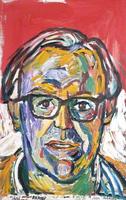
Brian Aldiss
John Bratby
Self Portrait 11
Mehram Sheikholeslami
Bortnyik Sándor, Férfi Portré,
Sandor Bortnyik
Self Portrait
Gregoire Boonzaier
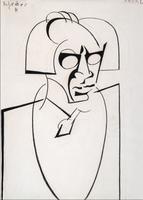
Scheiber Hugó, Harvarth Walden Portré
Scheiber Hugó
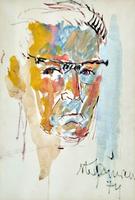
Self-Portrait
George Stefanescu