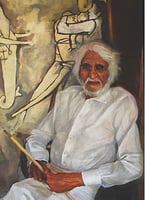
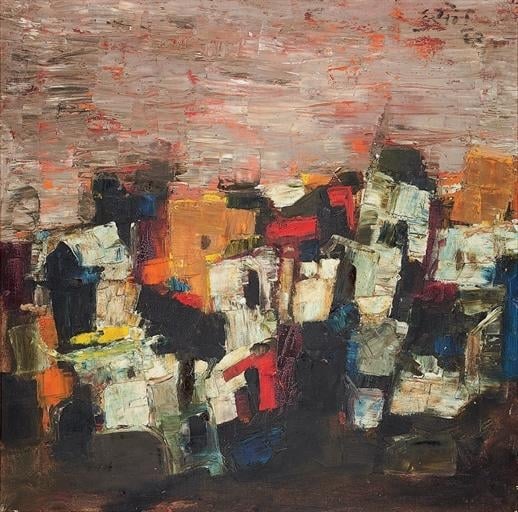
M.F. Husain sanatçısının Untitled (Bundi Landscape) eseri hakkında uzman analizi
Tarz: Abstract Expressionism · Tür: cityscape
Artwork: Untitled (Bundi Landscape)
Artist: M.F. Husain
Style: Abstract Expressionism
Genre: Cityscape
Expert Analysis & Significance
M.F. Husain’s Untitled (Bundi Landscape) stands as a powerful convergence of Western Abstract Expressionism and distinctly Indian visual culture. While Abstract Expressionism—particularly the gestural, all-over compositions of American painters like Jackson Pollock or Willem de Kooning—often pushed toward pure, non-representational form, Husain’s work re-grounds the movement in a specific, recognizable locale.
The choice of Bundi, a historic Rajput city in Rajasthan, is crucial. By filtering this traditional Indian town through the lens of Abstract Expressionism, Husain achieves several significant departures:
-
Fusion of Abstraction and Representation – Unlike many American Abstract Expressionists who retreated from recognizable imagery, Husain retains the cityscape as his subject. His brushwork and energetic mark-making likely dissolve the walls, stepwells, and palace facades into rhythmic, angular strokes, creating a tension between architectural structure and painterly chaos. This hybridity was a hallmark of his broader project: modernizing Indian art without abandoning its roots.
-
Cultural Translation of a Western Style – In the mid-20th century, Husain co-founded the Progressive Artists’ Group, which sought to break from colonial academic traditions while infusing Indian themes with modernist languages. Here, Abstract Expressionism becomes not a wholesale import but a tool to express the felt experience of a Rajasthani town—its heat, light, and density—rather than a literal transcription. The cityscape is thus both a place and an emotional state.
-
Vernacular Color and Line – Abstract Expressionism’s reliance on improvisation and color fields takes on a local character. The vibrant palettes of Indian miniature painting (often associated with Bundi’s own rich artistic heritage) likely inform Husain’s choices, transforming the Western style into something at once global and deeply provincial.
-
Significance within the Period – By the 1950s–1960s, Abstract Expressionism dominated global art discourse. Husain’s Bundi Landscape asserts that a non-Western artist can claim this language while telling a story firmly rooted in Indian geography and history. It expands the definition of Abstract Expressionism beyond New York, proposing a pluralistic, postcolonial modernism.
In sum, Untitled (Bundi Landscape) is significant because it demonstrates how a quintessentially Western movement can be re-territorialized, making Abstract Expressionism speak of monsoons, palace walls, and the labyrinthine streets of Bundi—without ever losing its urgency or scale.
Görsel olarak benzer
İlişkili kompozisyon ve renk paletine sahip 20 eser
Méditerranée 01
Nicolas de Staël
Modok Mária, Képkonstrukcio ,.
Modok Mária
Objets
Alekos Kontopoulos
Paysage méditerranéen
Nicolas de Staël
Interior
Alekos Kontopoulos
Town
Tove Jansson
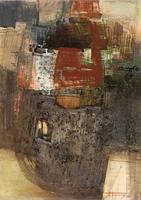
Composition
Alekos Kontopoulos
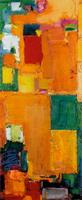
Kaleidos
Hans Hofmann
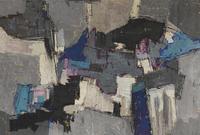
Untitled
Francis Bott
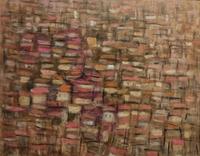
Modok Mária, Házak 1960
Modok Mária
Univéronique
Camille Bryen
The Western Wall
Mordecai Ardon
Composition
Alekos Kontopoulos
Немов Вода (Like Water)
Артемій Присяжнюк
Ciel
Nicolas de Staël
Стрітення (Stritennya)
Артемій Присяжнюк
Time Exposure
Enrico Donati
Поле тяжіння (The field of gravity)
Артемій Присяжнюк
Modok Mária, Képkonstrukció
Modok Mária
Силуети (Silhouettes)
Артемій Присяжнюк