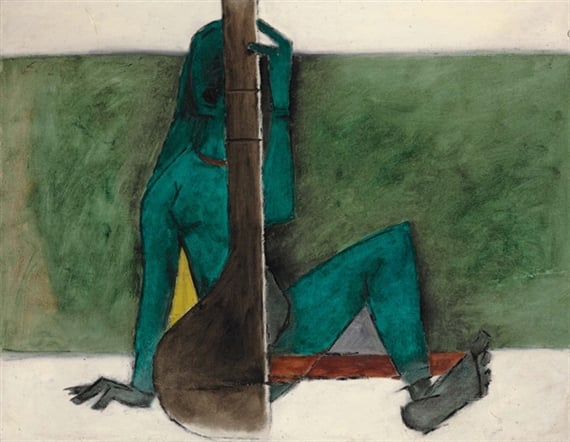
Untitled (Lady with Tanpura)
Expert analysis of M.F. Husain’s Untitled (Lady with Tanpura)
Style: Cubism, Expressionism · Genre: genre painting
Expert Analysis: "Untitled (Lady with Tanpura)" by M.F. Husain
M.F. Husain’s "Untitled (Lady with Tanpura" stands as a quintessential example of his ability to fuse Western modernist idioms with Indian iconographic traditions, a hallmark of his significance in 20th-century art. The work belongs to the genre of genre painting—depicting everyday life—yet transcends mere documentation through its dynamic synthesis of Cubism and Expressionism.
Stylistic Significance:
- Cubist Structure: Husain employs fractured planes and geometric faceting, echoing Picasso and Braque, but applies them to a distinctly Indian subject: a woman holding a tanpura (a long-necked string instrument). The figure is constructed through angular, overlapping shapes that suggest movement and rhythm, mirroring the drone of the tanpura’s sound. This cubist vocabulary is not merely derivative; it is adapted to convey the spiritual and sensory essence of Indian classical music.
- Expressionist Energy: Vivid, aggressive brushstrokes and a bold palette—often deep reds, earthy browns, and stark blacks—inject emotional intensity. The woman’s elongated limbs and distorted proportions are not anatomical errors but expressive devices that emphasize grace, devotion, and the trance-like state of a musician. The face is often abstracted or mask-like, a nod to both tribal art and Husain’s own narrative of anonymity for the female muse.
Thematic Significance:
- Cultural Hybridity: The tanpura is a traditional instrument central to Indian classical music. By rendering it through a cubist lens, Husain bridges the ancient with the modern, the local with the global. This hybridization challenged the postcolonial art world, proving that Indian subjects could be reimagined through avant-garde forms without losing their cultural soul.
- Gender and Iconography: Husain’s female figures are often monumental, restless, and symbolic. Here, the lady is both a performer and an archetype—perhaps a devotee of Saraswati (goddess of arts) or a metaphor for India itself. The cubist fragmentation suggests the multifaceted nature of feminine identity and artistic creation.
Legacy: This work exemplifies Husain’s role as a pioneer of Indian modernism. By rejecting naturalistic representation and embracing the tensions between figurative and abstract, he redefined genre painting as a vehicle for psychological depth and national identity. "Lady with Tanpura" is not just a picture of a musician; it is a visual symphony that reconciles Cubism’s intellect with Expressionism’s passion, all while resolutely rooted in the artist’s Indian heritage.
Visually similar
20 works with related composition and palette
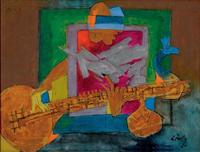
Untitled (Veena Player)
M.F. Husain
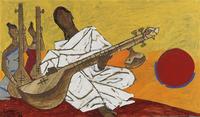
Untitled (Woman Playing Sitar)
M.F. Husain
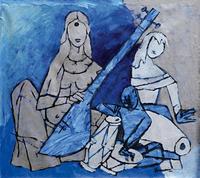
Untitled
M.F. Husain
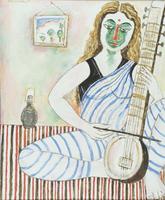
Dilruba Player or Kumundini
Paritosh Sen
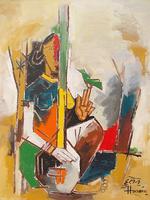
Lady with Veena
M.F. Husain
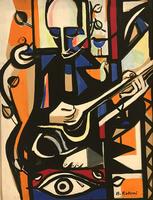
Asik Veysel
Bedri Rahmi Eyuboglu
Untitled
Nzante Spee
ECSTASY
Yervand Kochar
Scheiber Hugó, Táncosnő Bendzsóval
Scheiber Hugó
Scheiber Hugó, Bendzsó.
Scheiber Hugó
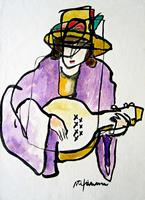
Minstrel
George Stefanescu
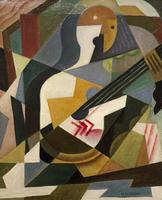
Guitarrista
Maria Blanchard
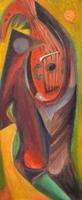
Mujer Y Mandolina
Antonia Eiriz
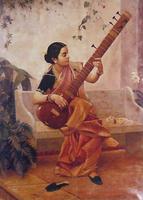
Kadambari
Raja Ravi Varma
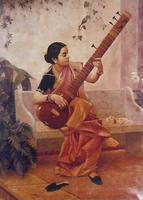
Kadambari
Raja Ravi Varma
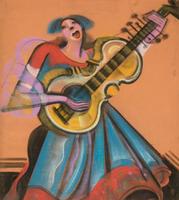
Scheiber Hugó, Zenélő,
Scheiber Hugó
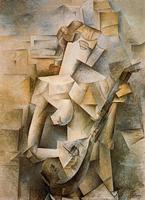
Girl with mandolin (Fanny Tellier)
Pablo Picasso
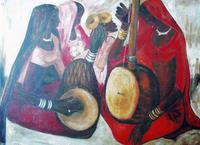
Untitled
Amrita Sher-Gil
Woman with Veena
Raja Ravi Varma
Art Deco Akt
Bela Kadar