Analisi esperta di Untitled (Raj series) di M.F. Husain
Stile: Cubism, Expressionism · Genere: genre painting
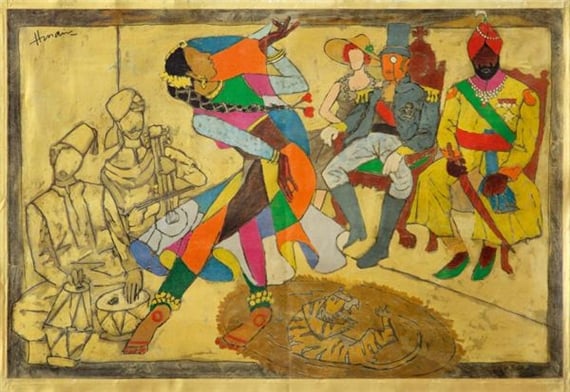
This analysis of M.F. Husain's Untitled (Raj series) is based solely on the provided facts: Style (Cubism, Expressionism) and Genre (genre painting). The work’s significance lies in its masterful fusion of two distinct Western modernist languages—Cubism’s fractured, multi-perspectival structure and Expressionism’s emotive, distorted intensity—to reimagine a deeply Indian subject: the colonial era and its impact on everyday life.
As a genre painting, the piece moves beyond mere anecdotal scene-setting. Husain synthesizes the geometric abstraction of Cubism (borrowing its faceted planes and spatial dislocation) with the raw, psychologically charged brushwork and heightened color of Expressionism. This hybridity allows him to portray the “Raj” not as a historical tableau but as a lived, visceral experience. The Cubist fragmentation suggests the ruptured identities and social structures imposed by colonial rule, while the Expressionist fervor injects a sense of protest, passion, or melancholy.
The work is significant because it embodies a pivotal moment in 20th-century Indian modernism. Husain—a founding member of the Progressive Artists’ Group—was part of a generation that sought to decolonize Indian art not by rejecting Western styles, but by weaponizing them against colonial narratives. In Untitled (Raj series), he appropriates Cubism and Expressionism, originally European tools for depicting modern urban anxiety, to critique the Raj from within. The genre-painting format (scenes from ordinary life) further roots this critique in the everyday, making the political personal. The result is a work that stands as a powerful testament to cultural synthesis, where Western technique becomes a vehicle for Indian identity and anti-colonial sentiment.
Genere
Stile
Visivamente simili
20 opere con composizione e palette affini
Sheherazade
Gosta Adrian-Nilsson
Indo-persian dance
Leon Bakst
The sleeping beauty eastern prince and his page
Leon Bakst
Aide de camp of the Shah, costume design for Diaghilev's production of the ballet Scheherazade
Leon Bakst
The sweet and touching tale of Fleur and Blanchefleur
Eleanor Fortescue-Brickdale
Arugba Osun
Twins Seven Seven
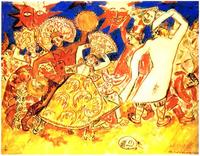
Midnight Sun
Mikhail Larionov
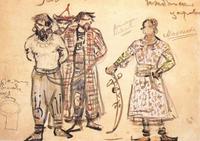
Captured Pechenegs (Costume design for the opera "Rogneda")
Mikhail Vrubel
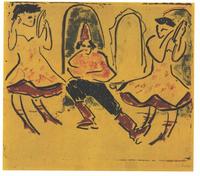
Hungarian Dance
Ernst Ludwig Kirchner
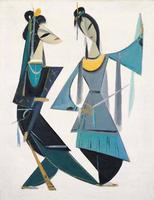
Chinese opera series: Madame Snake White
Lin Fengmian
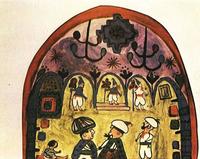
Spectacle "Cossack beyond the Danube"
Maria Primachenko
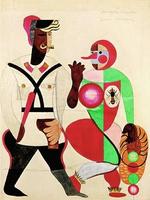
Militiaman and Merchant. Sketch of Costumes for the Play 'Footballer'
Anatol Petrytsky
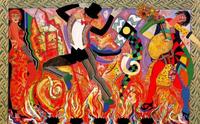
Master of Ceremonies
Miriam Schapiro
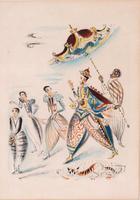
Untitled
Mily Possoz
Clowns Skula and Yeroshka
Nicholas Roerich
Samba
Anita Malfatti
Dancers
Erich Heckel
A Moonlight Music Party
Abanindranath Tagore
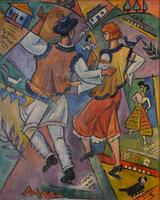
Composition With Romanian Motifs
Corneliu Michailescu
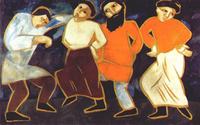
Peasants dancing
Natalia Goncharova