Expert analysis of Kay Sage’s Margin of Silence
Style: Surrealism · Genre: landscape
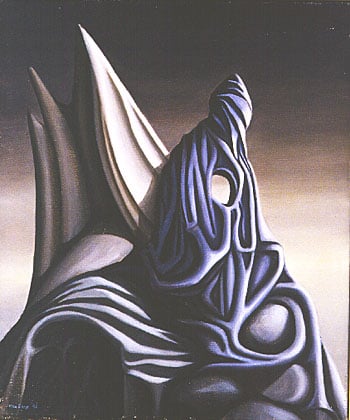
Analysis of "Margin of Silence" by Kay Sage
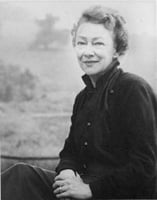
Artist & Style: Kay Sage was a prominent American Surrealist painter known for her highly controlled, architectural landscapes that convey a distinct sense of psychological isolation. While many Surrealists explored the subconscious through organic, biomorphic forms, Sage’s work aligns more with the “veristic” or “illusionistic” branch of Surrealism—pioneered by Giorgio de Chirico and later René Magritte—where dreamlike states are rendered with meticulous, almost photographic precision.
Subject & Genre: Classified as a landscape, Margin of Silence depicts an arid, spare environment dominated by rigid, geometric structures. The composition often features towering scaffold-like frameworks, sharp receding perspectives, and vast, empty foregrounds. The sky is typically flat, luminous, and unnervingly calm. There are no human figures; instead, the viewer is confronted with an architecture of emptiness.
Significance within Surrealism:
-
Gender and Perspective: As one of the few female Surrealists to gain critical recognition in the mid-20th century, Sage brought a distinct voice to the movement. Her landscapes are not the eroticized dreamscapes of male Surrealists but rather meditations on solitude, time, and the psychic weight of silence. The title itself—Margin of Silence—evokes the boundary between sound and stillness, interior and exterior, a theme that runs through much of her oeuvre.
-
Precision and Ambiguity: Sage’s technique is remarkably clean and impersonal, which paradoxically intensifies the emotional charge. The stark geometry and shallow depth of field create a sense of spatial dislocation. Objects such as ladders, walls, and arches suggest incompleteness or transition, yet their function remains ambiguous. This tension between precise form and elusive meaning is a hallmark of her best work.
-
Architectural Surrealism: Unlike Dalí’s melting clocks or Ernst’s frottage, Sage’s surrealism is rooted in architecture and perspective. Her landscapes often resemble forgotten stage sets or ruins of a future civilization. Margin of Silence exemplifies her ability to transform the familiar (a horizon, a structure) into something hauntingly alien—a frozen world that seems to exist just beyond the edge of human perception.
Conclusion: Margin of Silence stands as a significant achievement within Surrealism for its masterful synthesis of technical rigor, psychological depth, and a distinctly female sensibility. Sage’s work challenges the movement’s often masculine iconography by exploring emptiness not as lack, but as presence—a space where silence itself becomes a tangible, architectural force.
Genre
Style
Visually similar
20 works with related composition and palette

The Hidden Letter
Kay Sage
Landscape with Wheatgerm
Max Ernst
From Another Approach
Kay Sage
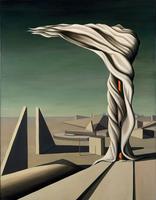
I Saw Three Cities
Kay Sage
Abstract Composition
Tamara de Lempicka
A Young tree
Emily Carr
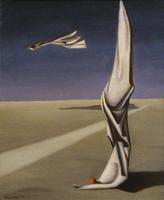
Journey To Go
Kay Sage
Fragment de Liberté
Jacques Hérold
Primavera (Spring)
Giacomo Balla
Imperial Monument of Woma-Child. Gala (Utopian Fantasy)
Salvador Dali
Untitled
Jackson Pollock
Jack-in-the-Pulpit №V
Georgia O'Keeffe
Black Place Green
Georgia O'Keeffe

Nature Forms Gasp
Georgia O'Keeffe
Profanation of the Host
Salvador Dali
Topological Study for 'Exploded Head'
Salvador Dali
Feast of the God
Max Ernst
Untitled
Artin Demirci
Harlequin
Salvador Dali
Wind
Yves Tanguy