Expert analysis of Germaine Richier’s Hurricane Woman
Style: Existential Art · Genre: sculpture
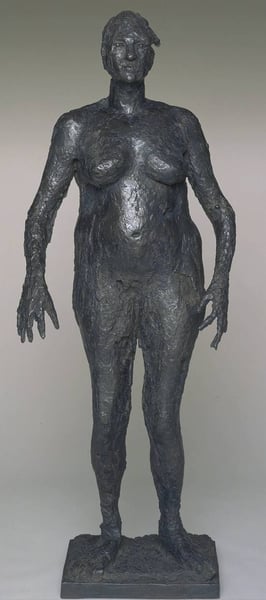
Expert Analysis: “Hurricane Woman” by Germaine Richier
Style & Context
Germaine Richier’s “Hurricane Woman” is a landmark work of Existential Art, a post-World War II movement that foregrounded themes of anxiety, alienation, and the precarious nature of human existence. Emerging in a period marked by trauma and philosophical questioning, this sculpture embodies the existentialist belief that the individual must confront a world stripped of inherent meaning.
Formal & Thematic Significance
As a sculpture, “Hurricane Woman” breaks from classical ideals of harmony and completeness. Richier’s figure is deliberately fractured, with elongated, distorted limbs and a torso that appears both in motion and under duress. The title evokes natural catastrophe, but the “hurricane” is internalized: the woman is not simply battered by external forces but is the storm—a metaphor for the turbulent, conflicted self.
Richier’s technique—rough, uneven surfaces, open gaps, and a sense of organic decay—directly translates existential angst into physical form. The figure’s instability (often leaning, unbalanced) mirrors the existentialist view of the human condition as fundamentally unstable and unfinished.
Significance Within Existential Art
Richier’s work is pivotal because it moves existentialist ideas from philosophy into tangible, visceral sculpture. Unlike the abstract gestures of her contemporaries, she retains the human figure as a site of meaning, but deforms it to express psychological rupture. “Hurricane Woman” stands as a definitive statement of the existentialist aesthetic: the individual as a fragmented, struggling presence in a chaotic world—neither heroic nor tragic, but profoundly, vulnerably human.
Visually similar
20 works with related composition and palette
Storm Man
Germaine Richier
Medo e Desejo
Giancarlo Avantaggiato
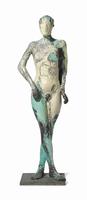
Figure with Legs Crossed
Manuel Neri
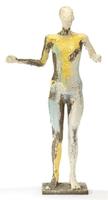
Rosa Negra #1
Manuel Neri
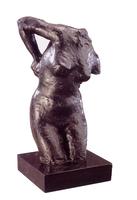
Sitting woman drying herself
Edgar Degas
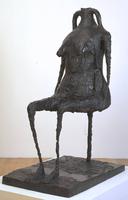
Water
Germaine Richier
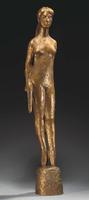
Ballerina, passo di danza
Giacomo Manzu
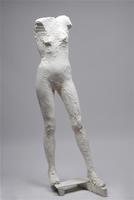
Standing Female Figure
Manuel Neri
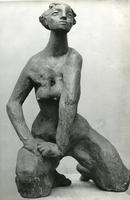
Monument to Burned Down City
Alina Szapocznikow
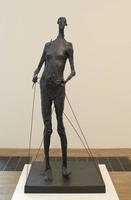
Diabolo
Germaine Richier
Woman
Louise Bourgeois
Hombre Colorado
Manuel Neri
Daughter's necklace
Yannoulis Chalepas
Hero
Allan Kaprow
First Love
Alina Szapocznikow
Tall Figure
Alberto Giacometti
Nude study for Balzac
Auguste Rodin
Cuerpo desnudo
Francisco Serra Andrés
Mafai con i pennelli
Antonietta Raphael
Io (Standing)
Kiki Smith