Analisi esperta di Rue de la Reynarde, Marseilles, France di Edward Wadsworth
Stile: Metaphysical art, Surrealism · Genere: cityscape
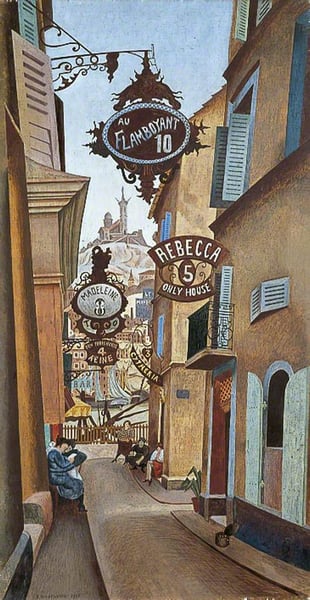
Expert Analysis: "Rue de la Reynarde, Marseilles, France" by Edward Wadsworth
Style & Period Context
This work belongs to Metaphysical art and Surrealism, movements that sought to destabilize rational perception through dreamlike, uncanny imagery. While Wadsworth was a founding member of the British Vorticist movement (known for geometric abstraction and industrial energy), his later shift toward Metaphysical and Surrealist modes marks a crucial evolution in his career—and in British modernism's engagement with continental European avant-gardes.
Significance
The painting’s significance lies in its fusion of Wadsworth’s precise draftsmanship (honed during his Vorticist years) with the eerie stillness characteristic of Giorgio de Chirico’s Metaphysical cityscapes. Here, the bustling street of Rue de la Reynarde—a real location in Marseilles—is transformed into a silent, psychologically charged stage.
- The “Empty Stage” Effect – The narrow, receding street is devoid of human presence, its architecture looming with exaggerated, hard-edged shadows. This emptiness echoes de Chirico’s arcades and piazzas, creating a sense of suspended time and latent anxiety. Wadsworth’s sharp linearity, however, retains a British precision, lending the scene an almost architectural clarity that contrasts with the more painterly atmospheres of Italian Metaphysical works.
- Surrealist Juxtaposition – The work subtly introduces Surrealist dislocation: the street’s perspectival rigor is disrupted by incongruous details (perhaps a tilted sign, an oddly placed shadow, or a window that refuses to align). These elements suggest a dream logic, where the familiar becomes foreign—a hallmark of Surrealism’s attack on conventional reality.
- Cultural Crossroads – By choosing Marseilles, a port city mediating between Europe and North Africa, Wadsworth embeds a sense of transience and cultural dislocation. The street becomes a threshold between the rational (urban planning) and the irrational (the subconscious).
Conclusion
“Rue de la Reynarde” is significant as a rare British example of Metaphysical-Surrealist synthesis. It demonstrates how Wadsworth, rooted in Vorticism’s machine-age energy, refined those formalist skills to evoke the melancholic, uncanny spaces of the European avant-garde. The work thus bridges two major modernist currents, offering a uniquely British inflection on the metaphysical cityscape—rational form rendered irrational, empty yet heavy with meaning.
Visivamente simili
20 opere con composizione e palette affini
Hotel
Charles Demuth
Harbour scene
Arturo Souto
Commonplaces - Where to Unwind the Spool
Max Ernst
Rue du Singe Qui Pêche
Charles Demuth
Naples
Mstislav Dobuzhinsky
Paris street scene
Gerard Sekoto
Collioure. Street with the palm
Zinaida Serebriakova
Street in Montmartre
Rudolf Schweitzer-Cumpana
The Bernot's House
Maurice Utrillo
Olshtin Street
Petros Malayan
Fontenay Aux Roses, probablement la cour intérieure du 24 rue Boucicaut
Fernand Combes
Bicyclettes, Paris, France
C. R. W. Nevinson
Collioure. A street with arch
Zinaida Serebriakova
Plaza in Montmartre
Iosif Iser
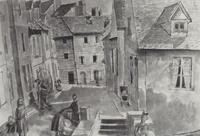
Old Dieppe
Kuzma Petrov-Vodkin
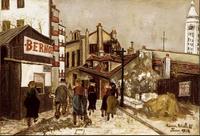
Bernot House
Maurice Utrillo
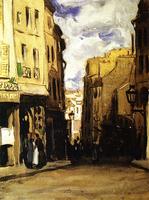
Montparnasse Landscape
Frederick Carl Frieseke
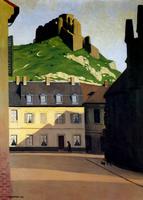
The Strong Castle and the place of Andelys
Felix Vallotton
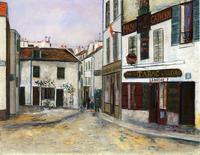
Mother Catherine's Restaurant in Montmartre
Maurice Utrillo
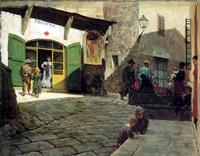
Bakery in Settignano
Telemaco Signorini