Expert analysis of Charlotte Posenenske’s Prototype for Revolving Vane
Style: Conceptual Art, Minimalism · Genre: installation
Expert Analysis: "Prototype for Revolving Vane" (1967) by Charlotte Posenenske
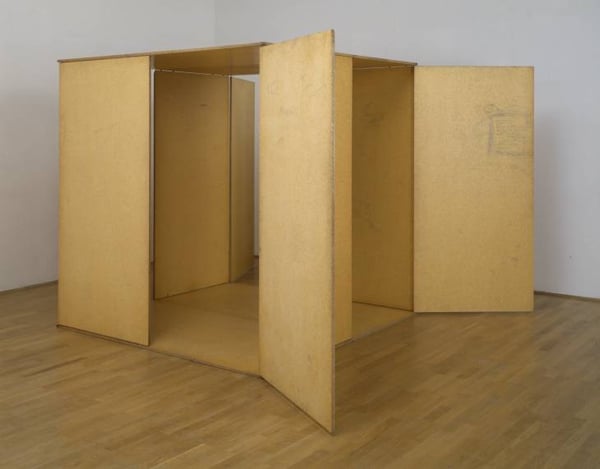
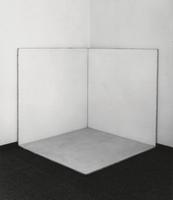
Charlotte Posenenske’s Prototype for Revolving Vane is a landmark work within both Minimalism and Conceptual Art, and it exemplifies the radical shift away from the unique, handcrafted object toward industrially produced, modular forms that invite audience participation. Created in 1967, the work consists of identical, geometric metal panels (often painted in matte black or white) mounted on casters, allowing them to be rotated and rearranged by viewers. This construction deliberately blurs the line between sculpture and functional design, echoing the seriality of industrial manufacturing.
Significance within its style and period:
-
Anti-Commodity Stance: Posenenske rejected the traditional art market by making her pieces reproducible and deliberately low-cost. She authorized unlimited editions and encouraged owners to modify or even mass-produce the works, undermining the scarcity that underpins art’s commercial value. This aligns with Conceptual Art’s emphasis on idea over object and with Minimalism’s use of anonymous, industrial materials.
-
Participatory and Democratic: The revolving vane is not static; it physically requires the viewer to become a co-creator. By rotating the elements, the audience alters the spatial configuration, foregrounding process over fixed composition. This interactive quality anticipates later participatory and installation art, while also challenging the passive spectator role typical of earlier modernism.
-
Seriality and Modularity: The work’s modular design echoes Minimalist principles of repetition and non-hierarchical arrangement, as seen in the sculptures of Donald Judd or Sol LeWitt. However, Posenenske goes further by making the modules moveable, so the artwork’s meaning is never finalized. Each installation becomes a unique event, controlled not by the artist but by the context and the user.
-
Prototype as Art: The title itself—Prototype for Revolving Vane—is significant. It frames the piece as a model for production rather than a finished masterpiece. This reflects a Conceptualist critique of the “auratic” art object (in the sense Walter Benjamin described) and aligns with movements like Arte Povera and Process Art in emphasizing the artwork’s provisional, ever-incomplete nature.
In sum, Prototype for Revolving Vane is a radical synthesis of Minimalist aesthetics and Conceptualist anti-authoritarianism. It remains a prescient example of how art can resist commodification, embrace collaboration, and treat the viewing body as an integral part of the work’s meaning—a legacy that echoes in contemporary installation and relational art.
Visually similar
20 works with related composition and palette
Circuit II
Richard Serra
Untitled (Triangular Columns)
Mary Corse

Your Double-Lighthouse Projection
Olafur Eliasson
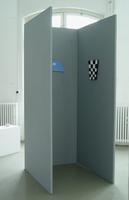
Grey Cell
JCJ Vanderheyden
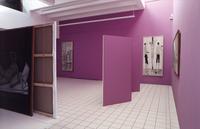
dé-finition/méthode #261: la peinture sort de sa réserve
Claude Rutault
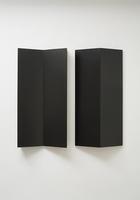
Relief, Series B
Charlotte Posenenske
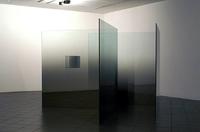
Untitled
Larry Bell
Diamond Column
De Wain Valentine
Canto #1B
Cildo Meireles
Cell No. 4 (Prototype)
Absalon
Anima
Enrico Pinardi
Space Fragment
Stanley Brouwn
It Is Believed That Some Dinosaurs Could Run Faster Than a Cheetah
Julian Opie
En un país lejano, Utopos
Francis Naranjo
Cell No. 1
Absalon
Flacher Raum
Franz Erhard Walther
Pointless Pink House of Art
Jan Maarten Voskuil
moiré glas
Carsten Nicolai
Swinging Curve
Carsten Holler
Ut-op
Giulio Paolini