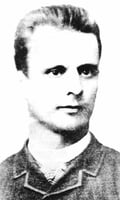
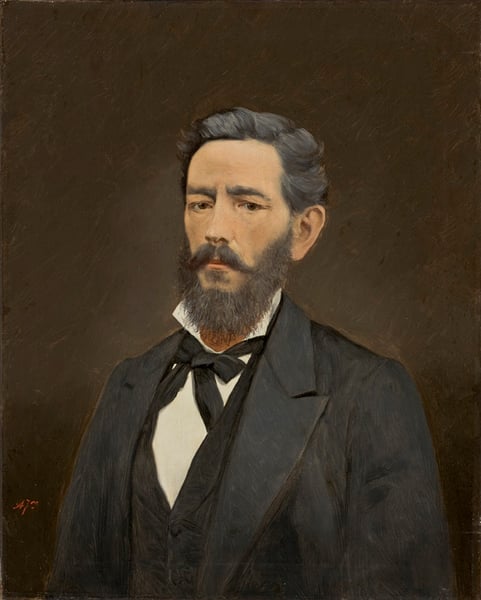
Bust of a Man
Analisi esperta di Bust of a Man di Jose Ferraz de Almeida Junior
Stile: Realism · Genere: portrait
Expert Analysis: "Bust of a Man" by José Ferraz de Almeida Júnior
Significance within Realism and Brazilian Art
José Ferraz de Almeida Júnior (1850–1899) is widely regarded as the foremost Brazilian exponent of 19th-century Realism, and Bust of a Man exemplifies the core tenets of the movement as adapted to a Brazilian context. The work’s significance lies in its deliberate rejection of the idealized, academic portraiture that dominated earlier Brazilian painting (rooted in Romanticism and Neoclassicism), replacing it with a direct, unvarnished study of an ordinary individual.
Key Elements Contributing to Its Importance:
-
Truthful Depiction of the Common Subject:
As a Realist portrait, Bust of a Man focuses on a presumably anonymous sitter—likely a working-class man or peasant—rather than a noble, cleric, or celebrated figure. Almeida Júnior’s choice to elevate the everyday person to the status of fine art was a radical statement in a society still structured by colonialism and rigid social hierarchies. The sitter’s weathered features, unidealized expression, and plain attire convey dignity without sentimentality, aligning with Realism’s mission to portray life as it truly was. -
Technical Mastery in Service of Verisimilitude:
Almeida Júnior’s handling of light, shadow, and texture reflects the Realist emphasis on empirical observation. The modeling of the face—capturing subtle shifts in skin tone, the weight of the jaw, and the effect of light on the brow—demonstrates his academic training (he studied at the Imperial Academy of Fine Arts in Rio de Janeiro and later in Paris under Jean-Léon Gérôme). However, unlike the polished, smooth surfaces of academic portraiture, Bust of a Man retains a slightly gritty, direct quality that emphasizes the sitter’s physical presence and natural humanity. -
Contextualizing Brazilian Realism:
Almeida Júnior’s work is pivotal because it transplants European Realist principles into a Brazilian visual vocabulary. While French Realists like Courbet and Millet depicted rural laborers, Almeida Júnior infused his portraits with the specific ethnic and social diversity of Brazil (often featuring mulatto, caboclo, or caipira subjects). Bust of a Man likely reflects this, as the sitter’s features and bearing suggest a person of mixed heritage—a subtle but powerful assertion that Brazilian identity, rooted in racial and cultural amalgamation, was a worthy subject for high art. -
Transition from Romanticism to Nationalist Modernism:
Almeida Júnior’s Realist portraits bridged the gap between the idealized images of the Empire and the later emergence of a more critical, socially engaged Brazilian modernism. Bust of a Man is not merely a likeness; it is a statement that the nation’s true character resided not in European-style allegories but in the honest, unposed faces of its people. This work thus foreshadows the turn-of-the-century interest in brasilidade (Brazilianness) that would dominate 20th-century art.
Conclusion
Bust of a Man is significant because it distills the core of Realism—truth, observation, and social awareness—into a concentrated portrait. It demonstrates Almeida Júnior’s skill in rendering human presence with stark honesty, while also asserting the dignity of the common Brazilian individual in an era of profound social change. The painting stands as a landmark in the development of a genuinely Brazilian artistic voice, one that looked beyond European conventions to find meaning in the everyday lives of the nation’s people.
Museum / Gallery
Visivamente simili
20 opere con composizione e palette affini
Portrait of the Painter Carolus
Louise Abbéma
Samuel P. Avery
Raimundo de Madrazo
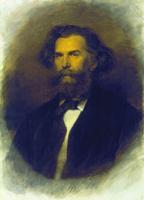
Portrait of A.P. Bogoliubov
Ivan Kramskoy
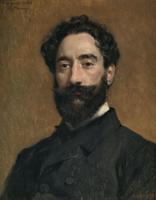
The Engraver Bernardo Rico
Raimundo de Madrazo
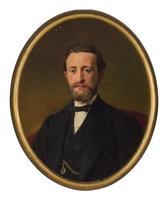
Portrait of a nobleman
Gerolamo Induno
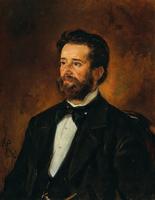
Portrait of Architect Johann De Colle
Anton Romako
Portrait of the Artist K.D. Flavitsky
Fyodor Bronnikov
Portrait of Ivan Kramskoi
Arkhyp Kuindzhi
Self Portrait
John Singer Sargent
Self Portrait
Mårten Eskil Winge
Ivan Goncharov
Ivan Kramskoy
Self-portrait
Fyodor Bronnikov
Charles Ephrussi
Leon Bonnat
Self-Portrait
Richard Caton Woodville Sr.
Self Portrait
Eugène Burnand
Self-Portrait
John Singer Sargent
The painter August Riedel
Leopold Pollak
Portrait of Mr. Pierre Cabanel
Alexandre Cabanel
Francis Holl, the artist's father
Frank Holl
Self-Portrait
Ivan Mrkviсka