
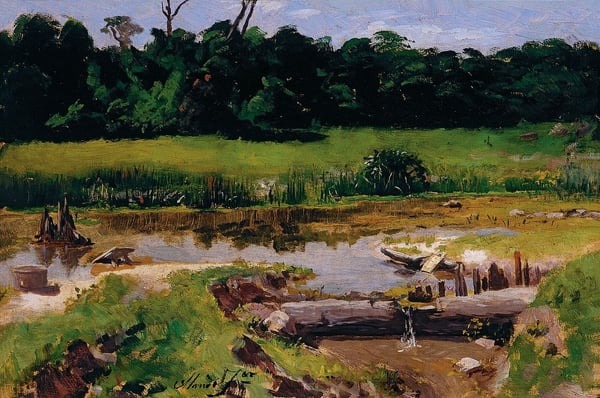
Expertenanalyse zu Jose Ferraz de Almeida Juniors Fluvial Landscape
Stil: Realism · Genre: landscape
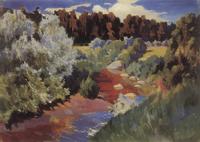
Expert Analysis of "Fluvial Landscape" by José Ferraz de Almeida Júnior
José Ferraz de Almeida Júnior (1850–1899) is celebrated as a foundational figure in Brazilian Realism, and Fluvial Landscape exemplifies the core tenets of that movement within the genre of landscape painting. While the work depicts a seemingly straightforward river scene, its significance lies in how it deliberately breaks from the romanticized, idealized visions of nature that dominated Brazilian art before the 1880s.
Significance within the Realist Style:
Realism demanded an unvarnished, truthful observation of the world, and Almeida Júnior applies this rigorously to the Brazilian countryside. Unlike earlier academic landscapes that often framed nature as a heroic or pastoral backdrop, Fluvial Landscape likely presents a direct, almost documentary view of a river and its surroundings. The artist’s attention to the specific qualities of light, water, and vegetation—recorded with precise brushwork and a muted, natural palette—anchors the painting firmly in the real, observable environment. This approach reflects Realism’s rejection of invention in favor of empirical perception.
Genre and Cultural Context:
Landscape painting in Brazil had long been dominated by the European-influenced paysage tradition, but Almeida Júnior’s treatment asserts a distinctly national identity. By choosing a fluvial (river) scene—likely set in his home state of São Paulo or the surrounding rural interior—he brings attention to the unremarkable yet authentic spaces of everyday Brazilian life. This is not a majestic Amazon vista or a dramatic coastline; it is a humble, working river, perhaps used for transport or local livelihood. In this, the painting aligns with Realism’s interest in the ordinary and the regional, asserting that the Brazilian landscape—even its simplest stretches—deserves serious artistic study.
Artistic Legacy:
Almeida Júnior’s shift toward Realism was both aesthetic and social. Fluvial Landscape likely avoids the symbolic or allegorical embellishments common in earlier Brazilian art, instead offering a document of place and climate. This straightforward gaze influenced later painters who sought to capture the true character of Brazil’s interior, from its rivers to its rural workers. Furthermore, the work demonstrates Almeida Júnior’s mastery of atmospheric perspective and the natural play of light on water—technical achievements that grounded his reputation as the first major Realist landscapist in Brazil.
In summary, Fluvial Landscape is significant not for spectacle, but for its quiet, unflinching fidelity to the real. It asserts that the Brazilian river—its banks, light, and daily stillness—deserves the same rigorous observation as any European subject, marking a turning point in the nation’s art history from romantic idealism to a grounded, truthful representation of the land.
Museum / Gallery
Visuell ähnlich
20 Werke mit ähnlicher Komposition und Farbpalette
The River Vorya at Abramtsevo
Konstantin Korovin
Landscape
Isaac Levitan
Waterfront
Károly Lotz
Landscape
Konstantin Makovsky
Late Afternoon
Robert Julian Onderdonk
Pond
Ivan Shishkin
Forest river
Arkady Rylov
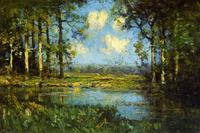
The Woodland Pool
Robert Julian Onderdonk
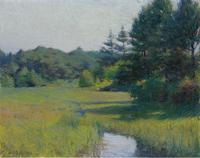
River Scene
Frank W. Benson
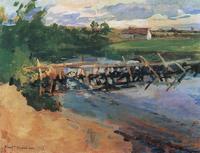
At the pool
Konstantin Korovin
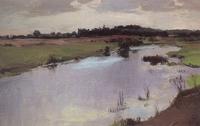
River
Arkady Rylov
Nocturne, Templestowe
David Davies
Woman Standing Near a Pond
Edward Mitchell Bannister
Lake near Breccles in Autumn
Winston Churchill
Landscape
Maxime Maufra
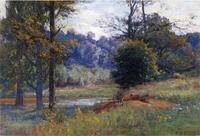
Along the Creek
T. C. Steele
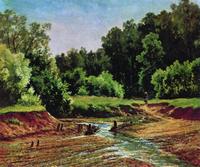
Forest Landscape
Ivan Shishkin
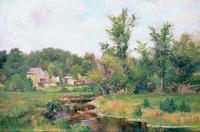
Farm Scene
Willard Metcalf
Lake in the forest
Ivan Shishkin
Landscape with a river
Arkady Rylov