
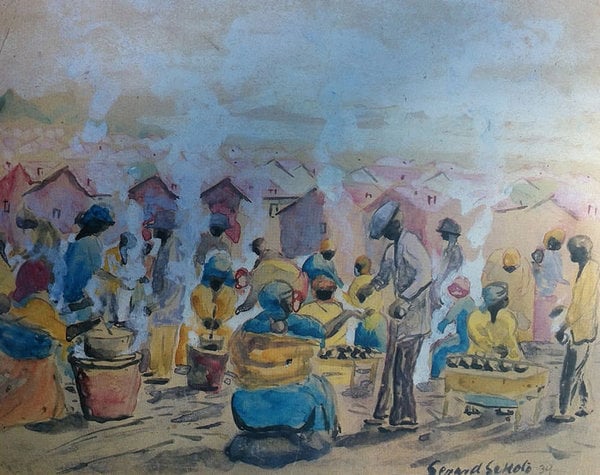
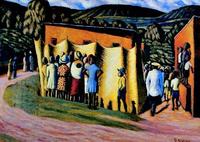
Expert analysis of Gerard Sekoto’s MARKET AT WESTERN NATIVE TOWNSHIP
Style: Social Realism · Genre: genre painting
Expert Analysis: "MARKET AT WESTERN NATIVE TOWNSHIP" by Gerard Sekoto
Painted within the tradition of Social Realism, Gerard Sekoto’s Market at Western Native Township is a seminal work that captures the daily life of Black South Africans under early apartheid-era segregation. As a genre painting, it elevates an ordinary communal activity—the bustling market—into a document of resilience, dignity, and cultural vitality.
Significance within Social Realism:
Sekoto is regarded as a pioneer of modern Black South African art, and this painting exemplifies his commitment to Social Realism—an approach that focuses on the lived experiences of marginalized communities. Unlike the romanticized or exoticized depictions of African subjects common in colonial art, Sekoto presents the market as a self-contained, vibrant economy and social space. The composition emphasizes the energy of the crowd, the exchange of goods, and the subtle interactions between vendors and buyers. This reframes the township not as a site of deprivation, but as a thriving community.
Historical and Cultural Context:
“Western Native Township” was a segregated area for Black Africans in Johannesburg. By depicting a market there, Sekoto visually records a form of survival and resistance: the informal economy that sustained families despite systemic displacement and exclusion from the city’s white-dominated commercial centers. His use of warm, earthy tones and dynamic, slightly flattened figures recalls the influence of European modernists (such as Rouault or the Fauves), but the subject matter is distinctly local and political. The painting becomes a quiet protest—asserting the humanity and agency of people who were systematically dehumanized by apartheid laws.
What Makes It Significant:
- Documentary Value: It provides a rare contemporaneous visual record of daily life in an urban Black township during the 1940s–50s, a period when official photography and media largely ignored such scenes.
- Artistic Synthesis: Sekoto blends European stylistic elements (Post-Impressionist brushwork, Social Realist narrative) with a uniquely South African sensibility, paving the way for later generations of township artists.
- Emotional Resonance: The market is vibrant, not desperate; the figures are active, not passive. This refusal to portray Black life solely through suffering is a key aspect of Sekoto’s legacy.
In sum, Market at Western Native Township is a cornerstone of South African Social Realism—a painting that transforms a simple market scene into a powerful, historically charged statement about community, endurance, and the right to be seen.
Genre
Style
Visually similar
20 works with related composition and palette

BOYS AROUND A BRAZIER, EASTWOOD
Gerard Sekoto
Village Life
Walter Battiss
A5
Amos Langdown
Noon
Albert Huie
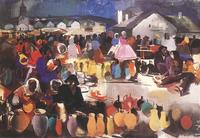
Market of Ceramics
Vilmos Aba-Novak
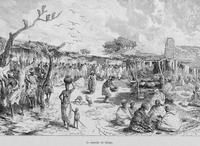
"le Marché De Salaga"
Edouard Riou
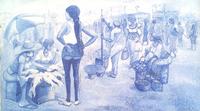
A Lady at Market
Olusola David, Ayibiowu
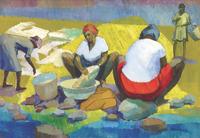
Washer Women
Barrington Watson
STREET SCENE
Gerard Sekoto
An African Scene
Walter Battiss
GOING HOME
Gerard Sekoto

Come and Buy Fish
Olusola David, Ayibiowu
Village Market in Cardoso
Amadeo de Souza-Cardoso
Indaba
Gerard Sekoto
Black Tent
John Singer Sargent

WOMEN AND CHILD, EASTWOOD, PRETORIA
Gerard Sekoto
Les Laveuses Au Bord De La Mer
Hélène de Beauvoir
Lotsani Ruins, Limpopo
Walter Battiss
Soko Majoka (Sixpence a Door)
Gerard Sekoto
Abstract painting of figures
Walter Battiss