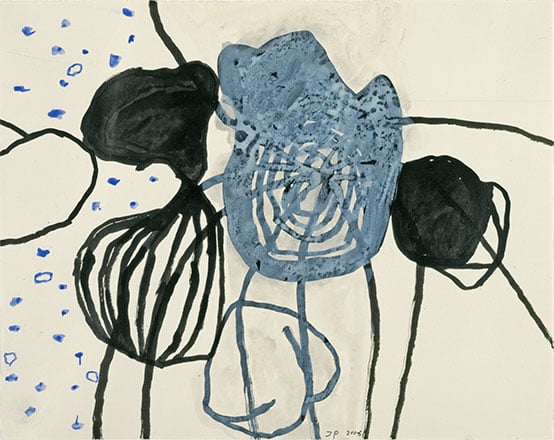
Analisi esperta di Fulgor Oscuro (IV of VI) di Jurgen Partenheimer
Stile: Abstract Expressionism · Genere: abstract
Expert Analysis of "Fulgor Oscuro (IV of VI)" by Jurgen Partenheimer
Style & Context:
Although classified under Abstract Expressionism, Partenheimer’s work represents a more contemplative, European inflection of the movement—one that tempers the raw emotionalism of American gestural painting with rigorous compositional discipline and philosophical introspection. "Fulgor Oscuro (IV of VI)" belongs to a series of six, suggesting a cyclical or serial exploration of a single poetic idea. The title itself—Spanish for "Dark Glow" or "Obscure Splendor"—points to a core tension: the visual dialogue between illumination and shadow, presence and absence, structure and dissolution.
Visual Language:
Drawing on the vocabulary of lyrical abstraction, Partenheimer likely employs delicate, calligraphic marks suspended in vast, muted fields of color. The work is not about explosive gesture but about the calibrated balance of a single line, a wash of pigment, a charged void. Each element carries a meditative weight. The "dark glow" implies that even the deepest, most recessive areas of the composition emit a subtle radiance—a luminosity achieved through nuanced layering, unprimed canvas, or the interplay of matte and reflective surfaces.
Significance within Abstract Expressionism:
-
Reorientation of Gesture: Where Abstract Expressionists like Pollock or de Kooning used gesture as raw emotional outburst, Partenheimer refines gesture into an act of precision. His marks are intentional, often spare, evoking Eastern calligraphy and the legacy of European modernism (Klee, Mondrian). This work demonstrates that Abstract Expressionism’s freedom can coexist with control and restraint.
-
Philosophical Depth: The series format—"IV of VI"—underscores a process of repetition with variation, inviting the viewer to track subtle shifts in mood and form. This seriality connects Partenheimer to conceptual concerns more typical of Minimalism, enriching Abstract Expressionism with a temporal, almost musical structure. "Fulgor Oscuro" becomes a meditation on the instability of perception: how darkness can seem to hold light, how form emerges from the formless.
-
Cross-Cultural Synthesis: Partenheimer’s practice merges Western abstraction with a Zen-like sensitivity to emptiness and the power of the singular brushstroke. In "IV of VI," the void is not a lack but an active presence—a "dark glow" that resonates as strongly as any painted mark. This integration positions the artwork as a bridge between Abstract Expressionist vitality and the quiet, elemental language of Minimalist and Post-Minimalist art.
Conclusion:
"Fulgor Oscuro (IV of VI)" is significant because it expands the definition of Abstract Expressionism beyond the heroic, large-scale gesture into a realm of intimate, cerebral beauty. It exemplifies how European abstraction recontextualized American spontaneity through a lens of restraint, seriality, and existential lyricism. The work is a luminous pause—a subtle, powerful statement on the coexistence of opposites that defines much of Partenheimer’s enduring influence.
Genere
Visivamente simili
20 opere con composizione e palette affini
Untitled
Atsuko Tanaka
Black strokes I
Wassily Kandinsky
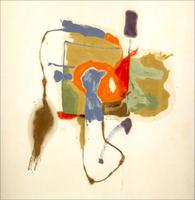
Blue Form in a Scene
Helen Frankenthaler
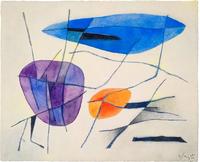
Soleil/Maree basse I
Gustave Singier
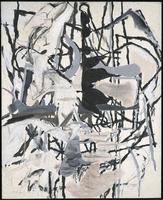
Early Morning Garden
Perle Fine
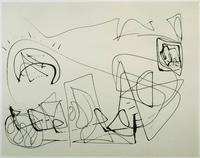
Drawing [D182]
Morris Louis
Untitled
Samuel Buri
After Botticelli 3
Brice Marden
Work
Atsuko Tanaka
Untitled
Brice Marden
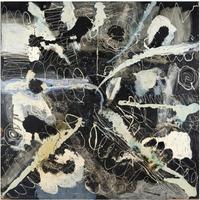
Work-K-61
Matsutani
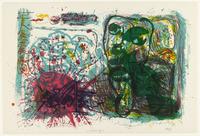
Aleching
Pierre Alechinsky
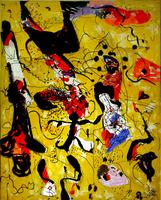
The Street II
Romul Nutiu
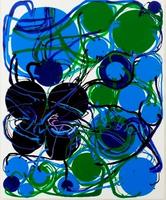
89m
Atsuko Tanaka
Solstice
Hans Hofmann
Untitled
Aki Kuroda
Untitled
Alexander Calder
Untitled
Artin Demirci
Age de fer II
Pierre Tal-Coat
Agway
James Brooks