Expertenanalyse zu Xu Beihongs Slave and Lion
Stil: Romanticism · Genre: genre painting
Expert Analysis of "Slave and Lion" by Xu Beihong
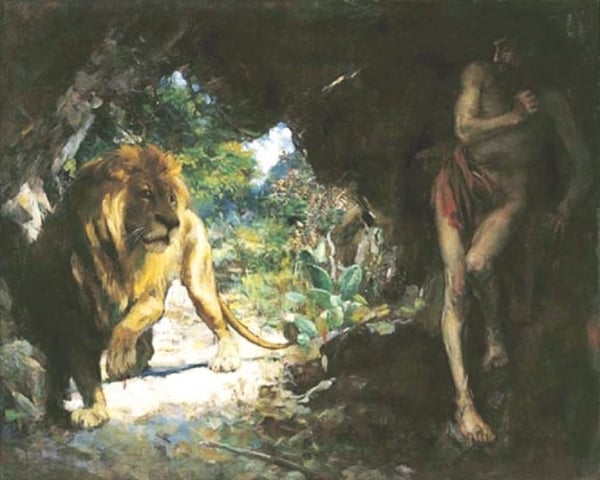
In Slave and Lion, Xu Beihong masterfully synthesizes the emotional intensity of European Romanticism with a distinctly Chinese humanist sensibility, creating a work that is both a technical tour de force and a profound moral allegory. The painting depicts the ancient story of Androcles—the Roman slave who wins the gratitude of a lion by removing a thorn from its paw—though Xu recasts this tale with his characteristic fusion of Western composition and Eastern ink-wash fluidity.
Stylistic Significance within Romanticism
Xu, trained at the École des Beaux-Arts in Paris, channels the Romantic fascination with raw emotion, exoticism, and the sublime power of nature. The lion is rendered with a muscular, almost theatrical dynamism—its mane swept by an invisible wind, its posture a coiled blend of pain and trust. The slave, in turn, is not a passive victim but a figure of compassionate agency, his body angled in a heroic contrapposto that echoes classical sculpture. Xu uses dramatic chiaroscuro (a hallmark of Romantic painting) to heighten the tension: deep shadows pool in the cave background, while a shaft of light illuminates the critical moment of contact between man and beast, emphasizing a transcendent connection that overcomes social hierarchy.
Genre Painting as Moral Philosophy
While the work fits the genre of "genre painting" (depicting everyday or historical scenes), Xu elevates it into a universal meditation on empathy and liberation. The painting was created during a period of national turmoil in China (the 1930s–40s), when Xu was actively advocating for art that could "reform the national spirit." Here, the slave’s act of kindness is not an escape from bondage but a redefinition of freedom—a theme deeply resonant for a China struggling against colonial powers and internal strife. By choosing a Roman narrative, Xu also aligns Chinese humanism with a Western classical tradition, demonstrating that compassion transcends cultural boundaries.
Technical Innovation and Legacy
What makes Slave and Lion truly significant is Xu’s bold integration of Western oil-painting techniques (modeling of form, atmospheric perspective) with the calligraphic energy of Chinese ink painting. The lion’s fur is built from energetic, layered brushstrokes that recall the “bone method” of traditional Chinese painting, while the slave’s skin tone is modeled with subtle Western tonalities. This synthesis was radical in Xu’s time: he argued that Chinese art could modernize without losing its soul, and this painting stands as a manifesto for that belief.
In sum, Slave and Lion is not merely a genre scene; it is a bridge between two worlds—the poetic tradition of Chinese literati painting and the emotional narrative of European Romanticism—and a timeless call to recognize our shared humanity even in the most unequal of relationships.
Visuell ähnlich
20 Werke mit ähnlicher Komposition und Farbpalette
The King Drinks
Briton Riviere
Lion Rending Apart a Corpse
Eugene Delacroix
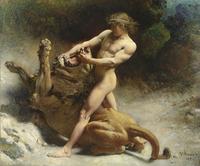
Samson’s youth
Leon Bonnat
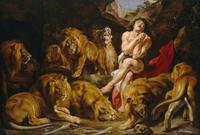
Daniel in the Lion's Den
Peter Paul Rubens
Sketch for 'Daniel in the Lion's Den'
James Ward
The Effect of Disobedience
James Ward
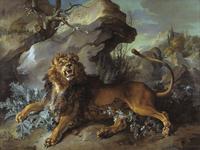
The Lion and the Fly
Jean-Baptiste Oudry
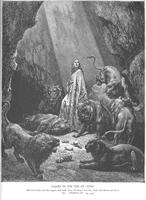
Daniel in the Den of Lions
Gustave Dore
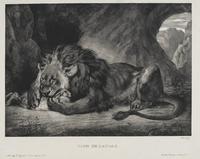
Lion of the Atlas
Eugene Delacroix
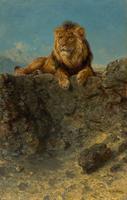
Enthroned lion
Ludwig Knaus
Fight between a Lion and a Tiger
James Ward
Lion and alligator
Eugene Delacroix
From the series 'Repressiveness of the Beautiful Hero'
Kateryna Lysovenko
Lying Lions
Théodore Géricault
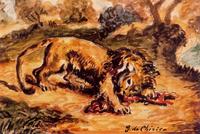
Lion devouring a piece of meat
Giorgio de Chirico
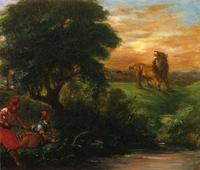
The Lion Hunt
Eugene Delacroix
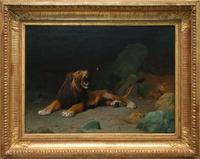
Lion Snapping at a Butterfly
Jean-Leon Gerome
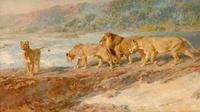
On the Bank of an African River
Briton Riviere
Untitled
Basuki Abdullah
Lion with lioness
Antonio Ligabue