Экспертный разбор работы «Je rêvais (1ère version)» художника Le Corbusier
Стиль: Cubism, Surrealism · Жанр: symbolic painting
Expert Analysis: "Je rêvais (1ère version)" by Le Corbusier
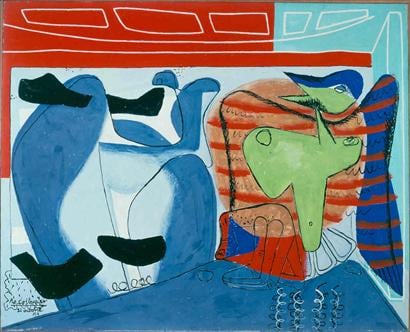
Le Corbusier’s Je rêvais (1ère version) (c. 1933–1934) stands as a pivotal intersection between two seemingly opposing movements—Cubism and Surrealism—while also revealing the artist’s unique ability to translate architectural thinking into symbolic, dreamlike painting. Known primarily as the father of modern architecture, Le Corbusier (Charles-Édouard Jeanneret) was also a rigorous painter. This work, whose title translates to “I was dreaming,” occupies a significant place in his transition from the rational, purified geometries of Purism (a disciplined offshoot of Cubism) toward a more personal, mythopoetic Surrealism.
Stylistic Hybridity and Symbolic Ambiguity
The painting fuses Cubist spatial fragmentation—overlapping planes, tilted perspectives, and a muted earthy palette—with Surrealist iconography: biomorphic forms, floating objects, and an inexplicable, dreamlike atmosphere. Le Corbusier retains the structural clarity of his earlier architectural schemas (the “object-type” bottles, glassware, and musical instruments typical of Purism), but now they dissolve into ambiguous, often eroticized shapes. The composition feels like a memory or a half-recalled vision, where everyday objects lose their functional identity and become symbolic vessels for the subconscious. This hybridization is significant because it demonstrates that Le Corbusier never abandoned Cubism’s analytical dissection of form; instead, he infused it with the psychological depth of Surrealism, creating a private visual language that prefigures his later, more openly mythical works like the Ubu series.
Bridging Architecture and the Unconscious
For Le Corbusier, architecture was a “machine for living,” governed by proportion and function. Je rêvais challenges that dogma by suggesting that even the most rational forms can be inhabited by dream and desire. The painting’s significance lies in its role as a laboratory for architectural ideas: the stacked, cubic volumes and floating planes echo the modular, open-floor plans of his contemporaneous villas, yet they are rendered unstable and mobile—as if the building itself is dreaming. This tension between order and irrationality defines the work’s importance: it reveals that the same mind which designed the Villa Savoye could also create a lyrical, uncanny world where geometry becomes reverie.
Art-Historical Context
Created during a period when Surrealism was at its peak—and when Le Corbusier was increasingly drawn to primitivism and organic forms (evident in the Cité de Refuge and the Pavillon Suisse)—the painting marks a deliberate break from the strict Purist doctrine he had co-founded. Je rêvais (1ère version) is thus a manifesto of artistic liberation: it shows Le Corbusier embracing the irrational as a necessary complement to his architectural rationalism. Its “first version” status further underscores its experimental nature—a trial run for a personal mythos that would culminate in his later works such as Femme couchée and the monumental Unité d’Habitation sculptures.
In sum, this painting is significant not as a mere curiosity by a famous architect, but as a crucial document of the cross-pollination between Cubist structure and Surrealist symbolism, and as a window into Le Corbusier’s lifelong quest to reconcile the measured with the numinous.
Стиль
Визуально похожие
20 работ с близкой композицией и палитрой
I was dreaming (first version)
Le Corbusier
Taureau XI
Le Corbusier
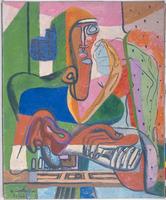
Portrait de femme à la cathédrale de Sens
Le Corbusier
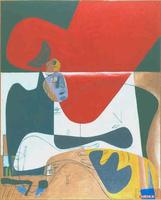
Icône 3
Le Corbusier
Untitled
Louis Schanker
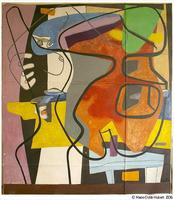
Peinture murale, 35 rue de Sèvres à Paris
Le Corbusier
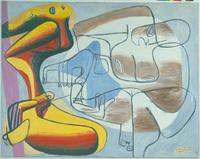
Deux figures
Le Corbusier
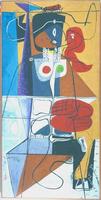
Taureau X
Le Corbusier
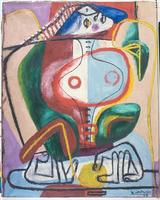
Femme et mains
Le Corbusier
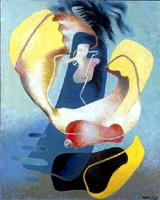
The Figure in Space
Enrico Prampolini
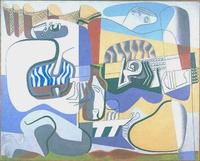
Deux musiciennes
Le Corbusier
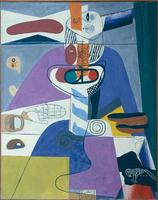
Taureau XVI
Le Corbusier
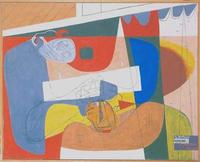
Taureau XIII
Le Corbusier
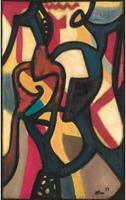
Agrigente
Jean-Michel Atlan
Totem 3
Le Corbusier
Eidos Floating
Willi Baumeister
Brown Still Life
Georges Braque
Yellow Predominance
Hans Hofmann
Femme
Le Corbusier
Kneeling nude
Theo van Doesburg