
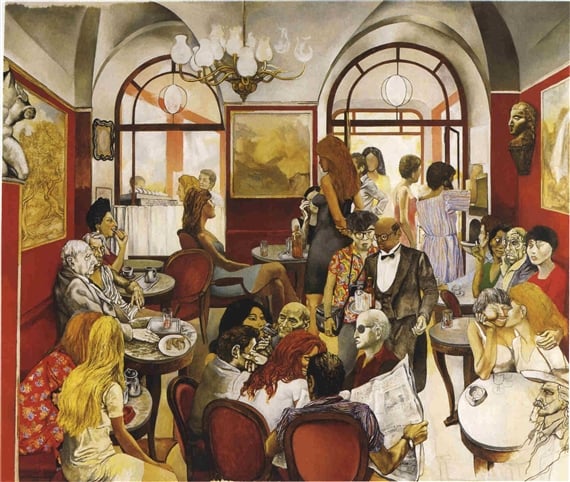
Analisi esperta di Caffe Greco di Renato Guttuso
Stile: Social Realism · Genere: genre painting
Expert Analysis of Renato Guttuso's "Caffe Greco"
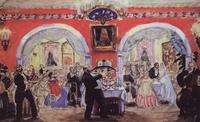
Within the framework of Social Realism, Renato Guttuso’s Caffe Greco stands as a compelling example of how the artist transforms a quotidian social space into a site of political and human significance. As a genre painting—a depiction of everyday life—the work transcends mere documentation by infusing a familiar café interior with the ideological weight of mid-20th-century Italian social consciousness.
Significance within Social Realism:
Guttuso, a leading figure in this style, uses the crowded, lively atmosphere of Caffe Greco—a historic Roman café—not as a retreat into bourgeois leisure, but as a stage for the collective experience of modern life. The painting’s significance lies in its refusal to romanticize its subjects; instead, it presents them with a gritty, almost reportorial honesty. The figures are not idealized; they are rendered with robust, expressive brushwork that emphasizes their physicality and social presence. This aligns with Social Realism’s core mission: to depict the real conditions and struggles of ordinary people, often with a critical or empathetic lens.
Genre Painting as a Political Tool:
By choosing a genre scene, Guttuso elevates a mundane moment—friends conversing, patrons reading, waiters moving—into a microcosm of society. The café becomes a democratic crossroads where different classes, ages, and temperaments intersect. This is emblematic of Social Realism’s interest in collective life over individual heroism. The significance here is in how Guttuso uses the tradition of genre painting (typically associated with Dutch Golden Age domesticity or 19th-century bourgeois leisure) to instead address the social tensions and camaraderie of a modern urban populace.
Stylistic and Period Context:
The painting’s dense composition, with figures overlapping in a shallow space, reflects Guttuso’s engagement with both Cubist spatial compression and the raw energy of Expressionism. This stylistic synthesis serves the Social Realist goal: it prioritizes the emotional and social truth over naturalistic illusion. The significance of Caffe Greco within its period is its ability to speak to the anxieties and hopes of post-war Italy—where public spaces like cafés were arenas for political debate, artistic exchange, and the forging of new social identities.
In sum, Caffe Greco is significant because it demonstrates how Social Realism could reimagine a traditional genre. Guttuso transforms a simple café scene into a loaded document of its time, proving that the most ordinary slice of life can carry the most profound commentary on the human condition.
Museum / Gallery
Genere
Stile
Visivamente simili
20 opere con composizione e palette affini
Cafe
Panayiotis Tetsis
Maxim
Tsuguharu Foujita
Bistro
Periklis Vyzantios
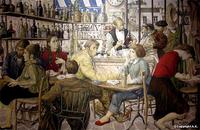
Un bistrot à Saint-Germain-des-Prés
Tsuguharu Foujita
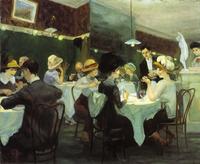
Renganeschi's Saturday Night
John French Sloan
At Dominic's
Ilya Repin
A café, interiour
Edouard Manet
Abend im Café Bauer
Lesser Ury
Cafe Paris
Archibald Motley
At the restaurant
Ivan Kramskoy
Ball
Arturo Souto
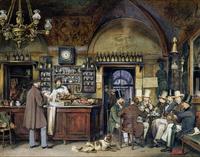
Artists at Cafe Greco in Rome
Ludwig Passini
Czene Béla, Cukrázdában
Czene Béla
Czene Béla, Lányok Presszóban 1960
Czene Béla
Le Bar
Theophile Steinlen
Celestina's House
Paula Rego
Czene Béla, Este a Gundelnél 1959
Czene Béla
Blue Night (hopper)
Gregorio Undurraga
New York Restaurant
Edward Hopper
Merchant wedding
Boris Kustodiev