
Sheila Hicks の Menhir II の専門的な分析
スタイル:Minimalism · ジャンル:installation
Expert Art Historical Analysis: "Menhir II" by Sheila Hicks
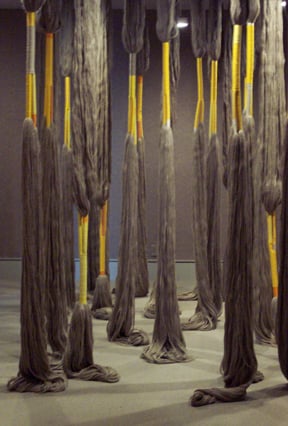
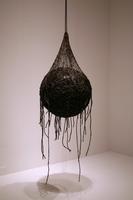
Sheila Hicks’s Menhir II occupies a vital and often overlooked position within the canon of Minimalist installation. While Minimalism is frequently associated with rigid, industrial materials—steel, concrete, plexiglass—and the hard-edged geometries of artists like Donald Judd or Carl Andre, Hicks subverts this vocabulary by retaining Minimalism’s core principles of reductive form, seriality, and phenomenological presence, yet employing soft, hand-woven fibers.
The title itself, Menhir II, references the ancient standing stones of Brittany, objects that are at once primal, monolithic, and deeply site-specific. By translating the menhir into a textile installation, Hicks accomplishes a radical transposition: she replaces the immobility of stone with the pliancy of thread, and the permanence of the prehistoric monument with the temporality of woven material. This move is significant because it challenges the gendered hierarchy of art materials in the 1960s–70s—fibers were often dismissed as "craft" or feminine, while Minimalism’s steel was celebrated as high art. Hicks refuses this distinction, proving that Minimalism’s concerns with volume, verticality, and viewer engagement can be achieved with equal rigor through thread and rope.
In terms of style, Menhir II adheres to Minimalism’s insistence on primary structures: a single, upright, columnar form that reduces sculpture to its most elemental geometry. Yet the texture and softness of the material create a tension between the viewer’s visual expectation of weight and the physical reality of lightness and flexibility. The installation activates its surrounding space, encouraging the viewer to walk around the piece, experiencing shifts in light and shadow across its fibrous surface. This phenomenological engagement—the direct bodily experience of the object in real space—is a hallmark of Minimalist installation, and Hicks delivers it with a tactile warmth that the movement’s canonical works often lack.
Ultimately, Menhir II is significant because it expands Minimalism’s definition from a hard, industrial aesthetic to a more inclusive, material-diverse practice. It asserts that fiber is as legitimate a vehicle for formal reduction and spatial presence as metal or concrete, and it prefigures the later rise of installation art that would freely cross the boundaries between sculpture, architecture, and textile. Hicks here quietly revolutionizes Minimalism from within, making it softer, more ancient, and deeply human.
視覚的に類似
構図やパレットが近い作品 20 件
The Principal Wife
Sheila Hicks
Temmuz
Fusun Onur
Hastings Visit to the Great Plains
Sheila Hicks
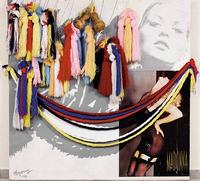
Wool & Madonna
Burhan Dogancay
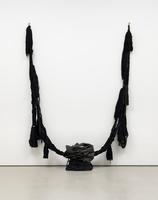
The Albino
Barbara Chase-Riboud
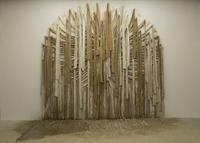
Moderate Landscapes
Zahrah Al-Ghamdi
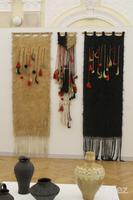
Untitled
Maria Saka-Racila
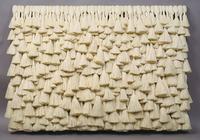
Linen Lean-To
Sheila Hicks
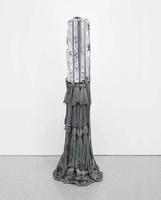
Well of the Concubine Pearl
Barbara Chase-Riboud
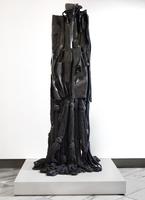
Zanzibar Black
Barbara Chase-Riboud
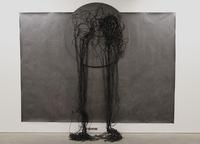
Superposition 92-2
Matsutani
Untitled
Sheila Hicks
The Labyrinth and Time
Zahrah Al-Ghamdi
Cell of the Earth
Zahrah Al-Ghamdi
Untitled
Judith Scott
Untitled
Jannis Kounellis
Harrar Middle Passage
Barbara Chase-Riboud
Untitled
Judith Scott
Malcolm X #3
Barbara Chase-Riboud
Vertiginous Detour
Eva Hesse