Analisi esperta di Bataille Monument di Thomas Hirschhorn
Stile: Conceptual Art · Genere: installation
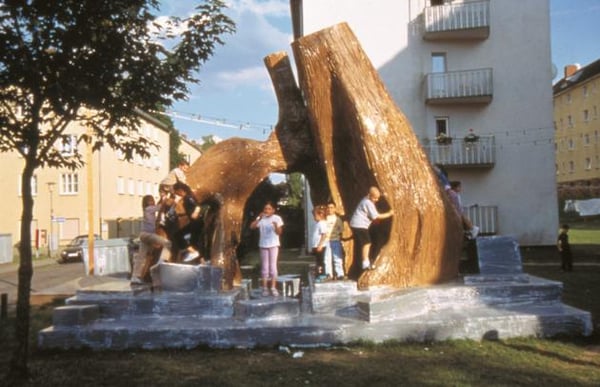
"Bataille Monument" (2002) by Thomas Hirschhorn is a landmark work of Conceptual Art and installation practice, notable for its radical redefinition of where, how, and for whom art is made. Created for Documenta 11, this sprawling, temporary structure was built in a Turkish immigrant neighborhood in Kassel, Germany, far from the event’s official venues.
Significance within Conceptual Art and Installation:
-
Site-Specific Social Critique: Hirschhorn rejected the white cube gallery, instead embedding his monument in a marginalized, working-class community. This decision directly challenges the institutional elitism of contemporary art and questions who has access to cultural discourse.
-
DIY Materiality: Constructed from cheap, fragile materials such as cardboard, packing tape, aluminum foil, and plywood, the work embodies a deliberate anti-monumental aesthetic. This material choice is not casual—it reflects conceptual art’s interest in process and ephemerality while also echoing Bataille’s ideas about devaluation and the “formless.”
-
Participatory and Educational Function: The monument was not a static object but an active hub. It featured a free library of books by and about Georges Bataille, a video lounge, a computer station, and a sculpture studio. Local residents were invited to use the space, engage with Bataille’s transgressive philosophy, and even become paid caretakers. This blurs the line between artist, artwork, and audience, making the work a relational and pedagogical gesture.
-
Echoes of Georges Bataille: Named after the French philosopher, the installation embodies Bataille’s concepts of transgression, excess, and the “sacred” as a destabilizing force. Hirschhorn constructs a monument not to honor a hero, but to provoke thought about expenditure, loss, and community—turning the monument into a site of critical inquiry rather than commemoration.
Cultural and Art-Historical Impact:
"Bataille Monument" is a pivotal example of early 2000s socially engaged and participatory art. It demonstrated that conceptual installation could be simultaneously intellectually rigorous, politically charged, and deeply embedded in everyday life. By foregrounding collaboration, impermanence, and anti-spectacle, Hirschhorn expanded the definition of what a monument—and an artwork—can be.
Visivamente simili
20 opere con composizione e palette affini
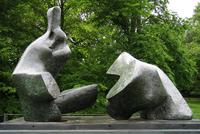
Two Piece Reclining Figure No. 5
Henry Moore
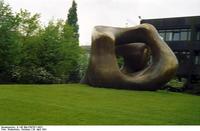
Two Forms
Henry Moore
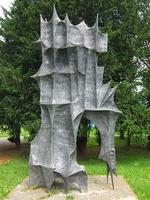
Monument to the December victims 1943
Dusan Dzamonja
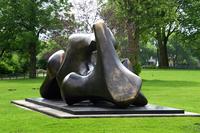
Large Vertebrae (Wirbel)
Henry Moore
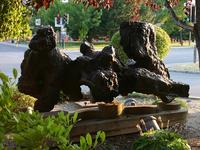
Power and glory
Armand Vaillancourt
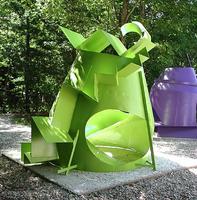
Steropes The Cyclops
Jules Olitski
Frammento di Vuoto I
Gio Pomodoro
Arbre
Eduardo Chillida
The Birth of Liquid Desires
Salvador Dali
Three Piece Reclining Figure No. 1
Henry Moore
We the People (detail)
Danh Vō
Matrice
Giuseppe Penone
The Labours of Alexander
Rene Magritte
Sainte-Trinité
Armand Vaillancourt
Hill Arches
Henry Moore
Untitled
Alberto Carneiro
I plunged into solitude. I dwelt in the tree behind me. (plate 9)
Odilon Redon
Buscando la luz
Eduardo Chillida
Medieval Forest
Eyvind Earle
Within
Phillip King