
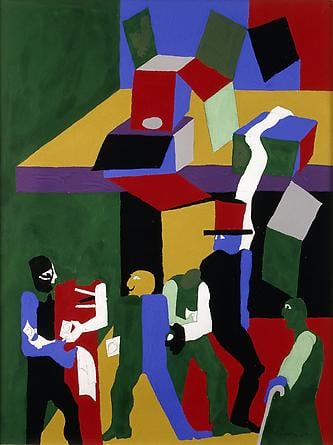
Expert analysis of Jacob Lawrence’s Games - Sleight of Hand
Style: Cubism · Genre: genre painting
An expert analysis of Jacob Lawrence’s Games – Sleight of Hand reveals a striking fusion of Cubist formal language with the intimate, narrative focus of genre painting. While Cubism is often associated with early‑20th‑century European avant‑garde (Picasso, Braque), Lawrence reimagined its principles—fragmented planes, shifting perspectives, and flattened space—to depict the lived experiences of African American communities. This work is significant for several reasons.
First, it demonstrates Lawrence’s unique adaptation of Cubism not as an abstract exercise but as a tool for storytelling. In Games – Sleight of Hand, the scene likely centers on a card trick or a moment of deceptive skill, a common subject in his broader “Games” series. The Cubist treatment breaks the figures and tabletop into geometric facets, compressing multiple viewpoints into a single frame. This fragmentation mirrors the very concept of “sleight of hand”—a visual trick that makes the viewer question what is real and what is illusion. The composition’s dynamic, angular rhythms also evoke the tension and concentration of a game, with hands and gestures emphasized through sharp, interlocking shapes.
Second, Lawrence’s use of bold, often unmixed colors—typical of his palette—infuses Cubism with an emotional vibrancy wholly his own. Where European Cubism often subdued color in favor of monochrome or muted tones, Lawrence’s reds, yellows, and deep browns assert a sense of cultural identity and vitality. The flatness of the forms, combined with these strong hues, creates a decorative yet powerful surface that keeps the work grounded in the observable world of everyday life—here, a simple game among ordinary people.
Finally, the painting’s significance lies in its contribution to the history of American modernism. Jacob Lawrence is best known for his narrative series (e.g., The Migration Series), but in Games – Sleight of Hand, he demonstrates that Cubist abstraction can be wedded to genre painting to dignify even the most humble, private moments of Black experience. By infusing a traditionally European style with the textures, colors, and human dignity of African American culture, Lawrence expands the possibilities of Cubism itself, making it a vehicle for social observation and personal expression rather than pure formal experiment. This work stands as a testament to his ability to synthesize multiple artistic traditions while always centering the human story.
Genre
Style
Visually similar
20 works with related composition and palette
Femme regardant au loin
Victor Brauner
Percolator
Stuart Davis
Windows
Jacob Lawrence
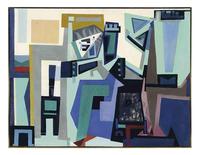
By the Sea
Peter Busa
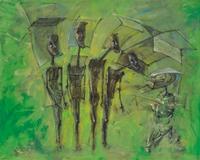
La relation I
Victor Brauner
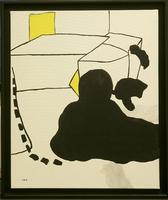
Untitled
Alvaro Lapa

Green Still Life with Lamp
Maria Blanchard

Man with pipe
Pablo Picasso

Untitled
Leopold Survage
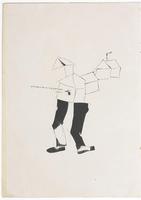
Illustration for review "Troyer/Courant"
Marc Chagall
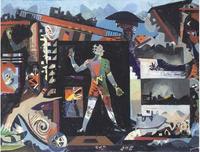
War
Eileen Agar

Untitled
Conroy Maddox
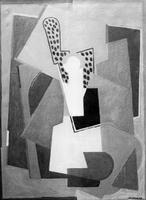
Composition
Albert Gleizes
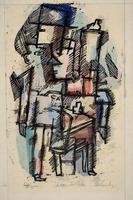
Café #1
Louis Schanker
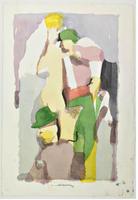
Figuras
Sa Nogueira
Costume Design for "Modern Khlestakov"
Aleksandra Ekster

Brouclé
Maurice Esteve
Femme Cubiste
Albert Gleizes
Untitled
James Brooks
Interior
Ion Pacea