Analisi esperta di 10 Stones di John Cage
Stile: Abstract Expressionism · Genere: abstract
Expert Art Historical Analysis: "10 Stones" by John Cage
Artwork: 10 Stones
Artist: John Cage (1912–1992)
Style: Abstract Expressionism
Genre: Abstract
Significance within Abstract Expressionism and Cage’s Oeuvre
John Cage is best known as a composer and philosopher of chance, silence, and indeterminacy, but his visual works—including 10 Stones—are crucial to understanding his radical rethinking of art-making. Created within the broader milieu of Abstract Expressionism, this piece nonetheless subverts the movement’s typical emphasis on spontaneous, gestural expression. Instead, Cage applies the same aleatory principles he pioneered in music to the visual realm.
1. Chance Operations as Compositional Method
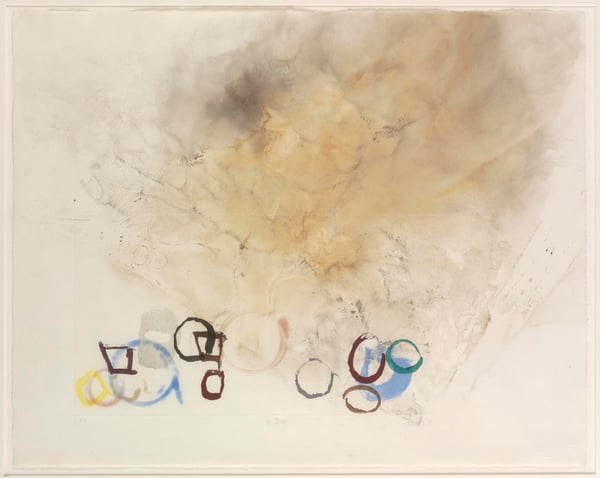
In 10 Stones, Cage likely employed his signature method of using the I Ching (or other chance procedures) to determine the placement, form, and perhaps even the number of elements. The title itself—10 Stones—suggests a deliberate limitation: ten discrete, natural objects are arranged in a field. This echoes his famous prepared piano, where foreign objects alter the instrument’s sound. Here, stones act as “preparations” on a flat surface, disrupting the traditional painterly mark.
2. Rejection of the Artist’s Hand
While Abstract Expressionists like Pollock or de Kooning celebrated the artist’s bodily gesture and emotional release, Cage sought to remove personal taste and ego from creation. The stones function as readymade elements; their arrangement is not a cathartic act but an impersonal, systematic process. This aligns Cage more closely with the later Conceptual and Minimalist movements, yet he remains rooted in the postwar American avant-garde through his embrace of materiality and surface.
3. Interplay of Sound, Silence, and Space
Cage often described his visual works as “graphic scores” or “visual silences.” 10 Stones can be read as a score for an imaginary performance: the spacing between stones creates rhythmic intervals, and their textures (rough, smooth, irregular) suggest tonal qualities. The work invites the viewer to “listen” with their eyes, perceiving the arrangement as a paused moment in a durational process—like the silent movements of 4’33”.
4. Dialogue with Nature and the Everyday
Cage’s deep interest in Zen Buddhism and the philosophy of Thoreau is evident. The stones are not symbolic but are themselves: ordinary objects lifted from the environment. By isolating ten of them in an abstract composition, Cage asks us to attend to the randomness and beauty of the natural world without imposing narrative or meaning. This counters the heroic sublimity of much Abstract Expressionism with humble, anti-heroic attention.
5. Contextual Legacy
10 Stones foreshadows Earth Art, Process Art, and the use of found materials in the 1960s and 70s (e.g., Robert Smithson, Andy Goldsworthy). Yet it remains tethered to Abstract Expressionism’s concern with the picture plane and non-objective form. Cage’s work destabilizes the boundary between music, visual art, and philosophy, making 10 Stones a significant crossover object that challenges how we define “painting” and “sculpture” within the movement.
Conclusion
10 Stones is not a typical Abstract Expressionist canvas; it is an act of radical listening and systematic chance. Its significance lies in how Cage transposes musical indeterminacy into a visual language—stripping away emotional gesture, embracing the ordinary, and creating a quiet, meditative abstraction that asks us to see the world anew. In doing so, it expands the boundaries of what Abstract Expressionism could be, linking it to broader conceptual practices that would define the later twentieth century.
Visivamente simili
20 opere con composizione e palette affini
West Wind
Helen Frankenthaler
Nero, verde, azzurro
Afro
037 L'eix
Genis Remacha
044 Flowers
Genis Remacha
Eve
Helen Frankenthaler
Bois aux feu
Camille Bryen
Untitled (Red, orange and pink)
Luis Feito
Untitled
John Ferren
Landscape Study: Sky and Clouds
Ralph Rosenborg
Untitled
Alexander Calder
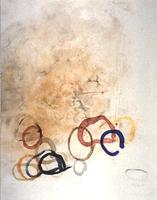
11 Stones
John Cage
Free Simulation Consciousness #5050W10
SHIH,SIAO-MO
Cosmic Storm
Carloluigi Colombo
Untitled
Helen Frankenthaler
Arrachement
Andre-Pierre Arnal
Komposition
Giuseppe Santomaso
Points No. 19
Kenzo Okada
Mojabe
Norman Bluhm
Where Necessary
Helen Frankenthaler
Sunblinded
Perle Fine