
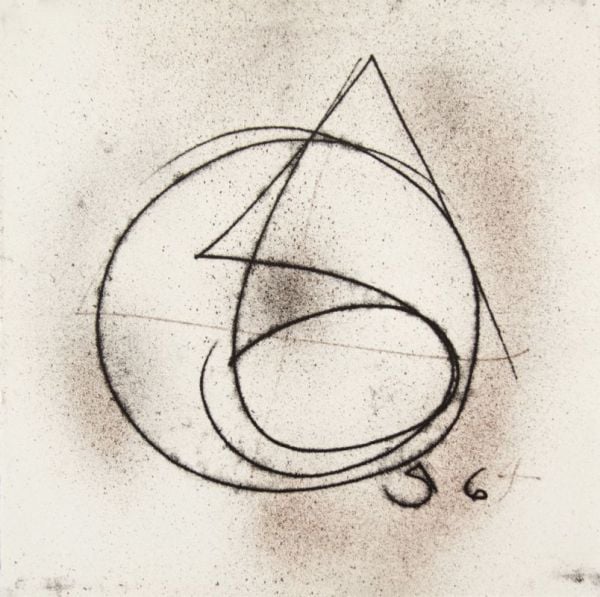
Expert analysis of Ulfert Wilke’s Five Six and Four (77-654)
Style: Abstract Expressionism · Genre: abstract
Expert Analysis of "Five Six and Four (77-654)" by Ulfert Wilke
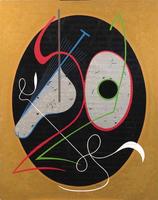
Ulfert Wilke’s Five Six and Four (77-654) is a compelling example of Abstract Expressionism’s more contemplative, calligraphic strand—a less bombastic but equally significant current within the movement. The title itself, a notation of numbers and a catalog-like parenthetical, hints at a methodical, almost musical or mathematical underpinning, a counterpoint to the purely spontaneous gestures often associated with the style.
Significance within Abstract Expressionism:
Wilke is not as widely known as Pollock or de Kooning, but his work represents a crucial dialogue between Western abstraction and Eastern calligraphic traditions. In Five Six and Four (77-654), the composition appears to derive from an intuitive, rhythmic mark-making that nonetheless respects a structured, almost measured placement. The numbers in the title might refer to a sequence of strokes, a color index, or a personal system of notation—echoing how artists like Bradley Walker Tomlin or Franz Kline used symbolic, letter-like forms without fixed meaning.
What makes this work noteworthy:
- Calligraphic Abstraction: Wilke’s brushwork likely merges fluid, expressive lines with a restrained, deliberate spacing. The painting does not aspire to raw emotional explosion but instead to a kind of visual poetry, where each mark carries weight and relationship.
- Hybrid of Planning and Improvisation: The parenthetical “(77-654)” suggests a series or inventory—an acknowledgment of the artwork as one in a chain of investigations. This contrasts with the myth of the heroic, singular act. Wilke’s practice treats abstraction as a cumulative language.
- Tension between Order and Chaos: The title “Five Six and Four” might allude to a triad of elements—perhaps three numeric groupings that create a structural chord within the composition. The work negotiates between the randomness of automatic drawing and the discipline of geometry, a hallmark of Wilke’s unique position among the second-generation Abstract Expressionists.
In sum, Five Six and Four (77-654) stands as a refined, cerebral contribution to Abstract Expressionism, demonstrating that the movement’s vitality extended beyond pure gesture into realms of symbolic system and cross-cultural synthesis.
Visually similar
20 works with related composition and palette
Untitled
Louise Bourgeois
Untitled from Large Illumination Drawings
Simone Forti
Green Column/Figure
Robert Mangold
Study Attic Series XIV
Robert Mangold
It's Orpheus When There's Singing #7
Richard Deacon
Abstract Composition
Erich Buchholz

Wallpainting For Musicroom
Otto Gustav Carlsund
Composition
Cesar Domela
Sous Zero
Antoni Tapies
Composition with Discs
Sonia Delaunay
Untitled
Cesar Domela
Untitled
Cesar Domela

Untitled
Sofia Areal
Study Attic Series VIII
Robert Mangold
Abstract Composition with triangles and Semicircles
Sonia Delaunay
Lineare Composition
Lyubov Popova
Jazz Evolution
Georges Troubat
Untitled
Cesar Domela
Composition
Leon Arthur Tutundjian
Composition
Leon Arthur Tutundjian