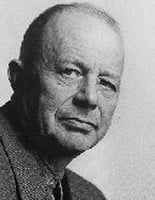
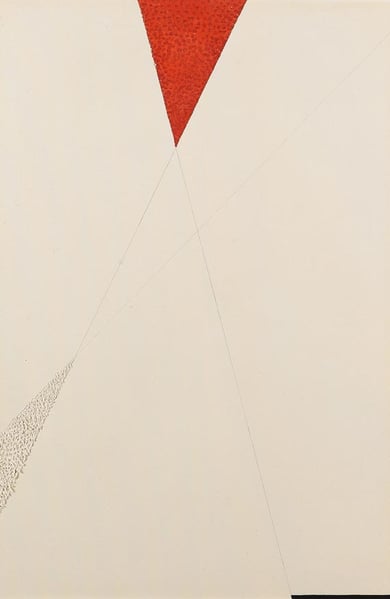
Analisi esperta di Komposition rotes Dreieck di Carl Buchheister
Stile: Constructivism · Genere: abstract
Expert Analysis of "Komposition rotes Dreieck" by Carl Buchheister
Carl Buchheister’s Komposition rotes Dreieck (Composition red triangle) stands as a quintessential example of European Constructivism, a movement that sought to strip art down to its most fundamental visual elements. Created within the interwar period’s fervor for abstraction, this work embodies the Constructivist ethos: geometry, clarity, and the dynamic interplay of form and color.
Significance within Constructivism
The painting’s title itself signals its core—a singular red triangle, likely anchoring the composition. In Constructivism, the triangle (alongside the square and circle) served as a primary building block, symbolizing direction, tension, and stability. Buchheister’s choice of a single, dominant red triangle demonstrates the movement’s commitment to reduction: removing all narrative, representation, or decoration to focus on pure visual relationships. The red hue—a primary color—would have been chosen for its optical intensity and emotional charge, contrasting with any surrounding neutral or complementary shapes to create a sense of spatial depth and rhythm.
Abstract Language and Spatial Construction
Buchheister’s work is notable for its constructive approach: rather than composing from observation, he builds the image through geometric planes and precise alignments. The red triangle likely interacts with other abstract elements—perhaps rectangles, lines, or color fields—to generate a non-hierarchical, balanced yet dynamic structure. This reflects Constructivism’s ideal of art as a form of “construction” analogous to engineering or architecture, where each part is essential to the whole. The painting’s abstract genre means it exists solely as a visual event, inviting the viewer to experience color, form, and composition without figurative distractions.
Historical Context and Legacy
Buchheister was a key figure in the German abstract avant-garde, affiliated with groups like the Abstrakten Hannover circle. Komposition rotes Dreieck exemplifies the move toward geometric abstraction that paralleled developments in Russia (Malevich, Rodchenko) and the Netherlands (De Stijl). What makes this work significant is its rigorous alignment of form and meaning: the red triangle is not just a shape but a statement—of modernity, of the rejection of illusionism, and of the belief that art could be a universal language of pure visual elements. In this, Buchheister contributes to Constructivism’s core legacy: proving that abstract geometry can be as expressive and profound as any representational art.
Visivamente simili
20 opere con composizione e palette affini
Bild mit schwarzem Keil
Carl Buchheister
The Point of Bahütte
Jose de Almada-Negreiros
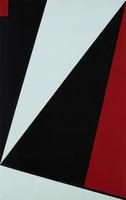
Provex
Olle Baertling
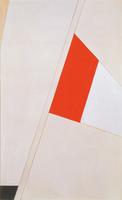
332 r
Carl Buchheister

Force Spatiale Blanc Noir Bleu
Olle Baertling
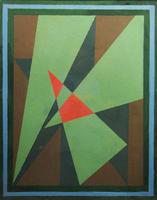
Letter K (I Don't Know Fantastic Aventures Lacking the Howl of the Wolves)
Vasile Dobrian
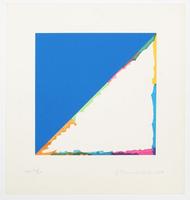
985
Funasaka Yoshisuke
Dall´alto al Basso
Giuseppe Santomaso
UNTITLED
Alexander Calder
Ocean Park #70
Richard Diebenkorn
Chatel
Richard Mortensen
081-45-05
Fernando Lanhas
Ocean Park #28
Richard Diebenkorn
Curious Course
Kenneth Noland
Composition
Jacques Villon
Ocean Park #24
Richard Diebenkorn
Imperfect painting
Roy Lichtenstein
Color Perspective
Jacques Villon
Ayar
Olle Baertling
Untitled
Alison Wilding